
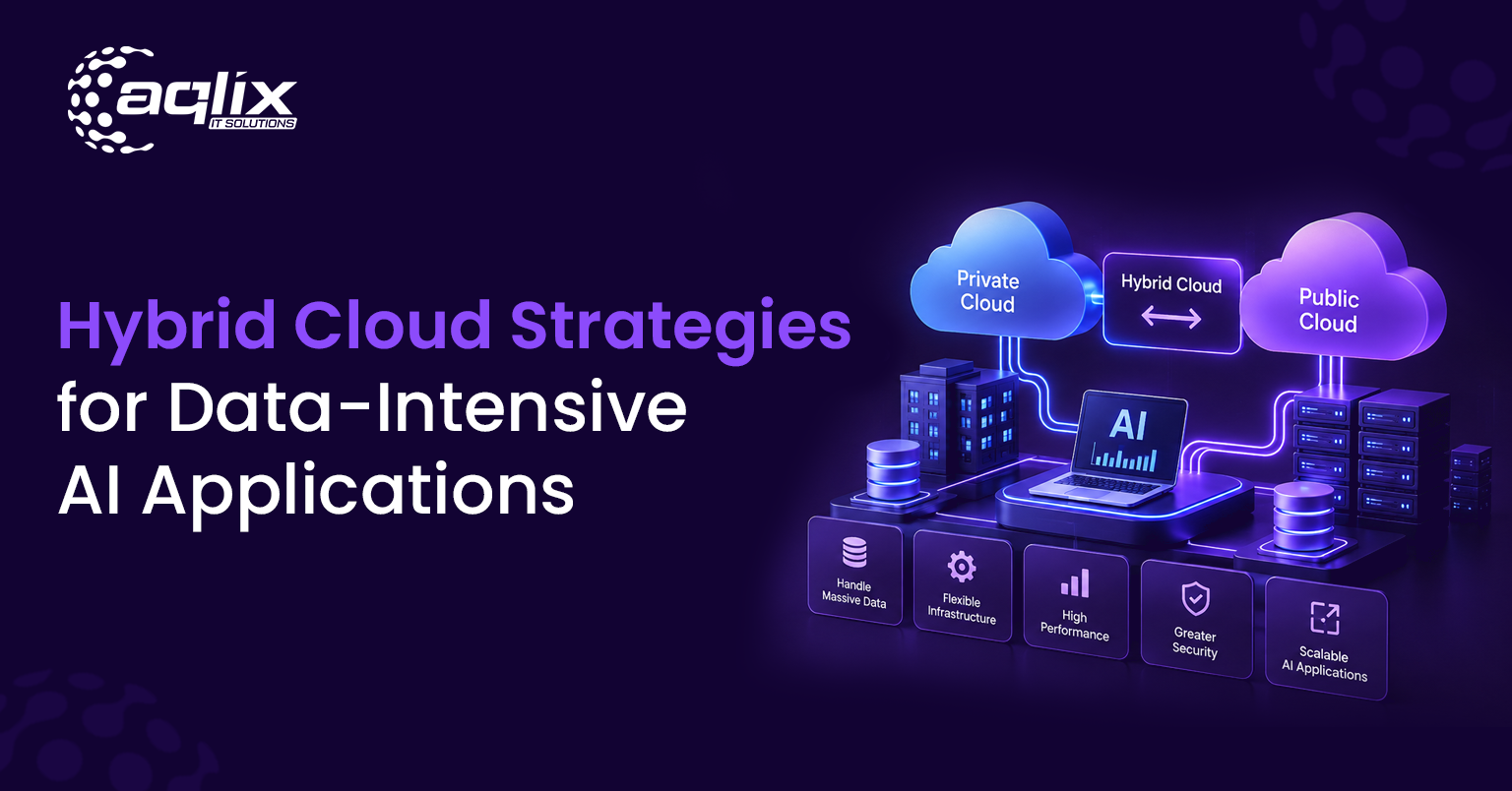

AI models inherently reflect the data that goes into them. That data, however, rarely resides in a single location. Some data is kept on-prem for compliance reasons. Other data is stored in the cloud to allow for greater scaling. Connecting the two well is one of the most difficult problems faced when trying to run AI at scale.
Aqlix IT Solutions helps businesses with cloud migration for their AI workloads. This approach keeps sensitive data on the private side while the more compute-intensive AI model training occurs in the cloud. Striking this balance improves compliance and finances while allowing AI models to continually improve quicker.
Why Pure Public or Private Cloud Falls Short for AI Workloads
Running all workloads against a single AI infrastructure may seem easy, but complications with big data volumes, high latency, and compliance will inevitably get in the way. A lot of companies end up doing a modernization of their applications on the public cloud, thinking they will improve things, only to realize certain workloads are better off or even mandated by law to stay on private infrastructure, primarily data-intensive applications, which means a hybrid infrastructure will be the ultimate choice for those teams.
1. Balancing Cost and Performance Across Environments
Using a public cloud for massive compute is convenient for training large models, but public clouds can become a financial burden when workloads continue to run. Private infrastructure is better suited for predictable, consistent workloads that run inferences for sustained large compute. Public clouds may be cost-effective for short-run, sporadic data processing.
A thorough IT strategy will dictate the placement of workload boundaries, balancing costs, latency, and compliance needs. An incorrectly made mapping may lead to excess costs due to the re-platforming of AI infrastructure.
2. Keeping Sensitive Data Where It Belongs
Healthcare, finance, and government sectors often use public cloud services. However, AI workloads have constraints around data sovereignty which prohibit them from using certain public cloud services. Ignoring these constraints causes issues, including the inability to launch services or violating laws and regulations.
Early adoption of consulting services in technology helps identify which data can stay on premise or on private cloud infrastructures and which data can be migrated to the public cloud for AI workloads. In the end, failing to plan results in Pandora’s box of auditing issues and fractured relationships with the regulatory bodies.
Building a Hybrid Architecture That Actually Works for AI
A true hybrid system runs between systems, with private systems and public cloud resources. True digital transformation with AI integrates data movement, security, and monitoring directly into architecture to allow for seamless end-to-end data flow between private systems and public cloud resources. Integration has to happen to allow workloads to shift to the location that serves the business best.
1. Designing for Seamless Data Movement
Using private storage for storing large datasets and using public cloud computations sounds easy. However, most pipelines used for training AI are usually the most sensitive to bandwidth, as the pipelines can take a lot longer than expected. Planning for these issues ends up avoiding duplicate data storage, time-consuming data transfers, and the need to wait for what should take a few minutes.
Some data analysis and business intelligence (BI) pipelines built for the cloud help manage data transfers, bringing frequently used datasets closer to related computations and less frequently used datasets to other, less expensive storage. End users notice no delay in speed, and cost is not a concern when obtaining relevant data for AI models.
2. Automating Operations Across Environments
It becomes unsustainable to manage the deployments, updates, and monitoring across two environments as an AI application has more use cases and users beyond just the first few. Small configuration differences between cloud and on-premises systems can also bring bugs that are hard to find and can break a system.
To avoid production outages, a solid foundation of DevOps automates testing, deployment pipelines, and monitoring on both platforms. Building this out first in an AI hybrid system avoids emergency on-calls for follow-up work and ensures the system can grow without worrying about what could break the system.
Conclusion
Hybrid cloud doesn’t have to be the compromise approach for data-intensive AI applications; it is usually the most optimal approach for maintaining the balance of performance, compliance, and cost as data sets and models continue to grow. Aqlix IT Solutions offers architectural designs for customers to best place workloads and avoid both complex designs and overspending.
Also, the benefits of an AI-centered, hybrid-cloud architecture begin to outweigh the downsides when compliance requirements or the growth of AI applications within a single cloud environment begin to present themselves. Aqlix IT Solutions can help you AI applications and data drive the design of a hybrid-cloud architecture tailored to your regulatory needs.
FAQs
What makes a hybrid cloud different from just using a public cloud for AI?
A hybrid cloud combines private cloud infrastructure with public cloud. It allows sensitive data to stay on-premises while compute-intensive AI training moves to the cloud. For businesses, this offers the scalability of the public cloud but also allows them to keep regulated and sensitive data within the confines of their controlled environment, unlike with traditional public cloud services.
Is a hybrid cloud more expensive than a single-cloud approach?
No. Complexity increases with two environments, yet with a hybrid setup, a team can keep a predictable workload on a cheaper private infrastructure while using public cloud compute for burst training or when they need to scale to meet demand, instead of maintaining expensive infrastructure.
How do you decide which data stays on-premises versus in the cloud?
The decision often depends on compliance, latency, and how often the data is accessed. Data that is regulated or is highly sensitive often remains on-premises, while significantly less regulated and more frequently changing datasets, even sensitive ones, that can be used for model training, often move to the cloud.
What’s the biggest technical challenge with hybrid cloud for AI workloads?
The hardest part is usually data movement-transferring large amounts of data smoothly and efficiently between environments, preferably with low latency, cost, and no duplication. Aqlix IT Solutions is a company that designs pipelines and establishes routing patterns that allow teams to update their data without unnecessary complexity. This means that data flows efficiently, allowing the models to be updated with AI being used.
Can small or mid-sized businesses realistically adopt a hybrid cloud strategy?
Yes, from an MSP perspective, it usually emerges at a certain scale or when compliance needs begin to appear. For example, we see most businesses start fully in the public cloud and move specific workloads to private infrastructure over time as the volume and sensitivity of data (regulation) or cost concerns grow over time.