
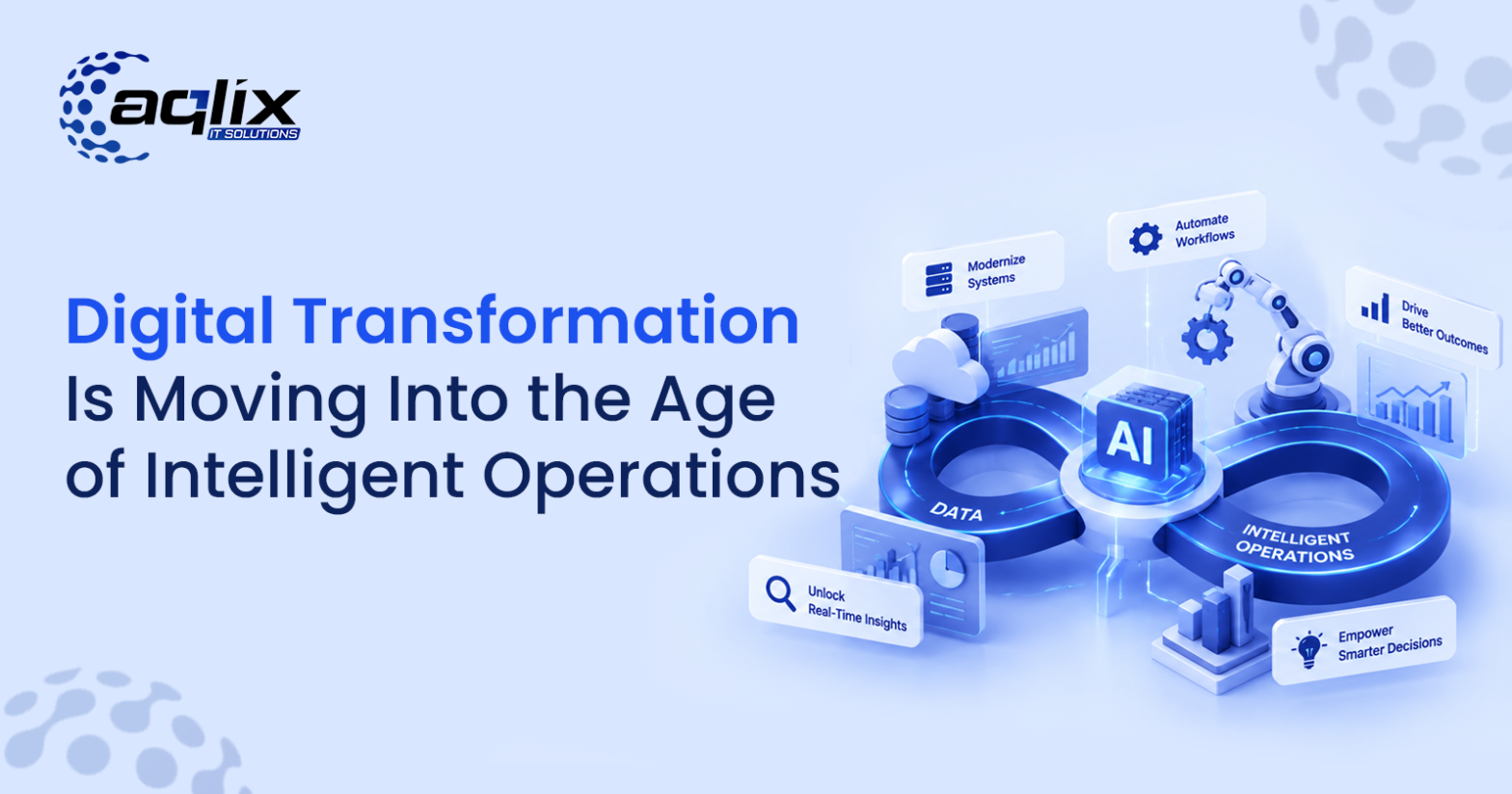

In the past, digitizing business processes and connecting disparate systems evolved into digital transformation. Most companies have progressed beyond this early phase, and new constructs are emerging in which processes not only collect and store data but also analyze and act on that data.
Aqlix has unique capabilities to help businesses cross this digital divide. Our services in Digital Transformation enable companies to shift beyond automated workflows to business operations which intelligently respond and adapt based on the changing conditions of the environment.
From Digitization to Intelligent Operations
The initial phase of digital transformation was geared toward replacing manual processes and systems with digital equivalents, where, for instance, paper forms were replaced with web forms. Intelligent operations move beyond digitization by creating systems that capture and analyze information and take action or make recommendations without being prompted to do so.
1. Moving Beyond Basic Process Digitization
Though many companies went through the first phase years ago, most have been stuck in the phase of digitizing a process and having an employee interpret the electronically stored data.
Intelligent operations transitions beyond data capture, and uses digitized data to drive internal recommendations and automate routine decisions without the need for manual intervention.
2. Embedding AI into Core Business Systems
Rather than viewing AI as an add-on tool, intelligent operations incorporate AI into the business systems used daily (ERPs, CRMs, operational dashboards). This way, insights can be displayed where the actual work is done.
Aqlix creates these offerings with AI and machine learning tools that can be easily integrated into existing systems. This assures customers that they won’t need to learn a new platform in order to use intelligent tools.
3. Real-Time Data as the New Operational Standard
Businesses are moving away from the reporting cycle of static or scheduled reports. Real-time data allows businesses to capture a window into what is happening across their operations. The ability to receive data and take action on it the moment it happens is not only possible, but has become the new standard of doing business.
The business infrastructure must be ready to absorb data as it comes. Real-time data allows businesses to decrease the time it takes to take action on opportunities as they come along.
What Intelligent Operations Means for Businesses
Intelligent operations offerings contain a series of systems that provide value at each point in the business cycle, as opposed to offering a single tool. Systems that incorporate intelligent operations reflect improvements in performance and provide the ability to make processes more efficient. Real-time data eliminates the burden of the traditional interpretation cycle, freeing up employees to focus on process improvement. Different departments experience this in different ways, however the core principle remains the same: less effort interpreting data. Custom Software Development can build on these operations. Customized software is built to interweave with a business’s unique operational processes.
1. Predictive Decision-Making Across Departments
Advances in technology shift the focus of investment and innovation from solving problems in the rear view mirror to problems that are predicted and addressed before they happen. Advanced systems have the ability to determine when a given supply is about to reach its minimum level before it is sold out, or when a given piece of equipment will fail before it actually does.
This ability to predict problems reduces the need for reactive, last minute shifts and requires strategic planning at convenient times. Additionally, it eliminates the stress and potential negative impacts caused by last-minute shifts. Aqlix’s Data Science & AI team helps companies predict system failures to reduce disruptions caused by last-minute shifts.
2. Self-Optimizing Workflows and Systems
Some systems have the ability to self-adjust workflows without user interaction. They can order inventory, build schedules, and determine the best placement for resources whenever the context of the situation changes.
Systems that adjust automatically require less user interaction. A company can require less attention to maintain a self-adjusting system when compared to other systems.
3. Building the Foundation for Continuous Adaptation
Intelligent operations is not a one-time upgrade because as systems collect more data, models continue to improve, leading to the improvement of the system as a whole. Conversely, static systems decay with time, and are outdated faster than ones that have the capability to adapt.
Aqlix’s Technology Consulting team helps businesses build this foundation deliberately, ensuring systems are designed to keep improving rather than requiring a full overhaul every few years.
Conclusion
The next level of digital transformation is providing systems with the ability to ‘think’ and act on their own by analyzing and interpreting data. This level of digital transformation is already redefining the nature of competition in the business world.
Aqlix IT Solutions helps businesses go beyond basic digitization toward the automation of business systems that respond to system-inherent dynamics. If your business systems require significant manual interpretation, Aqlix can help you determine how best to move forward.
Frequently Asked Questions
What are intelligent operations?
Intelligent operations refer to business systems that analyze on their own and take or suggest next steps. This would be the next phase of the digital transformation process beyond automating systems and digitizing processes.
How is this different from earlier digital transformation efforts?
Earlier processes of digital transformation automated systems and digitized processes. Intelligent operations put artificial intelligence within a system to analyze and decide on a course of action.
Does adopting intelligent operations require replacing our current systems entirely?
Intelligent operations can be added to existing systems, often the enterprise resource planning systems (ERPs) and customer relationship management systems (CRMs). This creates a significant opportunity to reduce disruption while gaining significant value.
Which business areas benefit most from intelligent operations?
Intelligent operations systems bring the most value to the functions that have constant patterns such as inventory systems, staffing systems, customer support systems, facilities maintenance systems. These are the systems that benefit the most from predictive analysis and operation optimization.
How can my business start moving toward intelligent operations?
One of these actions is identifying spaces in which the timeliness of decisions is negatively impacted by the manual analysis of data. Aqlix facilitates the creation of tailor-made intelligent functionalities corresponding to each of these workflows. This is done iteratively, on a results value basis.