
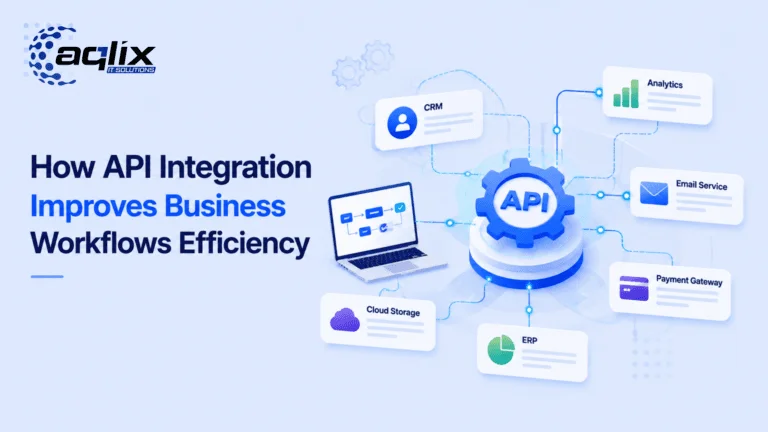

Companies today have many software systems in place to run their operations in various capacities (e.g., customer and sales process management, finance and logistics, etc.), but they also need to communicate with one another. Data is fraught with delays, duplicate entries & discrepancies when work is done in silos. API integration enables businesses to connect platforms and automate processes for efficiency gains.
API integration is being deployed by enterprises from healthcare, logistics, finance, and retail to accomplish operational excellence. We managed to help businesses with integrations across security and workflow automation and scaled up digital systems to drive productivity in terms of reduced manual work.
How API Integration Helps Automate Business Workflows
Businesses typically deal with tasks that are monotonous in nature and eat up time and other resources. Application Programming Interface (API) integration automates these workflows by allowing systems to exchange information automatically across applications.
1. Automated Data Synchronization
API integration does this by synchronizing business systems instantly. All of which could be reconciled across platforms at once, customer records, invoices, inventory data, and all operational reports without having to reenter. It minimizes errors and guarantees uniform data for parallel operation from numerous offices.
2. Faster Process Execution
With this approach connected applications help to minimize reliance on manual approvals and repetitive actions. It helps automate notifications, process documents, and update transaction teams. Quicker execution helps organizations to improve productivity while minimizing roadblocks in daily workflows and being integral to the business operations.
3. Improved Cross-Department Collaboration
Integrated systems provide the opportunity for departments to access shared information in real-time. Teams in sales, finance, logistics and support are the backbone of any business; they can work with data from centralized systems accurately. This enhances communication, reduces confusion and aids with coordination across business functions seamlessly.
How to Reduce Manual Data Entry
Also, data entries done manually are often repetitive, duplicating records and incomplete information leading to delays in the operations. API integration solves most of these problems by transferring data across platforms without human input.
1. Elimination of Duplicate Work
No more entering the same data on a per employee basis in multiple systems. This eliminates repetitive tasks and reduces the likelihood of human error since APIs automatically synchronize applications, updating customer records, invoices, operational databases and more.
2. Better Data Accuracy
The standardization of data transfer enables similar business systems to interact with one another. Accurate information generates reliable reports that have the ability to enhance consumer communication and maintain operational transparency without an organization having to depend on manual steps or spreadsheets.
3. Reduced Administrative Burden
API-driven automation frees up employees from traditional administration work, focusing them on strategic tasks. Improved productivity of the workforce enabling vital information to be processed faster and more efficiently between departments.
How to Improve Operational Efficiency
Better communication between systems is ideal for the automation of these workflows and thus increases the operational efficiency. Data smoothes between platforms via API integration, creating a connected environment.
1. Real-Time Information Access
The feature of instant access to updated information for businesses is made by integrated systems. Real-time access to orders, inventory and customer activity as well as financial records allows organizations to react much quicker to changes in operations and how they need to satisfy their customers.
2. Faster Customer Service
Customer support platforms are the ones that have customer insights and previous transaction history at their fingertips, aiding response. With information readily available in one location, teams could troubleshoot quickly and bring about a better service experience.
3. Better Resource Management
Through API integrations, organizations can monitor workflows, optimize resource utilization and reduce operational downtime. Connected reporting and monitoring systems allow businesses to identify process gaps faster, paired with timely intervention by means of performance optimization.
How to Streamline Business Operations
Businesses can increase scalability and performance by reducing complexity with streamlined operations. API integration helps in streamlining workflows by bridging all the business applications into a single ecosystem.
1. Centralized Business Processes
Integrated Solutions help in establishing a unified way of operating where data moves dynamically within departments. This helps bridge the communication gaps and facilitates better coordination throughout business operations and management teams.
2. Enhanced Cloud Connectivity
API integration is relevant for businesses that adopted cloud infrastructure, as the nature of cloud applications needs seamless communication between different platforms. APIs facilitate connectivity, aid scalability, and streamline the management of cloud-based workflows.
3. Improved Security and Compliance
Apart from ensuring compliance, an integration with a secure API also prevents data breaches. Because looser authentication creates an opportunity for loose access, along with poor supervision & low encryption, they are at risk of unauthorized access.
Challenges Businesses Face Without API Integration
Disconnected systems create workflows that are inefficient and slow down operations. In contrast, humans are fallible, and communication gaps slow down decision-making, which means manual processes tend to lead to poor-quality data.
Without integration, businesses may struggle with:
- Delayed information sharing
- Duplicate records across systems
- Increased administrative workload
- Limited visibility into operations
- Poor coordination between departments
For larger companies, managing isolated software environments is a growing challenge. With or Without API Integration, Organizations Scale their operations but data gaps lead to duplicated efforts and increased manual processes which rule out efficient working.
Conclusion
API integration is important in terms of increasing the efficiency of business work by connecting systems, automating repetitive tasks and reducing manual work. With connected digital environments, businesses can improve operational visibility, simplify communication and serve faster.
Across various sectors, organisations are spending on integrated systems that provide the power of scalability, data accuracy and productivity. Aqlix IT Solutions is a comprehensive cloud solution provider that supports businesses in API integration, workflow automation and secure digital infrastructure management for organizations to maximize operational efficiency.
FAQs
Why do businesses need API integration?
API Integration: A technique that connects software applications of all kinds and attempts to automate the information flow. This makes it easier for systems to communicate and avoids the insertion of human error when typing information because data entry is no longer necessary to be on par with data exchange. Cross-functional systems help businesses increase their productivity and operational efficiency while lowering the administrative burden of customer service as well as workflow lag across departments.
How does API integration reduce manual data entry?
An API, or Application Programming Interface is a collection of communication protocols that allow systems to communicate with one another, passing information between them, and reducing the need for workers to enter the same data again and again. This reduces duplication, increases accuracy and decreases the risk of human error. With integrated applications and automated workflows, businesses can connect the customer data with invoicing, inventory records, and reporting systems.
How does API integration improve operational efficiency?
API integration speeds up inter-system communication and automates repetitive manual business processes which in turn makes a business more functional. Indeed, real-time data enables teams to make consistent decisions faster by reducing time lag and facilitating coordination between departments. Integrated platforms also provide better reporting, resource management and workflow visibility for enterprises.
Which industries benefit from API integration?
API integration is useful for many industries like health care, logistics, finance, retail and manufacturing. Firms in these industries use integrated systems for customer relationship management, reporting, inventory control, invoicing management, automation of business processes and cloud networking. The integration of APIs with different business functions helps the organization to improve efficiency, scalability, and operational consistency.
How does Aqlix IT Solutions support API integration projects?
Aqlix IT Solutions is a company that supports businesses in secure API integrations, workflow automation and modernized digital infrastructure. They have worked with healthcare solutions, logistics systems, cloud migration and enterprise software products across various industries, all with the goal of increasing operational efficiency and scalability and managing business processes.