
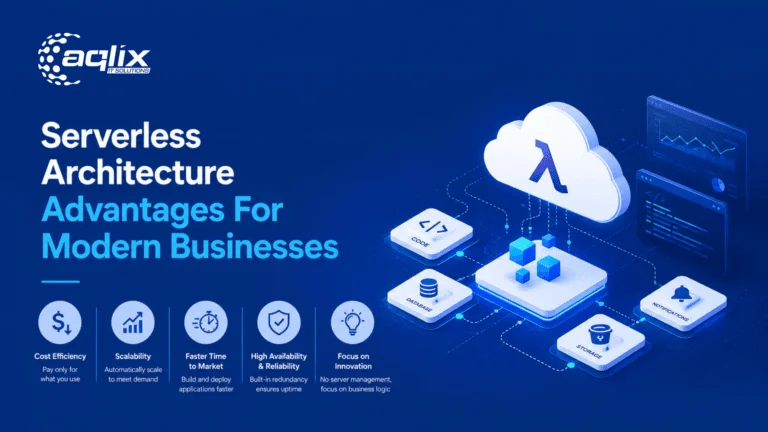

To alleviate scalability, infrastructure management, and software delivery speed, modern businesses are embracing serverless architecture. Serverless computing will enable the organization to build the application without taking control of any physical servers or complicated back-end systems. The cloud-native way empowers organizations to be more focused on development, automation, and customer experience.
Aqlix IT Solutions helps organizations modernize cloud, automate infrastructure and create scalable applications for healthcare, logistics & finance enterprises.
Understanding Serverless Architecture
A serverless architecture is a cloud computing model that automatically manages infrastructure, scaling, server provision and maintenance, and resource allocation by the provider. The business is just interest in building and deploying applications.
This assists organizations in decreasing operational complexity while enhancing flexibility and deployment velocity. Applications of serverless systems include APIs, web apps, data processing and cloud-native platforms.
Why Businesses Use Serverless Computing
Organizations are moving to serverless computing because it enhances operational efficiency and minimizes infrastructure management activity. Manually configuring servers is needlessly tedious and businesses can allow the applications to scale themselves up or down on demand.
Important benefits include:
- Reduced infrastructure maintenance
- Automatic scaling capabilities
- Faster software deployment
- Improved cost management
- Better development productivity
- Simplified cloud operations
With the help of Aqlix IT Solutions various organizations have modernized applications by using automated deployment workflows, scalable cloud environments and secure cloud-native architectures.
1. Faster Resource Scaling
Serverless platforms allow developers to pay for programming resources and automatically adjust computing capacity based on workload requirements. Apps can automatically allow businesses to scale large amounts of traffic without needing manual server management or the risk of downtime
2. Reduced Operational Complexity
Cloud providers handle infrastructure monitoring, updates and maintenance. Doing this lets development teams spend more of their time on application functionality and innovation instead of backend operations.
3. Better Cost Optimization
It is a pay as you go model; the businesses pay only for resources consumed by an application during its execution. This allows organizations to reduce redundant infrastructure expenses and enhance cloud-budgeting for their resources.
How To Automate Cloud Infrastructure
Among the key benefits of serverless architecture is infrastructure automation. Cloud Automation: This method entitles the deployment to be consistent and reduces manual effort involved in managing the cloud.
Key automation practices include:
- Continuous integration and deployment pipelines
- Automated testing environments
- Infrastructure-as-code implementation
- Cloud monitoring and alerts
- Automated security management
- Resource provisioning automation
Aqlix IT Solutions migrated to GitOps-based CI/CD workflows for healthcare and logistics businesses for more speed in deployments, better operational efficiency, and the ability to scale on the cloud.
1. Continuous Deployment Automation
Automated deployment pipelines increase an organization release updates faster and more accurately with regards to testing insights and the code being deployed to any environment.
2. Infrastructure-as-Code Implementation
While infrastructure-as-code (IaC) technology has matured, this gives businesses the ability to manage and monitor cloud resources via configuration files rather than a manual setup process. This minimizes mistakes and boosts scalability.
3. Automated Security Controls
Automation tools help in tracking vulnerabilities, ensuring compliance to security policies and managing the access permissions dynamically. Improve cloud security and assist compliance management
Why Enterprises Adopt Serverless Architecture
Serverless architecture is being adopted by enterprises to enable cloud-native development, improve scalability, and increase digital transformation efforts. Modern organizations are looking for systems to provide extensible frameworks and can scale rapidly in response to changing workloads and business needs.
Common enterprise benefits include:
- Faster product delivery
- Improved application reliability
- Simplified disaster recovery
- Better scalability
- Reduced infrastructure management
- Enhanced operational agility
Aqlix IT Solutions has been providing enterprise modernization, Kubernetes environments, automated workflows and scalable cloud infrastructure solutions.
Improved Business Agility
Serverless provides businesses faster access to new features without long infrastructure preparation cycles. Organizations respond to the market demands and customer expectations rather quickly.
Better Application Reliability: Basically they take care of scaling and redundancy while ensuring that the system is available most of the time. This enhances the application uptime as well as diminishes downtime risk for business-critical systems.
Faster Innovation Cycles: Serverless environments enable development teams to test, deploy and improve applications faster- helping businesses innovate software at top speed.
How To Improve Application Performance
Customer experience and business productivity are directly related to application performance. How serverless architecture helps improve performanceServerless architecture dynamically allocates resources based on workload demands.
Important performance improvement strategies include:
- Auto-scaling cloud functions
- Distributed cloud services
- Event-driven processing
- Automated caching systems
- API optimization
- Cloud-native monitoring
Aqlix IT Solutions has deployed scalable, cloud-based infrastructure to enhance application reliability and performance for healthcare and logistics platforms while streamlining their automated deployment practices
Dynamic Resource Allocation: This type of technology allocates resources automatically whenever there is a spike in the traffic on the application. This allows for consistent performance during peak traffic times.
Reduced Downtime Risks: Business continuity and recovery techniques ensure that there is automatic system redundancy for continuous application availability while conducting operations with minimal disruption.
How To Speed Application Deployment
In today’s evolving digital world, businesses must be faster at deploying. The serverless compute simplifies deployment workflows by reducing infrastructure dependencies.
Key deployment acceleration practices include:
- Automated CI/CD pipelines
- Containerized workflows
- Version-controlled deployments
- Automated rollback systems
- Integrated testing frameworks
- Cloud-native monitoring
Aqlix IT Solutions helps businesses with Cloud Native Deployment strategies, Automated Testing Environments and Scalable Application Modernization solutions.
Faster Release Cycles: Automation enables the increased release frequency of updates without disrupting application stability or changing how, where and when we deploy.
Better Development Productivity: Instead of wasting time managing infrastructure, development teams can build features- resulting in increased project efficiency with quicker software delivery timelines.
Conclusion
This cuts down on infrastructure complexity, enables automation of cloud operations, and makes application scalability much simpler for businesses using serverless architecture. This means organizations can deploy faster, better cost optimization and operational efficiency with serverless computing. Businesses of all shapes and sizes continue to invest in cloud-native technologies for digital transformation and future-proofing their operations. Aqlix IT Solutions helps organizations maximize their cloud potential with cutting-edge solutions, automation plans, and extensible application development services.
FAQs
What is serverless architecture?
Serverless Architecture: Serverless is a Cloud Computing model in which the complete infrastructure operations are auto-scalable, & managed by cloud providers. Over the years, businesses focused on application development while giving up manual duties for server management and complex operations.
Why do businesses use serverless computing?
Bringing the subject closer to home, we will use serverless if it allows us solving our scalability needs without us having to manage servers and infrastructure, that also integrates nicely into CI/CD pipelines with faster deployments and which can reduce our cloud costs. It is necessary to improve the business efficiency in development and operation.
How does serverless architecture improve performance?
Serverless server systems can automatically adjust top producing assets on the traffic it gets. It helps improve the responsiveness of applications, also reduces downtime risk, and maintains performance when workloads increase.
How does automation help cloud infrastructure?
Automation makes it easy to deploy, monitor test and manage security. Automated cloud workflows help organizations reduce manual tasks, make software delivery faster and improve consistency.
How does Aqlix IT Solutions support serverless modernization?
Aqlix IT Solutions helps enterprises to modernize and build their applications with cloud infrastructure, CI/CD automation, Kubernetes implementation and deployment strategies that design an enterprise ready cloud-native architecture.