

Lots of companies get massive traffic to their websites yet collect few leads. This is common when a site acts more like a digital brochure than a conversion engine. Designs that initially focused on aesthetics with smooth transitions to psychological aids for conversion cover hidden barriers.
Aqlix focuses on auditing technical, structural, and psychological bottlenecks to turn a website into a high-performance lead-generation engine. Whether it is improving user intent alignment or optimizing the technical infrastructure, any business can tremendously increase its conversion rate and ROI.
Conceptual Barriers to Conversion
No matter how aesthetically pleasing the website is, it just won’t work out if visitors do not have the right expectations. Conceptual misalignment between user intent and website content, cognitive overload, and absence of trust signals are some common barriers to conversions. Overcoming these roadblocks guarantees that visitors are engaging properly and moving up the sales funnel smoothly.
1. The Disconnect Between User Intent and Landing Content
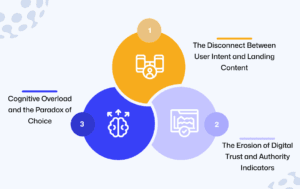
A common issue with landing pages is the “value gaps,” which means they don’t address visitor problems right away. When content fails to meet users’ needs or demonstrate relevance, they tend to leave. This leads to better engagement and fewer bounces; they map the website content against intent, use CTAs to a solution approach, and do personalized messaging.
2. Cognitive Overload and the Paradox of Choice
Visitors are overwhelmed by cluttered layouts, too many CTAs and multiple competing messages. Cognitive overload leads to friction, making decisions more difficult and increasing abandonment. By utilizing only the necessary paths to navigate and arranging primary CTAs in importance as well as grouping related actions together, users are guided towards taking that next step and therefore drive higher conversion and satisfaction rates.
3. The Erosion of Digital Trust and Authority Indicators
Credibility is evaluated more and more before you ever engage. Trust is dented by lack of social proof, weak security signals and generic branding. Testimonials, verified badges, privacy guarantees and consistent messaging add authority. To convert vigilant and informed users it takes credibility in 2026.
Technical and Structural Fixes
Even when content is aligned with intent, technical and structural deficiencies can block visitors from converting. It is vital to optimize for page speed, mobile experience, and lead capture mechanisms. Alignment in UX, CRO and site architecture means that visitors can easily engage in the funnel.
1. Optimizing Core Web Vitals for User Retention
Page load speed, layout stability and interactivity have a great impact on user retention. A slow-loading webpage leads to a high bounce rate and reduced trust. Improvements like performance audits, media compression, cache leverage and optimized code lead to better experiences, better engagement and higher conversions no matter the device.
2. Implementing Frictionless Lead Capture Mechanisms
Long forms and complicated submission processes will be off-putting to users. Reducing friction: progressive profiling, pre-filled fields and one-click contact options Machine learning and AI chatbots can suggest context-sensitive formats from exchanges or collect adaptively, enabling one-click transitions while preserving information integrity.
3. Repairing the Broken Mobile Conversion Journey
Mobile users are also having a hard time with tiny buttons, poor forms and inaccessible content. You’ll ensure that mobile visitors are able to complete desired actions by reviewing touch targets, simplifying layouts and optimizing lead magnets. Mobile-first optimization is critical 60% of B2B traffic comes from smartphones and tablets.
4. Mapping Content to the 2026 Buyer’s Journey
Each page must serve a strategic role in guiding the user. You also want to make sure you’re auditing your site architecture, linking through information + consideration + decision stage content and clearly articulating what the “next step” is in order for visitors to progress smoothly through the funnel. Predictive analytics can provide customized runs based on historical behavior.
Measuring Impact and Avoiding Common Traps
Monitoring and Analytics: Track and analyze the changes to ensure they are improving and continuing. Until there’s action of substance, figures are vanity metrics. Third-party tools that can indirectly enhance the experience area by automatically generating insights from various sources, such as heatmaps/session recordings, along with predictive analysis to dynamically adjust UX.
1. Using Heatmaps and Session Recordings to Validate UX
User activity also assists in the recognition of qualitative friction points. This is where heatmaps, scroll tracking, and session recordings come in to help you identify ignored content, confusing CTAs and drop-off points. AI-based analytics leverage behavioral data to uncover actionable insights and changes that ensure design/content changes drive conversion improvements.
2. Avoiding the Pitfall of Vanity Metrics Over Revenue
High page views or time-on-page can be misleading to look at. We prioritize KPIs that matter, like leads captured, conversion rates, and revenue influenced rather than measuring vanity metrics; we measure success and direct our focus on where it really matters. When you combine predictive AI capabilities with machine learning, predictive analytics also helps identify high-potential segments so that resources can be focused on the sectors where they are more likely to deliver ROI.
Conclusion
A website without leads is a liability. To fix it we need to address psychological, structural and technical barriers as well as deliver good mobile & desktop experiences. An effective CRO strategy turns traffic from passive to predictable revenue.
Aqlix IT Solutions audits websites to improve UX and AI/article generation-oriented solutions for enterprises. Join hands with Aqlix and transform your website into an around-the-clock lead-generation machine that fosters tangible growth.
Frequently Asked Questions
Why is my website traffic not converting into leads?
Not all high traffic correlates to leads. These include misaligned content with user intent, cognitive overload due to cluttered designs and absence of trust signals. Audit your UX, CRO, and technical infrastructure Fill the funnel
How can AI improve website lead generation?
AI tools may do this by tailoring content to the user, recommending CTAs, and streamlining form workflows. Machine learning, on the other hand, predicts what visitors want and offers personalized experiences that boost engagement and conversions. Chatbots offer to guide users through your forms, allow them to ask questions while filling out a form, and automatically capture the lead information.
What are the most common technical barriers to conversions?
The lack of responsiveness and slow loading speeds (and/or brokehigh-performance websitetechnical infrastructuren forms) are the biggest hurdle. Sophisticated Core Web Vitals, streamlined UX, and smooth lead capture systems help minimize technical drop-offs to ensure that visitors can interact more effortlessly with your website.
How does cognitive overload affect lead generation?
Another common pitfall: Too many options or competing CTAs overwhelm users, stalling or derailing decisions. If the next step is clear, fewer decisions need to be made by the user, resulting in less cognitive load and higher conversion rates when necessary actions are prioritized.
What metrics should businesses track for effective CRO?
Traffic, track leads generated, and conversion rates influence revenue. Use heatmaps, session recordings, and AI analytics to pinpoint points of friction. To measure website performance and return on investment (ROI), track actionable key performance indicators (KPIs), not vanity metrics.