

The rapid pace of digital transformation has pushed organizations to redefine how they work, deliver services and collaborate as teams. For over a decade, organizations wishing to stay competitive, agile and efficient have moved to cloud and SaaS platforms. Not just value-add add-ons Systems like this are infrastructure now, upon which you depend for business continuity and future growth.
Flexibility, access and the power to support near real-time creativity are a few of those reasons why SaaS and hybrid cloud have become so important for businesses across all industries. Whether a scrappy start-up challenging pay-as-you-scale services or an international monolith moving legacy equipment, the cloud is now a staple of digital strategy. Now it’s SaaS and cloud solutions, that-enabled combination is the foundation of inter-supported conversation, data hosting security and scalable business operations.
The Evolution of Business Technology
Business technology today is a far cry from the days of expensive, inflexible software systems; modern systems are dynamic (a better word than “flexible,” since flexible often implies that it can be too flexible, unstructured), host-based and subscription-driven. Before that companies were just using licensed software and was installed on premise with manual update (it required greater expense for investing in hardware). Which resulted in dependence on enterprise-specific IT department, long periods of time between maintenance and slower rates of innovation.
Today, subscription-dependent SaaS dominates the overall landscape. Consumers can access products just-in-time and pay-as-they-go per usage, and with getting them automatically updated. This transition has been compounded through cloud computing bringing enterprise class tooling to organisations of any size, anywhere in the world regardless of their IT infrastructure footprint.
In this environment businesses are looking for partners like Aqlix IT Solutions that can work with them to build and deploy customized cloud applications, focusing on real operational issues and digital scale requirements.
Leaving aside product type, the character of technology has shifted from possession to access, manual enhancement to auto-improvement and detached functionality to connected platform.
The Advantages of SaaS and Cloud Services For Business
The point for SaaS and cloud estates is plain to see with TCO advantages in delivering more efficient, future-proofed digital real estate. Following are some of the significant benefits affecting today’s business practices.
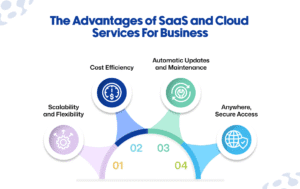
1. Scalability and Flexibility
With cloud based architecture, the filling of resources can be scaled up and down based on the user requirement, seasonal surge or planned growth. SaaS apps allow teams to pick up features as they go, rather than having to build everything themselves.
This kind of flexibility means that your business can scale up without compromising ou will be able to address their support queries which surface during the running of things.
2. Cost Efficiency
Old-school-based infrastructure involves big, upfront buys of servers and networking gear and/or other physical, licensed installs. SaaS eliminates those by converting them to operating expenses that more accurately mirror usage.
You are redundant to storage, hosting, processing and application deployments which reduces your total cost of ownership and increases service availability.
3. Automatic Updates and Maintenance
With SaaS-based systems, you don’t have the hassle of taking the system offline or onboarding IT support. Performance/Safety/Compliance updates auto-apply in the background- no software to maintain means teams can work without distractions.
4. Anywhere, Secure Access
Access the authenticated users authorized data from any device supporting remote work, team collaboration and personalisation with cloud based apps.
Flexible sign-in Policies,encryption depths and permission-based access rights enable the right balance of data governance and privacy.
Real-World Use Cases
We are witnessing the disruptive impact of SaaS and cloud solutions in many fields. From post comms to operations to CRM, these are now embedded into the business as usual.
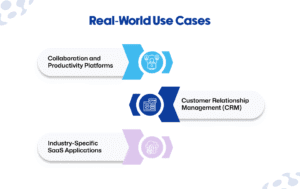
1. Collaboration and Productivity Platforms
Google Workspace and Slack are part of a different work world that adroitly deploys these tools to more efficiently communicate, share documents and tasks. Cloud-native apps breeze past time zones and devices.
2. Customer Relationship Management (CRM)
Apps such as Salesforce and HubSpot streamline customer data, automate follow-ups and improve the sales forecasting process. SaaS CRM enables teams to customize their outreach plans and receive replies more rapidly.
3. Industry-Specific SaaS Applications
Sector-specific cloud applications for healthcare, logistics, education and retail ease highly regulated and complex operations. Personalization (customization) means that workflows are not created to fit a one-size-fits-all system, but rather for the specific challenges faced in each industry.”
There are a number of benefits for businesses to have such a customised system in place, according to Aqlix IT Solutions, as it extends the time period they can keep up their digital performance and data-driven decision cycles.
SaaS and Cloud Security/Compliance
As-358_69f} / In the various interconnected systems, security is a major issue. That said, cloud services heavily invested with enforced encryption, identity management and wide-spread compliance models (GDPR, SOC3 HIPPA ISO etc.) this multi-authentication (both push and OTP) role based access control having enabled on-going & autosurveillance keep your private data beyond any unauthorised intervention.
We spend a lot of time in the cloud nowadays, It is better protected from viruses and malware than local servers by real-time advanced threat detection tools. With backup and disaster recovery services in place, your business can still run normally even if something goes wrong with the system out of the blue.
The Future: AI-Powered Cloud Platforms
The next thing coming up in the evolution of public cloud is integrating AI and ML into the shit we do everyday. AI-enabled cloud services can enable the development of predictive insights with real-time data, drive business process automation and enhance decision-making capabilities. Those are the kind of advancement that result in enhanced product customization, faster problem resolution and kick ass customer service.
Self-learning business systems and apps andicating where the tech is heading, AI-driven clouds es are going to power itself in the virtualisation break out too as autonomic resourcecontrol of IT stacks so that when an event occurs, they n -controled they do. AI combined with the cloud will push businesses from reactionary to proactive operations, bolstering a company’s digital resiliency.
Conclusion
SaaS and cloud are no longer tools that underpin enterprises, it’s now a solid base upon which organisations construct these scalable, secure and collaborative environments. As digital systems are increasingly entwined in the operation of organizations, such systems also become a key leveraging factor around which organizations innovate, deliver and compete in a global market.
Aqlix IT Solutions designs and develops SaaS & Cloud ecosystems that are tailored to fit business objectives and operating modes of large enterprises. With an emphasis on innovation, long-term business value, and the creativity of our people, the organization adds value across technology, making quantum leaps in business environments.
Frequently Asked Questions
Why are SaaS and cloud solutions crucial for businesses today?
They offer flexibility, economy, secure access and scalability which is great if you expect long-term digital growth.
What are the advantages of SaaS updates for companies?
Patches are rolled out seamlessly, minimizing downtime and there are no manual maintenance activities for on premise IT teams to perform.
Is it safe to use cloud platforms for confidential information?
Yes. The top services employ strict encryption, identity verification, and regulatory compliance to keep your information safe.
Cloud Software as a Service (SaaS) and cloud-based platforms, Can they enable hybrid/remote workforces?
Yes, teams can work together from anywhere and enjoy instant access to the data and applications they need.
What can AI do for cloud?
AI will be the glue enabling automation, predicative analytics and self-optimising business processes to deliver better operational results.