


Most organizations are still operating on legacy systems built for stability not adaptability. And while these tools can go a long way toward supporting essential business operations, they also have the potential to stifle progress, slow processes and harm your bottom-line budget. With digital expectations higher than ever, companies are reconsidering the right way to modernize without disrupting their daily business.
Legacy-modernization is concerned with the transformation of current systems to meet modern business needs including scalability, security and integration capabilities. But the ones that get it right will be able to maintain the integrity of their core systems, and offer open access for newer digital innovations.
Why Legacy Systems Need Strategic Upgrades
Old school platforms were built in a differ userent age. Bottom line is that these models just don’t scale as the security bar gets higher, customer demands change, and your buying requirements volatility increases. These limitations have caused problems in being able to react quickly to market fluctuations.
Modernization enables organizations to tackle technical debt while keeping their business running. Instead of rip and replace, companies can refresh parts selectively for added performance and flexibility.
Business Value Delivered Through Modernization
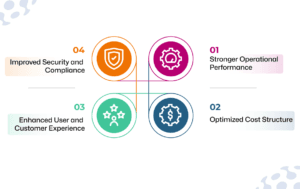
You can even measure the value of legacy modernization across operations. It is performance enhancing, with reduced long-term risk.
These enhancements cater to near term efficiency as well as long term digital readiness.
1. Stronger Operational Performance
Today’s systems are faster and can do more work. This results in faster responding apps with little to no down-time.
Performance gains immediately relate to the productivity of employees and customer satisfaction.
2. Optimized Cost Structure
Contemporary platforms minimize infrastructure overhead and maintenance cost. AccessNow is cloud-based so you can use the same server hardware for 3 to 5 years.
Automation also reduces operational cost by decreasing repetitive manual works.
3. Improved Security and Compliance
But it’s not just older systems, new ones will utilize modern security models and compliances. This decreases exposure to cyber attack and information theft.
Increased supervision and access control increase the overall resilience of the system.
4. Enhanced User and Customer Experience
Use is more convenient with new interfaces and quicker response time. Workers are more efficient, and customers get a smoother experience.
Improved experience, drives higher engagement and trust.
Industry-Specific Modernization Outcomes
The effects on business The move to modernize legacy systems can have varying effects across industries depending on the operational complexity and regulatory context. But the advantages are even across areas.
Businesses claim that their workflows are faster, there’s better visibility and decision-making.
1. Financial Services and Banking
Contemporary platforms are capable of real-time transaction management and regulatory reporting. Automation enhances accuracy in both compliance and risk management.
APIs For digital banking features & 3rd party integrations.
2. Healthcare and Life Sciences
Modernization of health systems to enhance data flow and cross-industry interfaces among healthcare providers. Secure data sharing promotes improved patient care and analytics.
Today’s platforms also enable compliance with changing healthcare mandates.
3. Manufacturing and Supply Chain
Modern platforms for production data analysis and optimization are added in the manufacturer’s environment. Automation increases efficiency and decreases downtime.
ML-type discoveries aid in anticipating when you’re going to have a maintenance problem or if your supply chain is going to be disrupted.
4. Retail and Commerce
Companies are rebuilding systems to enable omnichannel models and real-time inventory control. Analytics enable personalized customer experiences.
New systems enable greater order cycle speed and far better predictability of demand.
Key Obstacles Organizations Must Plan For
Careful and considered planning is required when embarking on a strategy of legacy modernisation to ensure there is NO operational risk. It is imperative that organizations prepare for technical and organizational issues in advance.
Knowing these challenges makes life easier.
- Managing Complex Data Transitions: Data migration has to be done with care to prevent loosing data or introduce inconsistency. Validation and testing neverphaseout data integrity during the process. Gradual migration mitigates risk and continuity is assured.
- Minimizing Business Disruption: And if you don’t plan it well it can disrupt daily errands. Parallel testing and rolling out gradually help keep things stable. Transparency with stakeholders diminishes the level of uncertainty.
- Preparing Teams for Change: Current technology requires a more up-to-date skill and workflow. Training programs ease teams into learning new tools and methods. Adoption success is dependent on change management.
- Aligning Budget and Scope: Smart planning will cure the patient of “scope creep” and over-spend. When you put areas with high-impact in the spotlight it pays off much better. Clear goals facilitate useful progress tracking.
How Aqlix Supports the Structured Evolution of Legacy Systems
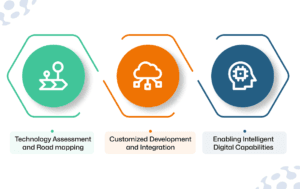
Aqlix helps companies from kickoff to legacy modernization. The approach takes inspiration from alignment, clarity and long term scalable-ness.
Everyday Technology Instead of creating a dramatic change, Aqlix serves as gradual and controlled evolution.
1. Technology Assessment and Roadmapping
Aqlix assesses your current systems to determine potential modernization. This evaluation matches new technical capabilities with business goals.
Roadmaps establish an execution timeline and key results.
2. Customized Development and Integration
Custom development makes it possible for these legacy platforms to operate with today’s cloud-native, AI-centric and API-driven systems.
Cures are engineered to keep your system in a stable condition.
-
Enabling Intelligent Digital Capabilities
Aqlix is the pioneer in sawbox that has combined ML models, testing automation enterprise and chatbot solutions to run better operations.
These functions enhance the value proposition of the systems without unnecessary complexity.
Conclusion
Legacy modernization enables organizations to transform without losing their stability. With strategic enhancements, companies can scale and secure as well as be more flexible.
With disciplined sourcing approaches and the implementation support of an experienced partner like Aqlix IT Solutions, corporations can modularly modernize and lay technology underpinnings to ensure future growth is sustainable.
Frequently Asked Questions
What does legacy modernization involve?
Changing legacy apps, which are inefficient or insecure, to new apps that scale and perform better. The transformation preserves some of the essential business logic but makes it more aligned with modern platforms in the cloud and elsewhere and digital tools. It’s a tactic to keep the companies’ systems going and avoid mission-critical outages.
Legacy systems in the world of AI and ML.
Yes exactly, I do believe that Our Legacy system is open and can have AI SD ML integrated through API’s, middleware and modular architecture. In the process, modern analytics, automation and AI capabilities can work alongside legacy systems to deliver data-driven insights and process uplift without having to entirely replace existing systems.
Is modernization bad for the business?
There is risk in modernization, however if the process is phased in, tested and managed effectively, it can be greatly reduced. Incremental improvements mean your business does not have to come to a complete halt, employees can catch problems early and you get to keep the ship steady during this time of change.
What’s the usual duration of modernization?
The time to modernize will vary based on the complexity of your systems, the amount of data and your approach. Smaller upgrades could take months, while enterprise-wide overhauls might stretch for years. It helps the deliverables come in smaller chunks, reducing risk and maintaining measurement throughout the projectnot just at the end of it.
What’s in it for me to choose Aqlix for legacy modernizations?
Aqlix unites technology consulting with custom software technologies and digital transformation capabilities in a framework that helps to ensure successful transformations. The approach is scalable, secure and delivers lasting value – it means organisations’ legacy systems are managed responsibly as they adapt to meet contemporary business needs and future challenges.