
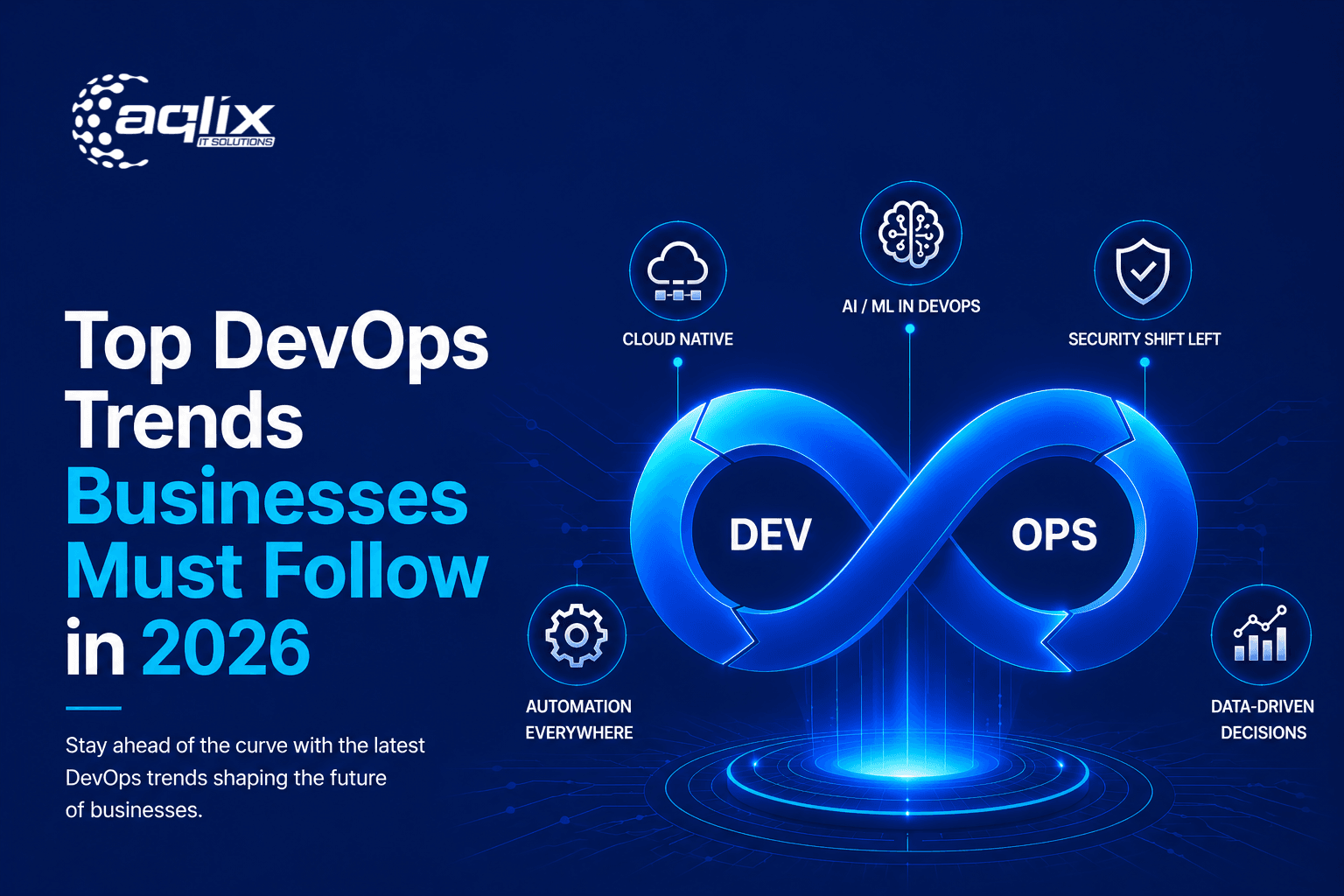

Software is accelerating these days, asking for faster and more stable delivery. By bringing together development and operations, DevOps is still the key ingredient for digital transformation.
It has become an imperative for businesses to adopt modern DevOps practices. By applying smart automation and security measures, business innovation can be improved. In this constantly changing digital environment, professional technology consulting strategies will help organizations achieve operational excellence and long-term success.
The Rise of AI-Driven DevOps and Automation
2026: A fundamental transformation by artificial intelligence in how teams view development lifecycles. AI tools predict failures, automate maintenance, and optimize resources so teams can focus on building scalable products.
1. Predictive Analytics for Operational Efficiency
With predictive analytics, teams can identify bottlenecks before they arrive. Historical performance data allows businesses to preemptively scale their infrastructure as needed.
Integrate predictive monitoring to reduce manual work and power systems that heal themselves. Coupled with a switch to active management that reduces downtime, your business applications are kept in a performant state and long-term costs associated with reactive troubleshooting or manual updates of systems are avoided.
2. Automated Incident Response and Recovery
No longer is there a need for manual intervention during system failures. Agencies now heal through automated incident response or even AI-driven systems to quickly identify and resolve issues from the source. Organizations achieve error mitigation with minimal impact through the utilization of software QA & testing automation.
Self-recovery systems keep services running smoothly. This reduces mean time to recovery, which enables businesses to protect their reputation and users’ disgruntledness by ensuring there is always seamless service available irrespective of complexities in the underlying infrastructure or shocking technical system pressures.
3. Enhancing CI/CD Pipelines with Machine Learning
Machine learning is making CI/CD pipelines smarter. They could automatically identify when abnormal deviations were being introduced in code commits, suggest optimizations, and also find testing processes that deliver the lowest confidence in software reliability so that focused efforts could be undertaken to make sure every deployment was safe, secure and production-ready.
By eliminating repetitive confirmation steps machine learning provides speed of delivery. This smart automation practically eliminates human error, so you can keep your development cycle fast and secure.
The Convergence of Security and Infrastructure
The notion that security was a last line of defense is now more like an auditor, shifted into a critical piece of the DevOps process. DevSecOps is the new normal; it incorporates security audits, vulnerability scanning and compliance checks directly into development pipelines to help protect organizations without sacrificing developer velocity or enterprise agility.
1. Infrastructure as Code (IaC) Security
Infrastructure as Code means keeping the IT infrastructure files in a machine-readable way. These files are a must in 2026. Automated IaC script scanning can help prevent misconfiguration, keeping your cloud environments strong, scalable and secure against threats.
The framework provides a repeatable methodology for deploying secure infrastructure. If you think of infrastructure security as code, your team can implement policies that cover all deployments at all times, nipping vulnerabilities in the bud before they ever reach production or affect your live services.
2. Compliance-as-Code Implementation
Manual checks to ensure compliance with regulatory requirements are becoming impractical as a result of their increasing complexity. Compliance-as-code enables organizations to encode their legal and security standards right into the pipelines.
Since these standards are baked into the code, they help mitigate hurdles presented through manual audits. This ensures that your software is always compliant with the highest standards, allowing your organization to innovate safely while having full visibility into security & governance processes.
3. Cloud-Native Resilience and Management
Managing complexity is critical as businesses move towards multi-cloud environments which makes sense. Companies can build more resilient architectures using microservices and containers and manage these cloud applications expertly.
Such resilience enables businesses to ride through sudden bursts of traffic loads or infrastructure unavailability. Using modular, cloud-native architectures future-proofs your software:
The Shift Toward Platform Engineering
By building internal developer platforms to streamline workflows, platform engineering is fundamentally changing how businesses create value. Together, a common set of tools and infrastructure enables organizations to let developers focus only on building great software features that lead to sustainable growth at scale.
1. Core Pillars of Platform Engineering
- Self-Service Capabilities: Developers provision their own infrastructure without tickets.
- Standardized Tooling: Reducing tool fragmentation through a consistent software stack.
- Reduced Cognitive Load: Automating backend complexities for product innovation.
- Enhanced Developer Experience: Streamlining workflows to improve velocity and morale.
2. Future Outlook for Internal Platforms
That previous statement brings so-called platform engineering topics into the picture and raises another: platform engineering is not about creating a tool. A unified platform helps businesses adhere to development standards in every department and project, creating an environment of collaboration that ensures long-term engineering quality and consistency.
Conclusion
As these 2026 DevOps trends take hold, strengthening your competitive advantage can hinge on catching on to them. The technical backbone of businesses can grow when enhanced through AI, security enhancement, and platform engineering. Aqlix IT Solutions simply possesses that knowledge on how these strategies can be executed in such a manner today.
We harness technology consulting and custom solution development at Aqlix to transform contemporary trends into your sustained success. And work with our team to solve these complexities and drive real business outcomes, confidently delivering sustainable, resilient innovation.
Frequently Asked Questions (FAQ)
Why is AI-driven DevOps important in 2026?
AI-driven DevOps is important as it helps in monitoring and automated execution of complex infrastructure tasks proactively. Decreased human dependence helps decrease the scope of human error and increase system uptime; it provides teams with a chance to focus on strategic innovation over day-to-day upkeep that is critical when trying to maintain your competitive advantage.
What is the “shift-left” approach in DevSecOps?
Then the “shift-left” approach comes forward, which means security testing and compliance checks should be integrated early in the software development life cycle (SDLC). Security does not become an afterthought and is part of the initial design and code, helping identify and remediate vulnerabilities before they are deployed to production.
How does Infrastructure as Code (IaC) improve efficiency?
IaC enables teams to control IT infrastructure through code instead of manual processes. Which means faster, consistent and repeatable across environments. It also prohibits configuration drift, guarantees similarities between development and production environments, and assists in rapid scaling up or down depending on changing business requirements with little fuss.
Can small businesses benefit from these DevOps trends?
Absolutely. Even though trends such as AI/advanced automation appear to be enterprise-focused trends, they are extremely scalable. The simplest way for small businesses to hit the ground running is by automating simple CI/CD pipelines or moving into the cloud-native tool chain that reduces cost, increases efficiency, and gives them the agility needed to compete with larger players in their industries.
How do I choose the right DevOps strategy?
Deciding the right strategy is all about your infrastructure, skill set, and goals. To manage the automation process successfully, existing workflows are audited and bottlenecks are identified, followed by incremental automation. Forming partnerships with experienced IT consultants can yield a concrete roadmap that enables your DevOps transformation to align closely with the desired business objectives.