

By 2026, many enterprises are suffering from “AI tools,” having poured money into disconnected tools that create data silos instead of solving operational problems. Businesses are evolving from simple generative AI to autonomous, agentic ecosystems where many models work together to accomplish complex goals.
Aqlix features a handpicked collection of small, but powerful AI tools that are interoperable, data-secure and have measurable ROI. These enable businesses to optimize workflows, accelerate revenue operations, automate development lifecycles and track forward-looking decisions against strategic business goals.
Why 2026 Demands a Unified AI Stack
And enterprises were building these integrated versus disparate AI strategies. With a unified AI stack, there is cross-departmental collaboration, decreased redundancy and measurable impact. These predictive, autonomous AI models enable large organizations to obtain insights, automate workflows, and ensure compliance while ensuring their high-volume enterprise operations are efficient.
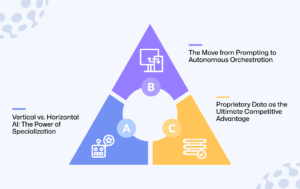
1. The Move from Prompting to Autonomous Orchestration
From mere chat-based interactions, businesses are progressing towards implementing AI agents that will independently carry out complete workflows (end-to-end). These systems handle task assignments, track progress and make real-time adjustments to ensure that operational objectives are achieved more quickly than would occur through manual or reactive approaches.
2. Proprietary Data as the Ultimate Competitive Advantage
AI tools that support fine-tuning on private, proprietary datasets substantiate a competitive advantage. While using public AI tools would result in generic models, training them securely on their internal data allows businesses to construct tailored insights and predictive capabilities that competitors cannot replicate, paving the way for better personalization, forecasting and strategic decision-making.
3. Vertical vs. Horizontal AI: The Power of Specialization
Industry-specific or “vertical” AI models outshine generic horizontal ones because they know industry science and jargon, compliance rules and operational workflows. For example, Fintech AI tools detects anomalies in transaction data or SaaS AI Tools predicts churn. The specialized AI provides much higher accuracy, efficiency, and return on investment than general-purpose models of the broad market.
Core Tool Categories for Maximum Impact
Identifying and executing on targeted AI solutions in each of these key operational areas means the bank is poised to make measurable improvements. Aqlix is about AI tools that helps you be productive, predicts what will happen and automates repetitive tasks so that leadership teams get better insights.
1. Agentic Project Management and Workflow Automation
AI-powered project management tools take over the task of assigning tasks, predicting what will be behind schedule and reallocating resources based on current team performance. They connect with collaboration solutions and offer prediction-based warnings and actionable suggestions to eliminate bottlenecks along the way, thus adding up to overall team productivity in enterprise projects.
2. Hyper-Personalized Revenue Operations (RevOps) Platforms
AI-enabled RevOps tools aggregate marketing, sales and customer data to anticipate client needs and carry out customized outreach at scale. These platforms leverage behavioral and transactional data to fine-tune lead scoring, prescribe best practices for engagement, and automate bespoke campaigns that maximize conversion rates and accelerate revenue predictability.
3. AI-Powered DevOps and Autonomous Code Maintenance
The machine learning model itself automates a lot of repetitive DevOps tasks such as patching, documentation, performance monitoring, etc. With the potential of AI, software systems will be constantly scoured for loopholes, security holes, and performance capacity issues to ensure that enterprise software remains easy to use without being breached or unable to handle increased loads.
4. Intelligent Business Analytics and Predictive Financial Modeling
AI tools can look at global market trends, analyze internal ledgers and ongoing operational metrics and provide predictive insights for cash flow, budgeting or expansion strategies. Predictive analytics gives finance teams the ability to spot risks, allocate resources in the most efficient way possible, and make proactive data-driven decisions with maximum business return on investment.
Ensuring Scalability and Security
Yet the benefits of implementing AI at scale come with caution to understand ROI, stay compliant, and mitigate risk. The enterprises need to track the performance of AI, manage model drift and ensure data security that helps in maintaining trust and accuracy while achieving maximum operational impact.
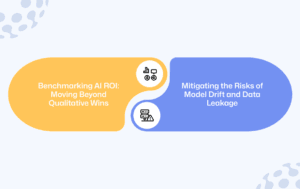
1. Benchmarking AI ROI: Moving Beyond Qualitative Wins
The impact of ai isn’t just about anecdotal success. Enterprises measure things like time saved per task, reduction of errors and revenue impact. We can make sure that not only have AI investments paid off but also that they generate business results for you by performing quantitative monitoring of the production.
2. Mitigating the Risks of Model Drift and Data Leakage
AI models stagnate in quality without regular auditing processes. Similarly, ongoing validation, testing and monitoring prevent drift and maintain fidelity in prediction. Such protective infrastructure and discrete data channels mitigate the potential for leaks while also complying with data privacy regulations, including protection of proprietary business insights.
Conclusion
By 2026, enterprises leverage a streamlined focus on AI stack rather than ad hoc and discrete tools. Exploits data through predictive, agentic and domain-agnostic AI solutions to drive operational excellence, revenue optimization and informed decision making.
Aqlix IT Solutions enables its partners to develop and execute an integrated AI strategy that combines machine learning, predictive analytics, and automation into a single scalable, secure enterprise-high ROI AI ecosystem. Protect your enterprise tech stack with Aqlix and solve the problem today.
Frequently Asked Questions
What are agentic AI ecosystems?
In this framing, agentic AI ecosystems mean end-to-end chains of several different AIs working together to autonomously operate complex business processes. Offering end-to-end workflows and optimizing resources and available data into actionable insights with little human intervention these solutions enable operational efficiencies from which the whole organization (and ultimately its specific business vertical) can derive ROI.
How can proprietary data enhance AI performance?
By fine-tuning on proprietary datasets, it can also educate models in domain-specific patterns, user behavior and operational nuances. This delivers unrivalled predictive powers no competitor can provide and subsequently enhances personalization, forecasting and decision-making around specific enterprise goals.
What is the difference between vertical and horizontal AI?
Vertical AI Industry (finance or health care) specific application data based, more accurate and domain expertise Horizontal AI general and it can be used in all industries but not precise Vertical AI will enable companies to adopt it faster, predict better, and achieve a higher ROI on enterprise-specific use cases.
How does AI improve revenue operations?
Using AI, businesses tie together marketing, sales and customer data to predict needs, automate outreach and personalize engagement. This translates to advanced machine learning and analytics being used by organizations for these processes along with better lead scoring, lower churn rates, improved conversion ratios that result in predictable revenue streams and operational efficiencies.
What are key considerations for AI scalability and security?
For scalable AI, you must monitor performance metrics, correct model drift, and keep secure data pipelines. Continuous auditing, privacy compliance and robust infrastructure eliminate errors, leaks and operational disruptions to protect your investments in AI for a long-term ROI while securing your securities.