

Startup operations sometimes start with a bang: speed and flexibility. But as a business blossoms, those informal ways of doing things can just as quickly block the drive in its tracks. Founders have to deal with growing teams and customer expectations around the clock while becoming increasingly operationally complex, but still efficient.
Technology, as well as guided structure, becomes very important for startups to scale in a sustainable manner. Through the use of digital transformation and professional technology consulting, startups can build operational structures that help in long-term growth. This is where Aqlix and the like come in by marrying technology with evolving business requirements.
Understanding Startup Operational Needs
All startups have them operational pressure points that emerge as they grow. Catching these needs early enables founders to construct systems that can scale, rather than reacting to issues down the line.
Operating clarity means growth doesn’t erode productivity, decision making or quality of service.
Workflow Management
Workflow management aims to structure tasks, approvals and dependencies between teams. Workflows are also informal among early-stage startups, causing even greater inefficiency as teams grow.
Digital workflow solutions help standardize processes, minimize redundancy and drive accountability.” With defined, automated workflows teams can concentrate on execution instead of coordination.
Resource Allocation
Startups run with limited resources, and their allocation is critical. To effectively make decisions, one needs to have an instantaneous view of what people are doing, how much money is being spent and time wasted.
Software platforms have centralized dashboards that make it easy for founders to track resource usage, anticipate demands and reprioritize workflows based on data not hunches.
Technology-Driven Transformation for Startups
Startups can do away with manual processes and instead streamline integrated systems which help them become more agile and scalable. It’s not just technology adoption we’re after, It’s operational alignment.
Good technology scales and grows but doesn’t needlessly complicate growth.
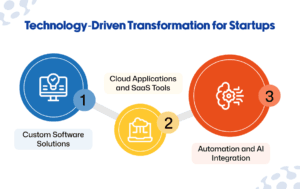
1. Custom Software Solutions
The custom software comes with the flow and objectives of a startup. Unlike one-size-fits-all solutions, these platforms are designed to together business logic not ask teams to change their process.
Custom solutions also enable startups to iterate on systems and add features or integrations as operational requirements shift over time.
2. Cloud Applications and SaaS Tools
Cloud-based applications and SaaS platforms offer flexibility and wider scale for startups. Crews can work together from anywhere, access systems securely and elastically scale out infrastructure without massive up-front capital investment.
Cloud cloud also enable faster deployment cycles and greater third-party tool support, which is crucial to small companies as they grow.
3. Automation and AI Integration
Automation eliminates mundane manual work like reporting, data entry and even customer support routing. This increases accuracy, and also frees up teams to work on strategy.
AI-enabled technologies, such as ML models and chatbots, extend operations capabilities to predictive insights, intelligent recommendations, and responsive customer interaction.
Benefits of Transforming Startup Operations
Getting it right will add long-lasting value to the foundation of a startup by providing structure, visibility and scalability. When the right technology backs up processes, it is easy for startups to scale without losing control or efficiency.
1. Improved Operational Efficiency
Fewer manual processes = less burdens for your teammates = no more bottlenecks. Task automation means that things work through a given process and pass on to subsequent stages, making it faster, more predictable and less reliant on individual decisions.
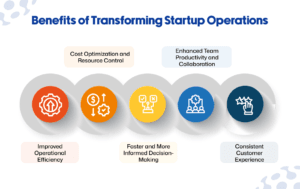
2. Cost Optimization and Resource Control
Operational transformation enables a startup to and track spending, allocate resources as needed and eliminate unnecessary layers of overhead. With centralized systems, founders get more visibility into how time, money and people are being spent.
3. Faster and More Informed Decision-Making
With real-time data and analytics, leadership teams can respond rapidly to market shifts. ML-based insights enable even better forecasting and performance tracking, meaning that you no longer will be forced to react to issues—proactively take care of significant problems instead.
4. Enhanced Team Productivity and Collaboration
Integrated systems improve communication between departments and remote staff. Coworking tools preserve information fidelity and keep everyone on the same page as your organization scales.
5. Consistent Customer Experience
Just enough process creates predictable service. By way of automated workflows or AI-enabled chatbots, startups can provide timely and consistent engagements which is critical for building trust with users.
How Aqlix Helps Startups Transform
Aqlix serves digital transformation services tailored to business needs. The emphasis is on developing, systems that support scale and growth without being bloated.
By developing custom software, cloud integration and AI solutions, Aqlix assists startups in simplifying operations and increasing transparency. This includes using automation, ML-powered analytics and chatbot solutions to improve efficiency and responsiveness.
Finally, Aqlix is designed for long term adaptability, to keep systems in place even as startups grow.
Conclusion
Grow at warp speed isn’t the end-all for scrappy startups. It requires well-defined processes, dependable technology and an intelligent approach to decision-making. Startup will scale better with less chaos If digital transformation is all set up correctly, it’s the perfect platform to let startups scale out of control without losing manuscript or clarity.
With the right tech consulting, automation and Smart Software Solutions to move your business forward, startups can overcome operational hurdles and lay a foundation for sustainable growth. Aqlix IT Solutions provides early stage founders with the tools and approaches they need to tailor performance to meet long-term business objectives.
Frequently Asked Questions
What are startup operations?
Startup operations involve the functions, systems and assets that a company needs to function on a daily basis. This includes workflows, team alignment, technology systems and customer support processes.
Why Digital Transformation is Necessary for Startups?
It is the digital transformation that allows startups to leave behind their manual operations and replace them with scalable systems. It boosts efficiency, data exposure and flexibility - all good things when you have to find a way to manage growth and competition.
In what way does automation benefit startups?
Automation eliminates repetitive work, decreases mistakes and increases uniformity. It lets teams focus on higher value activities, while it keeps them accurate in operations.
Would AI support growth of startups?
AI- ML, chatbots Do they deliver predictive insights, automating interactions or improving decisioning? Startups use these tools to operate more intelligently as they expand.
What is the role of Aqlix in enabling operational scaling?
Aqlix is a technology consulting, bespoke software design and digital transformation practice. The methodology centers around scalable, secure systems that scale with startup growth ambitions.