

Manufacturing environments are within accuracy, velocity, and flexibility are essential for competition. Whether you are managing shop floor production or supply chain coordination, all of it requires accurate data and real-time visibility. Given their rigid architecture and high cost of implementation, traditional ERP solutions do not evolve with changing manufacturing needs.
Modern manufacturing ERP solutions on Oracle APEX offer an agile & scalable alternative. Manufacturers can customize the ERP system to their needs with low-code development that aligns with production processes, inventory management and quality control. Hereby organizations can decrease complexity whilst increasing operational efficiency.
Manufacturing ERP Challenges Today
Conventional ERP platforms bring with them several operational and system-level challenges for manufacturers. The systems themselves are often built on rigid, inflexible frameworks.
As manufacturing of the future evolves towards digital transformation, businesses are requiring ERP systems that seamlessly encompass production data and analytics as well as automation. Operational bottlenecks and inefficiencies continue to grow without modernization.
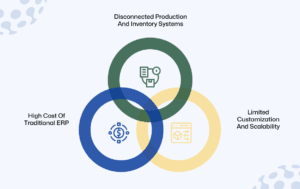
1. Disconnected Production And Inventory Systems
Manufacturers often have siloed systems for production planning, inventory tracking, procurement and quality control. Isolated platforms decrease department visibility and cause data discrepancies.
Low levels of inventory, long lead times, and poor information exchange among plant operating systems can cause stock shortages or unexpected overproduction. Integrations slow down decision-making and increase operational risk. A manufacturing ERP is integrated into all the modules, based on Oracle APEX data.
2. High Cost Of Traditional ERP
Legacy ERP applications typically translate to costly subscription licenses, development cycles that in some cases take years and extensive customization expenses. Upgrades are complicated and all-consuming to existing work.
Standard ERP implementations involve dedicated development resources and configuring tedious processes. This can hinder agility, particularly as mid-sized manufacturers strive for transformation in the digital age.
Oracle APEX focuses on a low-code ERP development process, eliminating the need for heavy coding, and still maintains true enterprise-grade reliability. It permits implementation faster and scaling more cost-effectively.
3. Limited Customization And Scalability
Many out-of-the-box ERP platforms offer standardized modules that do not align well with specific manufacturing workflows. Customization can be costly and technically limiting.
As manufacturing operations grow, legacy ERP systems do not scale well. It gets tricky adding new production lines, warehouses, or automation processes.
With Oracle APEX, it is possible to create a modular ERP design that serves as a scalable business solution.
Oracle APEX For ERP Development
Oracle APEX For ERP Development. Build Secure, Database-Driven ERP Applications on the Low Code Platform. Aqlix makes manufacturing more flexible and scalable. Declarative tools and Oracle Database durability.
Rapid ERP Development With Low Code
- Minimizes manual coding with built in forms, dashboards and workflows
- Faster ERP Deployment and Reduced Time-to-Market
- Helps enforce iterative improvements and phased rollouts with little impact
Seamless Integration
- Integrate third-party services and IoT through REST APIs.
- Integrate analytics and AI systems with ERP modules.
- Ensures data is managed in a consistent and centralized manner.
Secure And Scalable ERP Architecture
- Enterprise security- restrictions via authentication and role based access.
- It makes sure that the data is encrypted and the database is secure.
- Scales with increasing transaction volume without sacrificing performance.
Implementing Manufacturing ERP Using APEX
A manufacturing ERP implementation approach should do so along the lines of organized workflows. Oracle APEX is flexible but may lead to pain in the absence of a clear strategy and execution. With a proper roadmap established, ERP modules can meet production demands without compromising scalability or performance.
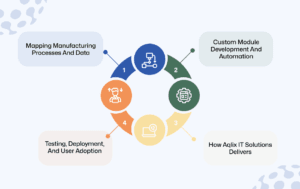
1. Mapping Manufacturing Processes And Data
This boosts the ERP implementation process, which starts with working on creating a map for the production workflow along with supply chain processes. To get started, better accuracy and less redundancy is achieved by identifying the data sources, followed by transaction flows and reporting needs. Having the mapping clear will also ensure that inventory, procurement and production scheduling complement one another.
2. Custom Module Development And Automation
Oracle APEX solutions for other domains provide support for custom modules of production planning, material management, maintenance, and quality control. Automation such as workflow triggers and warnings has built-in automation. The integration of machine learning allows predictive maintenance and smarter forecasting.
3. Testing, Deployment, And User Adoption
Testing at various levels to make sure it is reliable and secure before deployment. Gradual rollouts minimize disruption. Avenues for training and feedback aid in user adoption as well as sustained improvement of the system.
4. How Aqlix IT Solutions Delivers
Aqlix IT Solutions focuses on delivering secure, scalable Oracle APEX ERP systems tightly coupled with operational objectives through a mix of low-code systems and organized architecture.
Conclusion
The good news is Oracle APEX provides an alternative solution via low code development, secure architecture and powerful integration capabilities. Manufacturers are empowered to create systems built for long-term growth through accurate mapping of processes, modules customized specifically for their business and machine learning and automation.
When implemented in a structured manner and with continuous optimization, Oracle APEX can help manufacturers build cost-effective, future-ready ERP solutions that are outfitted to their operational landscape.
Frequently Asked Questions
What is the role of Oracle APEX in modern manufacturing ERP?
Oracle APEX for Manufacturing ERP Systems It provides fast low-code development in conjunction with Oracle Database for high security and performance. Manufacturers can customize modules for production, inventory management, procurement and quality control with real time visibility within one administration layer.
Why is Oracle APEX suitable for manufacturing ERP development?
APEX is a fit here, as it enables fast end to end low code development while leveraging Oracle Database security and scale. Manufacturers can have modular ERP designed with respect to each production, inventory and quality workflows. It has integration capabilities that enable real-time data access and enterprise-level performance needs.
How does low code improve ERP implementation timelines?
Low code minimizes traditional imperative programming through declarative tools and reusable components. This speeds up development, testing and deployment of your modules. From an ERP perspective, this lets manufacturers roll out features in increments, so they adapt more quickly to operational needs while keeping the system stable and secure.
Can Oracle APEX ERP systems integrate AI and IoT technologies?
It means that it can communicate with any AI or ML models and IoT devices through APIs or direct linking on the DB. This enables applications such as predictive maintenance, demand forecasting and real-time production monitoring. This integration enables better decision-making and enhances advanced automotive automation strategies.
How secure is an Oracle APEX-based manufacturing ERP system?
ERP systems built with Oracle APEX benefit from enterprise-grade security features provided by the underlying Oracle Database (authentication controls, role-based access, data encryption). Manufacturing organizations serving a department and securing locations with security must ensure the user-level permissions, audit trails, and compliance for sensitive operational data.