

Organizations are experimenting with the use of AI in productivity and decision-making. However, conventional generative AI tools typically do not address the long-term competitiveness issue. They are not usually fused with proprietary business data and they are generic models built for general use cases.
Enterprise is past generative AI experimentation and moving to unique generative AI architectures. Then these systems are trained or fine-tuned using internal datasets and custom workflows. By aligning AI models with business goals, businesses can not only automate complex actions but also improve operational accuracy and provide a measurable return on investment.
Why Custom Models Outperform General AI
Desktop source has useful functionality, as do generic AIs, which are not precise enough for enterprise use. This limitation can be overcome by building custom generative AI systems that analyze business-specific data, workflows and goals.
1. The Limitations of One Size Fits All Public Models
Public large language models are trained on broad internet data and optimized to work across a wide range of different tasks. However, oftentimes they do not have the contextual knowledge for industry-specific processes as they are flexible.
These models can also generate mistakes known as hallucinations. In enterprise contexts, misinformation could impact compliance or financial decisions and operational planning. Furthermore, using public AI services can pose data security issues as sensitive data is processed out of the system.
2. Leveraging Proprietary Data as a Competitive Moat
Internal data is one of the precious resources that exists in any organization. Data sets are built from interactions with customers, operational records, and industry knowledge that your competitors cannot readily copy.
General AI models can achieve phenomenal results but with specific datasets, such as conversational logs or email threads, you can train custom generative AI models or fine-tune existing ones; in both scenarios the results will be much more viable. Machine learning systems that understand an organization’s data domains, its terminology and the relationships between entities can provide insights, predictions and recommendations actionable to the business context.
Ensuring Long-Term Success and Compliance
Effective governance, monitoring, and infrastructure planning are essential to the successful adoption of generative AI. For these enterprises, the challenge is to achieve innovation with accuracy, security and regulatory compliance.
1. Navigating Ethical AI Governance and Hallucination Management
Always verify the information generated by an AI for its accuracy and reliability. Data until October 2023: Human-in-the-loop workflows review output before affecting key decisions
Such governance processes help to spot hallucinations or unexpected responses produced by AI systems. By applying human/AI augmentation, organizations can ensure they maintain faith in the quality of machine-generated insights while reaping the benefits of machine learning automation.
2. Scaling the AI Infrastructure for Future Growth
Generative AI technology is of course developing at a whirlwind pace. Therefore, enterprises need to create a modular architecture that can evolve/adjust as newer models/frameworks are released.
Deploying scalable infrastructure enables organizations to incrementally upgrade models, increase datasets and integrate different capabilities like advanced analytics or conversational AI chatbots. Investing in scalable solutions now will ensure that AI investments won’t be wasted as technology inevitably advances.
Aqlix helps organizations build flexible AI blueprints that fit into the greater technology roadmap and dynamic business needs.
Actionable Steps for Custom AI Integration
The implementation of generative AI use cases does follow a structured process combining technical design with business case analysis. Integration should be a long-run capability rather than a short-run experiment for the organization.
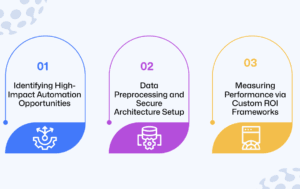
1. Identifying High-Impact Automation Opportunities
The first step is to Audit internal workflows for repetitive or time-intensive tasks Functions like customer service, finance, and operations regularly handle processes that are intensively manual.
Leveraged custom generative AI agents to automate the analysis of documents, generation of content and interpretation of data. By focusing on operational bottlenecks, organizations can enhance efficiency and decrease the time involved in regular tasks.
2. Data Preprocessing and Secure Architecture Setup
AI models must be trained on existing organizational datasets. Instead, it helps in cleaning, structuring and organizing data to ensure that it is accurate and can be used for different machine learning processes.
Building a secure architecture that protects sensitive data is another important consideration. Private cloud environments and controlled data pipelines offer complete control over data ownership while allowing AI systems to access relevant information efficiently and securely.
3. Measuring Performance via Custom ROI Frameworks
Once deployed, the measurement is a must for models. All organizations have to create metrics with which we can analyze the levels of productivity and efficiency one has achieved.
Common metrics are time to perform the task, execution accuracy, and reduction in resource costs. By monitoring these metrics, businesses can determine whether their AI solutions are delivering measurable value.
In our experience, a good ROI framework also drives enhancements and scaling of AI capabilities across clusters.
Conclusion
The promise of custom generative AI provides a real roadmap for companies seeking the return on their investments in artificial intelligence. Generic tools can be useful to experiment with, but custom AI systems yield better precision, assurance of data integrity and seamless end-to-end business process integration.
They can create a sustainable competitive advantage by leveraging structured workflows and performance metrics to derive operational value from AI initiatives in the long run, taking a holistic view of proprietary data. Join enterprises partnering with Aqlix IT Solutions to develop concrete frameworks for their AI development initiatives so that their internal data is turned into scalable solutions that facilitate innovation, efficiency and sustainable growth.
Frequently Asked Questions
What is custom generative AI in enterprise environments?
Enterprise generative AI is generative AI models trained on data and workflows similar to those of an organization. These systems are designed for specialized operational requirements, not public models. This results in greater accuracy, data privacy & security and enables organizations to leverage insights that cater better to the operation of internal systems.
How does custom AI improve return on investment?
AI application enhances the return on investment (ROI) by automating repetitive work at various stages, speeding up data analysis time and improving the quality of decisions. Since models are trained on company-specific data they give more relevant insights. This maintains process efficiency, lowers operational costs, and enables organizations to utilize resources efficiently across departments.
Why is proprietary data important for generative AI?
Proprietary data captures information about an organization’s specific customers, operations and industry. This information, when used to train AI models enables them to generate insights that competitors simply cannot produce on their own. This leads to a competitive advantage since the AI system is intimately connected with that organization’s unique environment and decision-making processes.
How can organizations reduce AI hallucinations?
It needs a structured governance and monitoring in place to reduce hallucination. Trial or manual processes, such as human-in-the-loop workflows, allow experts to evaluate outputs before they are used to assist business decisions. The approach may involve modifying training datasets, implementing validation rules, and testing models iteratively to deliver accuracy over a wide range of use cases.
What infrastructure is required for custom AI deployment?
Deploying your own AI typically requires secure cloud infrastructure, structured data pipelines and machine learning frameworks. Model performance should also be monitored, for which monitoring systems need to be in place. If implemented correctly, this architecture will allow your organization to scale its AI model while achieving the levels of security, data sanitization and operational reliability that are a necessity across all production systems.