

There is also the fact that many businesses are still running on reliable but outdated systems.” Mature applications, old databases and on prem infrastructure can retard innovation, limit customer experience and take up a larger portion of IT spend. Since digital markets change the rules quickly, it’s even more difficult to make legacy systems adapt, scale and interoperate with modern technologies.
Legacy modernization not only means throwing away old and ushering in new. It’s in transforming those outdated applications into valuable digital assets which increase speed, effectiveness and actionable business knowledge. When done intentionally, modernization becomes the launchpad for digital transformation because it allows your business to easily scale, secure, automate and innovate. It enables organisations to plan for the future while protecting businesses critical processes that are running now.
The Problem with Legacy Systems
Outdated Technology Legacy systems present both operational and financial obstacles that can prevent a business from growing. And while many companies still cling to them because they’re comfortable or time-consuming to replace, it gets costlier every year to keep maintaining ancient technology.
The primary challenge is the poor scalability. Legacy monolithic architectures were never intended to scale up or down quickly. As ‘increasing customer expectations and increasing demand outstripping the capacity of their existing (legacy) indexes’.
Then there’s the financial toll over the long term. With estate applications there is a requirement for specific support, manual maintenance of updates and a continuous investment in time to maintain. Organizations, as time goes by, spend more money on their legacy environments running than innovating the business.
Security and compliance concerns only grow with age. Insecure software, unpatched vulnerabilities and inflexible architecture make legacy systems top targets for cyber adversaries. Also, the more old school your environment gets, the harder it is to integrate new age technology and cause ineconomies of scale that can have a negative effect on data quality and customer experience.
What Is Legacy Modernization?
Application modernization involves updating older platforms by integrating them with new applications, either within the cloud or other environments. The goal is to keep that essence of traditional and oldworking systems, but make them faster, flexible and last longer.
In essence, modernization connects technology and the business strategy. It exchanges inflexible edifices for evolveable digital platforms that can scale and develop in lockstep with market requirements. Designed as an open, modern alternative to monolithic systems, new offerings such as cloud migration, integration through APIs and microservices architecture enable organisations and developers build modules for the future.
The other facet of modernization is transforming stagnant siloed data into actionable intelligence. By combining legacy systems with analytics tools and cloud platforms, organisations can operate based on up-to-the-minute information and not by internal reports or manual extraction.
For many organizations, modernization is seen as the launching pad for digital transformation. It enables businesses to streamline its processes, automate those manual tasks that have previously clouded operations and integrate the cloud computing efficiency without destroying the fundamental systems which underpin how an office works for years.
Key Approaches to Modernization
Legacy modernization has no one-size fits all approach. There is no one-size fits all approach every organisation should have a strategy that’s based on budget, risk appetite and their operational priorities. The most common approaches include:
1. Rehosting (Lift and Shift)
This means rehosting: click and move to the cloud. It’s also one of the quickest ways to increase performance and decrease infrastructure costs. Functionality hasn’t changed but the power, availability and reliability of the solution are exponentially better thanks to the cloud.
2. Replatforming
Replatforming changes only some aspects of the system so they are better suited to cloud services and scaling. It brings targeted upgrades, like managed databases or containerization, to an existing application without completely rewriting the app. This method considers both the cost and improved performance.
3. Refactoring
Refinement is the optimization of design, in terms of internal coding details and not essential system features. The aim is to enhance flexibility, performance and maintainability. Refactoring enables to pay back the debt of technology, enhance scalability and assimilate new development practices by an organization.
4. Rebuilding
Reconstruction is the most extreme approach to innovation since it involves a total redesign of the system with modern techniques. While the investment needed is greater, rebuilding provides you with the best long-term value in terms of a better user experience, more automation options and digital transformation strategy.
Both carry their advantages and it very much depends on the maturity of the organisation and its priorities. The correct approach is one that helps drive business now and allows growth in the future.
Business Benefits of Modernization
Modernizing the Legacy Systems not only creates immediate but long-term value for all business operations.
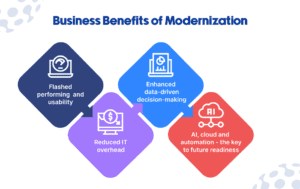
1. Flashed performing and usability
Today’s systems improve the speed of applications, minimize downtime and streamline the users’ experience for your employees and your customers. Higher performance means higher satisfaction, morale and productivity.
2. Reduced IT overhead
Abandoning old hardware, manual updates and specialized support cuts operating expenses by a big factor. This flexibility enables organisations to redirect budget towards innovation, rather than maintenance activities.
3. Enhanced data-driven decision-making
Live insights, predictive analytics and streamlined reporting are just some of the features on offer thanks to contemporary platforms. Rich, trustworthy data leads to better insights at operational and strategic levels.
4. AI, cloud and automation – the key to future readiness
The systems of today also easily connect to AI-based tools, automation workflows, SaaS products and cloud platforms. In doing so, technology investments can deliver value today and adapt to the changing requirements of business.
These benefits demonstrate why we can’t view modernization as a technical upgrade, but rather as a strategic investment that influences the long-term direction of an organization.
The Significance of Technology Consulting and Digital Transformation
Obsolete legacy is often complicated due to processes that are decades old, custom logic and fragmented systems. This is why so many organizations engage technology consulting partners who can map data flows, develop modernization roadmaps and mitigate risk.
Digital modernization and legacy transformation go hand in hand. Whereas modernization refreshes aging systems, transformation unlocks new revenue opportunities by enabling automation, cloud computing, analytics, and digital workflows. When the two are aligned, companies drive efficiency, accelerate development, and innovate technology that scales across new business models.
Aqlix IT Solutions helps organizations on this journey by providing out of the box modernization policies focused on performance, user experience and scalability over time.
Conclusion
In a world where legacy can be turned on its head. With the right modernization approach, they are capable of being assets that help business defences and provide long-term value. Modernization means more than new technology. It allows companies to mitigate operational risks, use scalable infrastructure, develop data-driven workflows and remain competitive in a fast changing market.
With a methodological approach in place, Aqlix IT Solutions supports organizations to update outdated infrastructure that matches with business objectives. Aqlix is the enabling platform for outdated to world class digital environments.
Frequently Asked Questions
Why should organisations modernise legacy systems?
Legacy modernization reduces cost of ownership, improve performance and enable the mainframe to coexist with new emergent technology.
Is it necessary to throw the baby out with the bathwater when modernizing?
Not always. Methods like rehosting, replatforming and refactoring give organizations a way to modernize systems without having to completely rewrite them.
What is the greatest risk of maintaining past systems?
Legacy systems are more expensive to maintain, expose security vulnerabilities and hold back the company’s ability to innovate and scale.
How long does it take to modernize?
The timelines differ depending on the complexity of the system and the adopted approach. “When we do a sit-down consult, it’s about setting some reasonable goals and figuring out what your priorities are.
Can modernisation underpin digital transformation plans?
Yes. Modernization is the building blocks required to support cloud, automation, data driven decision making and scalable business growth.