

Low-code development platforms are transforming the way businesses create, deploy, and deliver applications. Rather than relying exclusively on monolithic code-rich development cycles, organizations can now develop apps built securely and at massive scale to be data driven much faster. Oracle APEX is one of the oldest low-code platforms, which not only can meet high-scale enterprises’ needs but also brings about agility and innovation.
In this blog, you will see how organizations can not only utilize low-code solutions with Oracle APEX successfully but also extend their use into the future in support of digital transformation goals.
What Is Low-Code Development?
Low-code development is a software-creation technique that reduces the need to write traditional code line by line, instead relying on visual interfaces, prefab templates and re-useable components with automatic logic. It facilitates better collaboration between developers and business users in the development of an application.
With drag and drop components, pre-defined modules and applications teams can build quickly and not compromise quality. Low-code platforms are designed for incremental enhancements, so applications can be more easily modified as business requirements change. This method also minimizes reliance on big development teams, allowing organizations to more efficiently leverage resources and speed time-to-innovation.
Why Oracle APEX Is the Perfect Low-Code Platform
It’s taking the same approach to obfuscate or change anything when it comes to Oracle APEX. Its seamless integration with the Oracle Database allows for maximal performance, scalability and data integrity without compromises that make it the ideal choice for all enterprise applications.
The platform is cloud ready and can be deployed on-premise, hybrid or in the cloud. Oracle APEX A collection of pre-built components including interactive reports, dashboards, forms, and charts span the spectrum of development time.
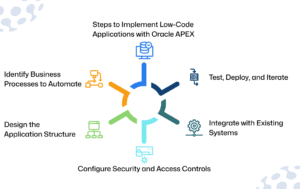
Steps to Implement Low-Code Applications with Oracle APEX
Code written with responsive design means applications are device-agnostic, while modern web standards aid in sustainment in the long run. Here are the following steps to implement low code applications with oracle apex:
Identify Business Processes to Automate
The reason most low-code efforts fail is that the people behind these initiatives didn’t first pick the use case or process where automation will provide maximum value.These are things like approval workflows, reporting systems, operational dashboards and internal tools that are predominantly dependent on structured data. Understanding the workflows and having clear goals help to prioritize use cases that can have a real impact.
“By strategically tying the goals of an application to business outcomes, organizations can have more confidence that their low-code initiatives provide them with bite-size chunks of tangible value and not simply one-off tools.”
1. Design the Application Structure
With Oracle APEX making it possible for app layouts, data models, and user interactions to be described visually. Developers can easily design forms, reports and dashboards on the fly adding declarative input / output settings rather than writing tons of hard crap. This provision describes application-level usability, data flow and logical structure that is necessary to support current and future needs.
Well-architected desigsn also facilitates future maintainability, and the addition of AI-based features such as chatbots or analytics dashboards that draw from machine learning models.
2. Configure Security and Access Controls
Security is an important consideration in enterprise application development. Oracle APEX has an innate support for authentication, authorization and session management. Somehow, the role-based access control restricts access to appropriate data and functionality only.
Effective security setup minimizes your compliance risk and meets governance needs especially for sensitive or regulated data industries.
3. Integrate with Existing Systems
Low-code apps usually require integration with ERPs, CRMs, or third-party systems. Oracle APEX integrates REST APIs, we services and data bases, as well how to do any integration with all external systems running in the company. This enables companies to add features without reworking processes in place.
Integration as well supports sophisticated use cases like integrating AI services, LLM-based analytics or conversational interfaces into operational applications.
4. Test, Deploy, and Iterate
It is to ensure that applications work properly and have performance and security requirements. Oracle APEX provides rapid iteration cycles so teams can test new features early and capture user feedback. The process of deploying is simplified by integrated support for version control and environment management.
Regular iteration makes it possible for the company to hone applications and use them in a way that keeps them working well with current needs.
How Aqlix IT Solutions Supports Low-Code Development
Aqlix IT Solutions provides the necessary resources and tools to help organisations who are considering low-code development using Oracle APEX. Through tech consulting, the businesses get to know which of their operations are best applicable for low-code automation and how these initiatives will satisfy the overall digital transformation motives.
Oracle APEX development Custom Oracle APEX applications are built for your operational needs, instead of being set in fixed templates. Aqlix additionally comes with system integration, security settings and performance tuning backed for scale and reliability. Continued support and optimization enable organizations to evolve applications over time as business requirements and technologies shift.
Advantages of Low-Code Oracle APEX Deployment
Oracle APEX Low Code Development brings focused gains across the enterprise to life. Accelerated development cycles shorten time-to-market, which allows teams to react promptly to operational issues. Reduced development and maintenance costs can enable you to maximize your IT budget without sacrificing quality.
IT and business working together is also better as low-code platforms really makes the application logic transparent and understandable to everyone. Oracle APEX-based apps are naturally scalable and maintainable, minimizing technical debt for a sustainable future.
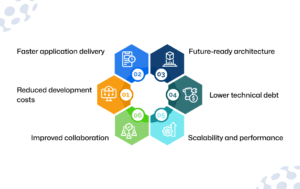
- Faster application delivery: The declarative development and reusable components makes it faster to develop new features with shorter turnaround time for releases/updates.
- Reduced development costs: Lower manual coding reduces the amount of resources required and the long-term maintenance cost.
- Improved collaboration: Business stakeholders can become more involved in application development, focusing applications to their operational requirements.
- Scalability and performance: Oracle Database-based applications inherit enterprise-grade scalability and robustness.
- Lower technical debt: Developers and maintainers can focus on building and improving features, while standardized parts enable your application to scale in size and complexity without becoming unmanageable.
- Future-ready architecture: Oracle APEX allows integration with APIs, Analytics, AI services, bots, and LLM based tools.
Common Challenges and How to Overcome Them
Though no-code provides many benefits, companies can face issues when trying to roll it out. Governance is crucial in order to keep the quality of and compliance with the applications consistent. Having clear guidelines and review processes established both helps keep things under control.
Integrating low code application solutions with legacy systems can also be complicated. Careful architecture, API and data management considerations mitigate this risk of the integration. Role Management, Encryption and Auditing practices must be proactively put in place to secure and achieve compliance on enterprise data.
Conclusion
With Oracle APEX, businesses of all sizes can now quickly develop and deploy applications using a low-code tool that is powerful, scalable, and secure. Low-Code For Simplifying Development and Collaboration Low-code platforms help companies streamline digital transformation by simplifying development. With Aqlix’s expertise, clients can implement Oracle APEX applications that are tailored to their strategic goals, seamlessly linked to current systems and solutions, and add long-term operational value.
Frequently Asked Questions (FAQ)
What kind of applications can we build using Oracle APEX?
Oracle APEX can be used to build dashboards, workflow systems, reporting applications, internal portals and data-centric apps for business that are focused towards application builder.
Can Oracle APEX be used by large businesses?
Yes, Oracle APEX is built on top of Oracle Database supporting Enterprize Grade security, Scability and performance.
How does low-code drive down the cost of development?
Low-code eliminates the need for manual writing of code, shortens development cycles and lowers testing and maintenance allocation, which results in overall costs reduction.
Is it possible that Oracle APEX be integrated with AI or LLM kind of tools?
API Integration Oracle APEX integration with AI services, analytics platforms and even conversational interfaces has been made available.
How does technology consulting factor into the acceptance of low-code?
Technology consulting partners help broker the right alignment between low-code initiatives and business objectives for a sustainable, scalable and suitably governed implementation.