

Today’s consumers demand instant responses, tailored suggestions and uninterrupted support 24/7. Even if it is a traditional team of humans, it can be expensive and because humans take longer to respond, the opportunity could be lost.
Instead, organizations are evolving from simple FAQ-scripted bots to conversational AI agents that understand customers’ intent and sentiment, as well as their entire journey. This unified AI chatbot strategy helps businesses find a solution that bridges lead generation, sales conversion, and post-buy experience. These systems, powered by artificial intelligence, increase efficiency, standardization and customer interaction at all levels.
Why AI Conversationalists Are Vital
The AI chatbots of now are no longer our simple assistants, but rather strategic tools that amplify customer interactions and deliver measurable business value. Not only this, conversational AI helps enterprises with real-time actions, contextual solutions and strive for optimal support operations without overwhelming human teams.
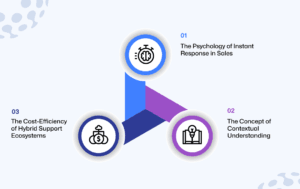
1. The Psychology of Instant Response in Sales
When a prospect is in the moment of highest intent, immediate engagement dramatically increases productivity now more than ever. AI chatbots can answer questions in real time, collect leads, and nurture leads through the pipeline. These agents deliver prompt resolutions of queries, they fill in the gap to prevent drop-offs and ensure potential customers are engaged with your business.
2. Beyond Templates: The Concept of Contextual Understanding
Today’s chatbots rely on natural language processing (NLP) and machine learning techniques to give a more contextualized understanding of user queries that go beyond the usage of keywords. Unlike template-based bots, these AI agents understand sentiment, context, and nuance to offer human-like responses that have actual meaning. As a result, they are capable of quickly generating brief queries and multi-turn dialogues.
3. The Cost-Efficiency of Hybrid Support Ecosystems
By automating common inquiries, AI chatbots free human agents to devote their time and effort to high-value work. Standard inquiries (70–80% for the most part) will be able to INSERT automatically, lowering operating costs and improving service quality. Hybrid ecosystems combine the efficiency of AI with the empathy of humans, allowing for scalability without sacrificing customer satisfaction.
Measuring Results and Avoiding Pitfalls
Integrating AI Chatbots: Focus On Measurable Outcomes & Thoughtful Implementation To optimize ROI, enterprises need to set key performance indicators and retain human oversight.
1. Defining KPIs for Chatbot ROI and User Satisfaction
Important metrics include FCR (first contact resolution), average response time, bot-assisted revenue, and customer satisfaction scores. In monitoring these KPIs to ensure that AI deployments are making a positive contribution towards operational efficiency, lead conversion and overall organizational objectives. For generations, we measure performance on a scale that allow us to improve AI over time.
2. Avoiding the Bot-Loop and Seamless Human Handoff
A classic mistake is getting stuck in a bot loop that leads to nowhere. Good AI strategies embed clear escalation pathways into human agents. Seamless handoff preserves trust, takes care of handling questions that are complex and ensures the right mix between automation and human knowledge. This makes user experience as well as operation convenient.
Deploying High-Performance AI Agents
Integrating them with enterprise systems and using chatbots at multiple touchpoints is necessary to realize the full potential. Strategic planning will help to make sure that the bot aligns with sales, marketing and support goals without compromising on customer experience.
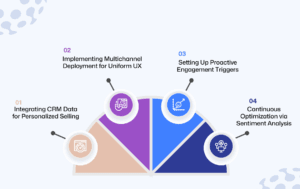
1. Integrating CRM Data for Personalized Selling
AI chatbots linked with CRM databases gain access to historical purchase details, account information, and likes/dislikes. This enables personalized product suggestions, preemptive offers, and contextual responses. Models using machine learning sift through past interactions to identify the very best sales suggestions and potential conversion. Integration strategies for enterprise systems are available from resources such as Aqlix AI development.
2. Implementing Multichannel Deployment for Uniform UX
The new-age customers engage over web, mobile, social media & messaging apps. AI brain shared across channels creates consistent brand voice and unified customer experience. Having (knowledge) centralized across the organization makes it easier to avoid mistakes, aggregates data points and makes analytics easier to see what you can improve on in your customer interactions.
3. Setting Up Proactive Engagement Triggers
Active involvement assists in reclaiming lost sales. Chatbots can be set up for exit-intent notifications, cart abandonment or delayed viewers. Triggered messages promote commitments (like completing a purchase) or offer help during times of high consideration, and they ultimately improve conversion rates and reduce churn with very little human transaction required.
4. Continuous Optimization via Sentiment Analysis
Enterprise are using AI-driven sentiment detection to analyse chat transcripts for trends of frustration, satisfaction and engagement with their customers. This kind of real-time feedback helps in fine-tuning responses, updating conversation scripts and also training ML models to be more accurate. Continuous optimization results in higher user satisfaction and better sales.
Conclusion
Now, AI chatbots are crucial to scalable sales and support efforts. By synergizing conversational intelligence, machine learning-based personalization, and multichannel deployment, enterprises can drive enhanced conversation rates, increased customer experience, and steered operational efficiency.
At Aqlix IT Solutions, we work with enterprises to design and build custom AI chatbot solutions that are integrated into existing systems for 24-7 engagement and tangible business value. Who you will meet: Aqlix | Smart Bot Automation
Frequently Asked Questions
What are AI chatbots and how do they work?
In a nutshell, artificial intelligence chat bots are intelligent virtual assistants that use natural language processing (NLP) and machine learning to match user intent. They can answer automatically, make personalized suggestions and handle complex multi-turn conversations transforming sales and customer support workflows as they do so like never before.
How can AI chatbots increase sales?
With the help of AI chatbots that engage prospects in real-time, direct them throughout the buying journey, and recommend products to consumers based on historical data These bots drive conversion rates up, and accelerate the sales funnel by inducing proactive outreach during high-intent moment, and decrease drop-offs.
What role does sentiment analysis play in chatbots?
Sentiment analysis enables chatbots to identify customer emotions and tailor their responses. With the help of sentiment analysis, based on whether the sentiment is positive, neutral or negative, it can decide which approach to follow during interaction with customers through bots acting empathetically in case if there is a negative feedback and asking them to reach out human agents.
Can AI chatbots integrate with CRM systems?
Yes. By combining chatbots with CRM systems, access to customer history, account data and preferences is possible. This enables room for personalized interactions, tailored offers, and data-backed recommendations. Integration enhances sales effectiveness, customer experience and enables predictive analysis for deriving business insights.
How do businesses balance automation and human support?
Approaches that work include answering easy questions with AI and forwarding out complex or sensitive cases to humans. Auto Escalation Paths, Real time Monitoring and Hybrid Ecosystems help to drive where Automation increases productivity but not at the cost of quality and Customer Satisfaction.