

Enterprise technology has changed a lot since then, with physical servers and on-premises systems being displaced in favor of dynamic and digitally connected cloud environments. On-prem Traditional on-premise was once the mainstay of enterprise infrastructure- providing full ownership and control, but also the maintenance, hardware refreshes, floor space, capital investment. Millions of jobsI know not but many more millions of people clinging on to a false premise that such need for office space would always persist (it won’t). Cleaning contracts are already being renewed in the short term, but technology requirements have grown and companies have globalized—including requesting solutions which flex more readily than real estate and operate independent of borders.
The move to cloud computing is now considered a matter of strategic necessity, rather than technological convenience. Adopting the cloud is in line with the necessities of modern business, which is operationally flexible, scalable at will, data mobile and innovation cycles faster. The shift is representative of a broader trend in Digital Transformation, where tech enables both long-term planning, agility and growth.
Getting to grips with the On-premise vs Cloud Model
Before jumping on the bandwagon of deploying new infrastructure, it helps to know how traditional in-house systems differ from cloud based settings.
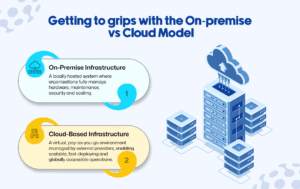
On-Premise Infrastructure
On-premise systems are those which use servers and other equipment that is placed in a company’s office or private data center. The firm takes on installation, maintenance, updates, backups and security. While this model provides total control and assures data in secured dedicated hosting; it requires a large initial capital, maintenance around the clock, and specialized personnel. Scale is hampered as any increase in size requires new hardware procurement and deployment.
Cloud-Based Infrastructure
Virtual servers that are hosted/managed by a third party; Cloud infrastructure. This model is also pay-as-you-go, to help business scale its resources for need, without heavy capital outlay. Cloud-based platforms also enable fast deployment and global access, which simplifies remote collaboration and the management of distributed teams. 3.Offloading of operational workloads When businesses invest in managed services, their effort simplifies and enables focus on core development, innovation, strategic planning and such factors that define future of the enterprise.
Cloud adoption is tightly correlated with the new Cloud Apps & Mobile Apps Dev trends, particularly when applications require real-time access to data and integration needs, as well as rapid release cycles.
Key Factors Enabling the Cloud Shift
Several industry, technology and operational trends have accelerated the shift from on-prem to cloud. Here are the best known drivers.
1. Remote Work and Global Accessibility
Employee collaboration and resource access in digital workplaces are distributed over different locations. The cloud uses the Internet to break down natural barriers and create secure authorized-based access. “There are plenty of startups that now rely on freelancers and distributed workforces.” This is also conducive to flexiwork arrangements, global operations and offshore teams.
2. Cost Optimisation and Operational Agility
Cloud platforms can save upfront capital costs and move technology spending toward operating budgets. Arbeit und Infrastruktur wird nach realen Verbräuchen skaliert. Operational agility is enhanced by its ability to test, deploy and roll out applications without being required to wait for new hardware provisioning.
3. Security Advancements and Compliance Features
Cloud vendors provide state-of-the-art out-of-the-box security including encryption, authentication and identity access control, Automatic Security updates to name a few that are relevant for most of clients and compliance certificates. While all systems carry risks, modern cloud protections and safer models available to us are increasingly meeting the requirements of regulated industries.
4. Integration with Emerging Technologies
Integration with AI, automation, IoT, advanced analytics and machine learning models is supported on cloud platform. These integrations are the basis of today’s digital transformation efforts, where systems create value beyond simply functioning properly.
Benefits of Cloud-Based Infrastructure
The cloud has long term strategic as well as operational benefits. Some key advantages include:
1. Scalability on Demand
Cloud resources are elastic, and so can be scaled as an organisation’s demand tightens or loosens. It’s helpful in seasonal demands, fast-growing businesses, and And) organizations with short testing windows. By trying to bring in scalability with the help of companies like Aqlix IT Solutions, you can ensure that your development path stays secure from resource constraints while workloads grow.
2. Streamlined Backups and Disaster Recovery
Cloud provider has built-in data backup and redundancy features. Data is distributed on many servers and accessed without problems in case one or several of them fail. This mitigates the risk in business continuity and reduces the downtime.
3. Minimal Maintenance for In-House IT Teams
Cloud Providers are not the sole defenders of those IT swamp Creatures When you leave your system operation to Cloud Provider, and in return free up your own team to do productive work geared for value such as process improvement, shift planning, automation and innovation, as opposed to maintenance.
4. Faster Innovation and Collaboration
Cloud providers have developer tools, test environments, and deployment pipelines that speed your products into market. This enables cross-discipline collaboration and reduces time-to-market for digital products and applications.
Challenges and Considerations
Switching to cloud infrastructure also needs planning, risk evaluation and well planned execution. Read more Below are some commonly known challenges to consider.
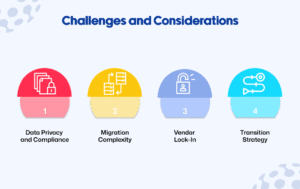
- Data Privacy and Compliance: Enterprises need to stay in line with local and global data regulations. This includes residency of data, security and how such services can serve a specific industry.
- Migration Complexity: Migrating workloads from on-prem to the cloud means assessing your applications, mapping data, reviewing compatibility and testing. Migration needs careful planning, with progressive deployment, and quality control and rollback plans.
- Vendor Lock-In: There might be a cloud-lock effect, where there’s customer lock-in to a single cloud provider. See how a multi-cloud or hybrid deployment strategy can mitigate risk and provide operational flexibility.
- Transition Strategy: Public, private, hybrid and multi-cloud selection depends on security requirements, industry regulations you may need to follow of where the data is stored, but also how much data you have and what scalable in handling that data will be needed in the future. The practical planning helps to ensure the sustainable use and prevents precipitate action.
The Future of IT Infrastructure
Next generation IT As an organisation our IT future is smart decentralised, automation-focused. There will be a continued trajectory to systems that are designed to be flexible, integratable and data-informed decision support. Emerging trends include:
Serverless Computing: With serverless models, developers write applications withouth having to worry about infrastructure. This speeds development up, and accelerates tests.
Edge Computing: Edge computing allows to process the data nearer to the source which is suitable for real-time applications like Internet of Things (IoT), health monitoring, autonomous system and industrial automation.
AI-Integrated Cloud Services: Cloud vendors have rolled out AI-enabled services capable of automating monitoring, predicting resource needs, detecting incidents and analyzing performance. This feature contributes to long-range planning for operations.
Organizations that anticipate these changes will gain advantage in innovation-led growth. The next decade of infrastructure is about efficient, decentralized systems with a digital-first architecture.
Conclusion
The reasons behind the shift from On-premise to Cloud Infrastructure are the need of flexible, secure, scalable as well as innovation-integrated systems. Cloud Computing and the role of Digital Transformation Cloud adoption enables Digital Transformation, because public clouds provide integration options due to more formalized with API’s faster go-to-market bring cost management based on real usage enable access from anywhere in the world.
And here’s where Aqlix has the capability to meet an organisation’s cloud-empowering tech-ready environment, the platform for collaboration, continuity and future digital ambitions can help. The next era of infrastructure is in platforms that merge resilience and agility to allow businesses to stay ahead, not just keep up with the market.
Frequently Asked Questions
Is the cloud services good for small and medium firms?
Yes there are cloud infrastructure options for startups, SMEs and even big business. It all really comes down to what’s the requirement, loads on data and future scale ideas.
Can companies deploy on-premise and cloud?
Hybrid models are commonly implemented and provide organizations with the flexibility to balance performance, compliance and investment planning.
What are the cost implications of cloud infrastructure?
Cloud models convert capex to opex. Price applied on storage, computing, licenses, consumption, integrations and monitoring. Benefits such as auto-scaling and resource optimisation can prevent over-provisioning, which further reduce ongoing costs.
How will the shift to cloud be instrumental in facilitating enduring digital transformation?
Cloud infrastructure enables businesses to access sophisticated technology such as automation, analytics, IoT and AI. It improves collaboration, accelerates time to market for products and provides a foundation for digital operations at scale.