

While businesses may be adopting large language models and automated decision systems, they also bring new security risks that traditional defenses lack the tools to address. Prompt injection, data poisoning, and model exploitation methods can perform adversarial attacks on AI systems.
Those reasons have put pressure on companies to adopt adversarial robustness, a concern that emphasizes the integrity of models and securing sensitive data. A written-out AI security framework makes sure that the intelligent system stays trusted and safe in operation, and also such systems are aligned with business goals. For this transformation, state-of-the-art secure AI architectures are available in the modern digital environments, and modernization-only solutions such as Aqlix provide them.
Understanding the New AI Threat Landscape
AI systems are fundamentally different than traditional software, bringing new types of security challenges. Now threats are directed not only at the infrastructure but also at the behavior and decision-making logic of machine learning models.
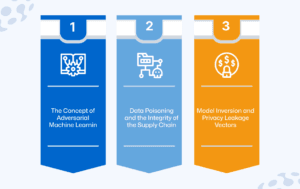
1. The Concept of Adversarial Machine Learning
Adversarial machine learning is based on altering the input data in order to change the ML algorithm’s behavior. Attackers send data into the system that looks perfectly ordinary but is in fact an effort to elicit erroneous or damaging outputs.
These attacks can target any kinds of model types, starting from classification models and recommendation engines to natural language processing models. Adversarial techniques help developers engineer systems that are able to recognize and resist manipulations, making models more reliable.
2. Data Poisoning and the Integrity of the Supply Chain
Data Poisoning: This is when adversaries inject malicious or misleading data into training datasets. Because the core idea behind machine learning models is based on producing accurate results from data, unstable datasets could adversely affect the productivity of a model.
We’ll cover risks from third-party data sources and supply chains. Because of this, data validation, secure sourcing, and ongoing monitoring must also be guaranteed to preserve the integrity and longevity of AI approaches that can otherwise lead to catastrophic long-term damage to business operations.
3. Model Inversion and Privacy Leakage Vectors
One family of attacks, called model inversion attacks, attempts to extract sensitive information from trained AI models. Attackers are also able to infer the training data used by analyzing outputs.
It can also expose sensitive business data or personal information. Reducing these risks requires careful design of model outputs, access policies, and privacy-preserving techniques that limit information that can be reconstructed from AI systems.
Hardening AI Architectures Against Exploitation
Securing AI systems and exposing vulnerabilities at multiple levels requires a multilayered strategy. These components range from input validation to defending the underlying infrastructure, and they must all work together to protect intelligent applications.
1. Implementing Robust Prompt Injection Filtering
Prompt injection attacks for AI models are a form of attack where the attacker injects malicious instructions in user-generated inputs. The instructions are trying to hack the system or extract sensitive information.
2. Securing API Integrations and Model Endpoints
APIs are used by AI systems to communicate with other applications and services. Unauthorized access can be targeted at these endpoints if they are not secured.
These communication pathways are further protected through the use of secure API gateways, authentication protocols, and rate limiting. Endpoint security ensures that only authorized users and devices can access AI services.
3. Differential Privacy and Data Masking Techniques
Avoiding the leak of sensitive data is a basic-level facet of AI development. If SBDIs, such as differential privacy techniques, are used to make it difficult for any individual identifier in datasets to be recognized through the addition of noise.
This data masking adds a layer of privacy on top by hiding sensitive data. These methods allow organizations to access the ability to train and interact with their data so that at no time is there risk of exposure or misuse.
4. Red Teaming and Continuous Stress Testing
And the works that simulated potential adversaries’ or dangers’ attacks came with plenty of ideas regarding red teaming AI systems. Like security professionals do, they play with models to try and find vulnerabilities and weaknesses.
Stress testing helps ensure that systems remain secure as they evolve. Supervision of new workforce aid organizations to combat emerging threats and build robust lines of defense across AI-driven web platforms.
Measuring Resilience and Future Proofing
Securing AI is not a process that can be done and forgotten; it is an “evergame” and should always remain on the front burner. Organizations should define measurable metrics and implement processes to enable long-term resiliency in their systems.
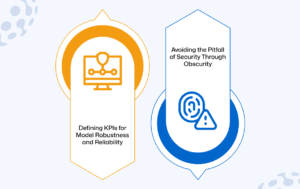
1. Defining KPIs for Model Robustness and Reliability
There are certain KPIs for measuring AI security effectiveness. Useful insights come from metrics like deflection rates of bad inputs and reliability under stress.
For example, organizations can observe how models respond to adversarial conditions in order to ensure stable performance. Metrics to guide the evaluation of security control measures and operational requirements in relation to strategic cyber investments.
2. Avoiding the Pitfall of Security Through Obscurity
If you put hidden system logic in front of your defense and rely on it as the core, it might make things vulnerable. Security through obscurity believes that if an attacker cannot see how systems work, they cannot exploit them.
A better strategy means transparent security practices, regular audits, and well-defined protocols. This means systems stay secure even if their structure is understood, for example, through reverse engineering, and as such, it reduces reliance on secrecy as a defensive mechanism.
Conclusion
Recommendations: Protecting AI systems is a nontrivial endeavor, but cybersecurity features alone can provide only partial solutions. As threats are dynamic, organizations need to keep iterating the ways in which they protect data, federate models, and maintain the integrity of the system.
Complex security schemas and predictive supervision can help organizations create enduring AI systems to sustain iterative innovation. Also through Aqlix IT Solutions, organizations can secure their intelligent platforms while scaling and innovating the right way.
Frequently Asked Questions
What are the main threats to AI systems?
There are threats to AI systems, like prompt injection, data poisoning, adversarial attacks, and model inversion. Such risks focus on the behavior and data of machine learning models, not traditional infrastructure. Knowledge of these threats enables organizations to put in place proper security protocols that ensure the integrity of their systems and sensitive data.
What is adversarial machine learning?
Adversarial machine learning refers to the deployment of altered input data to affect the behavior of an AI model. Attackers craft inputs intended to generate incorrect or malicious outputs. This approach emphasizes the need for models that are resilient against potential data poisoning attacks.
How can businesses protect AI models from data poisoning?
Preventing Data Poisoning for Businesses Businesses can take several steps to protect against data poisoning, including validating the source of data, monitoring datasets for abnormal activity, and ensuring secure data pipelines. Evolution of audit and anomaly detection procedures to ascertain suspicious data. By maintaining data integrity, we can be assured that our machine learning models will generate accurate results.
Why is API security important in AI systems?
Such a general rule in APIs is crucial since the AI systems work over communication and integration through it. When endpoints are not secure, it can result in unauthorized access or a data breach on the servers. Other safeguards could be authentication, encryption, or rate limiting to ensure that only trusted users and systems can use the AI services safely.
How does differential privacy improve AI security?
Enables the addition of controlled noise to datasets that can be used to protect sensitive information. This removes the attackers’ ability to identify individual data points while still allowing for meaningful analysis. It enables organizations to utilize data in a manner that protects against further potential privacy violations of AI applications.