

The world is being transformed by digital economy and how organizations do business, compete and grow. Today’s leaders need to make decisions at greater speeds, build more adaptable teams, and develop capabilities that enable them to embrace the latest tech. But many are still struggling with legacies, slow manual processes and confusion about where to start with technology adoption. These impediments obstruct a company’s ability to compete in an era of speed, intelligence and automation.
Technology Consulting has become an essential partner to leaders in dealing with this complexity. Instead of seeing technology as an end in itself, consultants guide companies to integrate goals with substantive digital pursuits. Then it is Aqlix’s job to help leaders take out the guesswork, cut through the red tape and create long-term capabilities in order to drive innovation and transformation.
The Changing Landscape of the Digital Economy
The digital economy generates changes that are constant across sectors. Its rapid nature demands leaders who will prioritize agility, data-driven planning and modern digital systems.
The transition toward connected, technology-driven business affects the way in which organizations create value, engage with customers and plan for what’s next. The ones who can adapt and take advantage win, while those that are dependent upon their traditional process will find it harder to keep up.
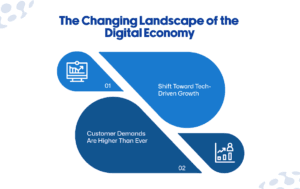
1. Shift Toward Tech-Driven Growth
Increasingly, all industries find themselves competing with fast-scaling digital-native companies that run advanced automation, cloud-based systems and data analytics. These disrupters are changing what customers expect from products and services.
Companies who combine new technologies in their business processes are more adaptive, efficient and innovative. To keep up in data-driven, on-demand worlds, leaders need to themselves become digital-first thinkers.
2. Customer Demands Are Higher Than Ever
Consumers demand every touchpoint to be personalized quickly and effortlessly. Legacy systems frequently lead to sluggish response times, reduced insight and the inability to provide a consistent level of service.
Digital Transformation facilitates the reimagination of these experiences by providing automation, improved data insights, and unified platforms. As customer needs change, so does transformation – no longer an upgrade; it’s mandatory.
Why Tech Consulting Is A Critical Service For Today’s Leaders
The journey to change can be complicated. Decisions on technology can have impacts across operations, budget, teams and future scalability. It offers leaders a roadmap to ensure that our decisions today are right for tomorrow stability and growth.
Expertise for Complex Tech Landscapes
Today’s tech ecosystems, comprised of AI, automation tools, cloud services and cyber solutions, digital apps and more are evolving constantly. It’s difficult to comprehend their impact and significance.
Technology advisers assist to interpret the complexity by providing structured plans with clear roadmaps and insights from a seasoned professional. Understand the risks and make informed investment decisions Leaders take minimal risks that fail to align to digital goals, resulting in the desired outcomes and long time value.
Turning Your Business Needs Into a Digital Strategy
Consulting assists the leaders to convert their practical concerns into an organised digital strategy. This means pinpointing inefficiencies, plotting high-impact possibilities, and choosing technologies that scale in ways that produce concrete results.
It’s written all down, leaders are moving forward knowing they’re taking every step you see is on the road to future progress not just detached upgrades.
Digital Transformation’s Impact on Leadership Success
More than modern tools Digital transformation gives leaders more than modern tools. It gives features that help strategic transparency, operational agility, and confident decision-making.
1. Smarter Decision-Making Through Data
Data is a leader’s best friend in the modern times. With its real-time dashboards and AI-powered analytics, leaders can anticipate trends, spot risks and plan ahead.
With quantitive data to influence decision-making, organizations are able to cut down on guesswork and increase accuracy. Furthermore, data-driven leadership increases transparency between the teams and directly identifies whether they are aligned or on the same page.
2. Increased Agility and Innovation
Process automation and digital workflows help to speed up and avoid delays. “It means leaders are able to react fast to changes in the market, try new things and pick up improvements with less ego.”
Today’s technology enables “continuous everything” — continuous improvement through cloud migration, AI adoption and operational innovation. Businesses can build more confident experiments, learn and innovate at a higher agile stack.
Aqlix as a Digital Transformation Partner
Aqlix offers leader guides all the way through a transformation journey to ensure that tech is serving real business needs. What drives us?FormGroup was founded with the vision to enable every business to use modern digital tools for sustainable growth.
Empowering Leaders with Modern Technology
Aqlix is designed to enable the use of modern solutions, combining automation and cloud platforms with AI-guided tools in existing workflows. These devices enhance reliability, scalability and efficiency in automation.
Both of our frameworks aim to ease the path towards digital adoption, and let leaders think big instead of focusing on immediate band-aid solutions. Agile – means that organisations grow gradually and react to new opportunities in the digital economy.
The Consulting That Turns Strategy Into Reality
Aqlix offers workable, operational assistance from initial evalution to action. We’ll help you make the right technology choices so you have focus and direction in your transformation.
Leaders love organized planning, trackable results and industry-specific solutions. This line-of-sight ensures that each transformation step is for the benefit of broader organisational success.
Key Pillars for Thriving in the Digital Economy
To succeed in today’s digital-first environment, leaders need to prioritize the creation of capabilities that enable both sustained growth and adaptability.
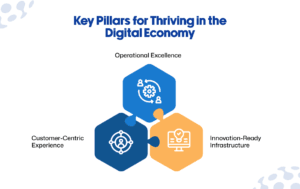
1. Operational Excellence
Great operations starts with active workflow optimization, lowering manual error rate, and adding automation wherever is possible. Digitally economy automated work is faster and more reliable, allowing teams to concentrate on the strategic.
Cloud-based solution facilitates flexibility, reliability and access building a strong operational platform. Combining these enhancements, organisations can develop effective and robust operations.
2. Customer-Centric Experience
Customers change the way they expect to interact at such a rapid pace that organisations need to provide proactive digital-first engagement. Personalization driven by AI and integrated systems make for seamless engagement across all channels.
Through increased responsiveness and transparency digital companies enable organisations to build trust and improve customer satisfaction. Leaders learn how to better empathize with customers and customize their services appropriately.
3. Innovation-Ready Infrastructure
Contemporary architecture helps advance innovation through rapid absorption of new technologies. Horizontally scalable systems into which you can easily integrate new and emerging tools, with reduced dependencies on the traditional monolithic architectures.
An infrastructure that is ready for the future means organisations can continue to compete and respond in this dynamic digital environment. This base enables leaders to innovate with confidence and to grow into new opportunities without massive disruption.
Real-World Examples
Real-life digital transformation success stories show how today’s leaders leverage technology to solve age-old problems and drive their companies forward. From AI powered automation to cloud expansion across the globe, these examples are proof of strategic thinking and execution.
Leadership Success
Digitalization initiatives are delivering tangible benefits across many industries. Organizations that leverage AI-enabled automations are, for instance, enabling them to reduce the operational workload while also increasing accuracy.
Organizations that rely on cloud infrastructure can scale across geographies more effectively and with increased confidence. Through formalized technology consulting, a great number of leaders are meeting operational cost reductions, improved performance and well-informed decision making.
Conclusion
To thrive in the digital economy, business leaders leaders need to adopt new technology and build into processes agility, insight and continual improvement. Digital transformation makes this possible with the help of structured frameworks, smarter tools, and more focused teamwork.
With the help of Aqlix, leaders are able to get clarity, capability and real impact in their transformation journey. With smart consulting and power of modern tech solutions, businesses get the ease they require to flourish in this fast paced digital century.
FAQ
Q: What makes digital transformation so important for business leaders today?
It is a tool that leaders can use to make informed decisions, save time and respond to the market environment. Contemporary resources enable organisations to avoid being left behind in the digital economy.
Q: Can you tell me how tech consulting is fostering transformation?
Your consulting will make sense of the tools, strategies and how to use them. It guides leaders and their choices to minimize risk to technology and answers that dovetail with their goals.
Q: What is the most difficult challenge for leaders in the digital economy?
Typical challenges are that you have a legacy and disparate systems with limited visibility of data, compulsory transformation strategy not defined. These challenges can be alleviated by digital funds transfer products and thoughtful planning.
Q: Do all transformations need broad, expensive investments?
Not always. A lot of businesses start with incremental enhancements – for example, automating a process or moving it to the cloud. “You want to have a serial approach because it’s cheaper and less complex.
Q: How can leaders ready their operations for innovation?
Through scalable architecture, automation and continual technology advancements. This will contribute to the adaptability and robustness of the system in the long run.