
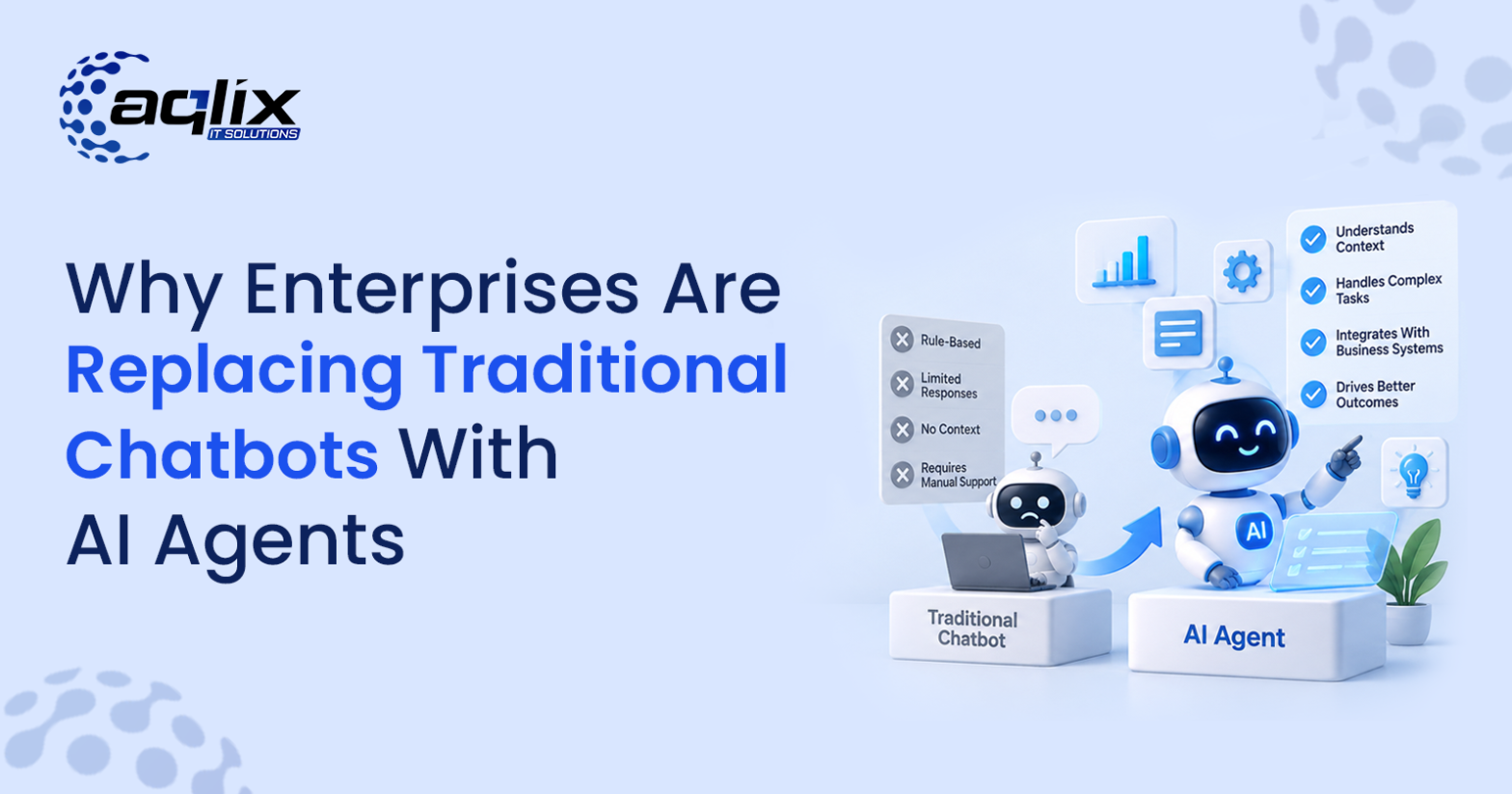

Purchasing a chatbot used to be exciting. It’s much more like purchasing a lemon these days. Customers quickly find out that basic chatbot interactions cut off as soon as input diverges slightly from the trained dataset. You’re either left with a customer that’s frustrated that you overcharged them, or you blow your budget after promising so much only to hand off your customer to a support agent.
At Aqlix IT Solutions, we find that IT customers are ditching rule-based chatbots for real AI chat agents in droves. AI chat agents can understand intent, use real-time data, and perform a requested action instead of spitting out prewritten responses. In that light, providing chatbot-based customer service is much more about resolution than response.
Where Traditional Chatbots Fall Short
Rule-based chatbots work great for very specific queries, but companies need systems that can handle all complexities, not just keywords and flows. Businesses are realizing that the limitations of chatbots, such as scripted responses, inability to consume context, and inability to remember prior conversations and connect with the numerous systems involved with most customer issues, exist in almost all digital transformations.
1. They Can’t Handle Context or Memory
Chatbots were extremely limited because once a human user ended a chatbot conversation, the chatbot reset and no longer remembered what was previously said. This caused issues because customers had to explain themselves constantly, and many customers just went to a competitor’s site or called the business instead.
Modern AI agents don’t lose context across a conversation or an entire session. Modern customers don’t have to start everything again from the beginning. These agents were built with reasoning, while older chatbots were built with an if-then logic system. This reasoning in conjunction with context allows these AI agents to interact with humans in a much more helpful way than older chatbots.
2. They Can’t Take Real Action
Traditional chatbots can very easily answer user questions, but they cannot update an order, check inventory, or forward a case to the appropriate department with details included. Customers receive an answer but still need to go to another area or wait for assistance.
AI agents, using generative AI, are capable of understanding and interpreting the intent of a user’s goal. They can initiate transactions or manage account details by executing backend workflow systems. The significant difference that organizations value when transitioning from chatbots is the ability to initiate actions as opposed to just verbal communication.
What AI Agents Bring to the Enterprise
Companies using AI agents aren’t just using the latest interface. They’re after business improvements traditional bots couldn’t accomplish. With advanced AI, agents are capable of automating processes free of the multiple-step hassle. Agents can resolve support tickets and process refund requests. Teams would otherwise be required to work manually. AI agents allow teams to focus on exceptions that involve human interaction.
1. Faster, End-to-End Resolutions
AI agents can rapidly answer questions and automate resolution of service tickets. This represents a material speed disruption to customer and internal support service teams. Unlike generic, out-of-the-box, generic chatbots, agents are purpose-built for a firm’s work across a firm’s systems and data and dynamically respond to a company’s work processes.
To get to this level of integration, firms typically need purpose-built software. AI agents that are designed to best fit a firm’s underlying work processes and systems work across multiple systems and increasingly improve the services offered.
2. Lower Costs and Better Scalability
Chatbots built around traditional AI already have issues with “script bloat” – where more and more custom interactions cause more manual work for developers and support tickets for users. AI agents show improvement over time with little to no need of a manual rule-editing army.
Experience technology consulting brings the most value by allowing enterprises to prioritize where AI agents provide the most advantages and where it’s best to hold off on automation instead of trying to cover everything. A phased approach of the right technology as a service is preferred over the traditional approach of trying to cover everything all at once, which often leads to cost and capability overflow.
Conclusion
The move from chatbots to AI agents is more than just a trend. It’s enterprises understanding that their customers and employees expect process automation technology to handle more than just answering simple requests. Aqlix IT Solutions provides business automation solutions by building AI agents that align to real workflow scenarios, unlike traditional AI agents that use generic one-size-fits-all approaches.
If your enterprise still uses scripted chatbots that are miles away from meeting your business needs, Aqlix IT Solutions can provide an AI agent customized automation solution that would most align with your business.
FAQs
What’s the main difference between a chatbot and an AI agent?
A chatbot’s answers are limited by a script, but an agent can understand the intent and reason through context to take actions like update records or make transactions. Unexpected questions pose no problem for an agent, unlike a chatbot, which literally runs out of script and gets stuck.
Can AI agents fully replace human customer service teams?
Not entirely, although that is not the intent. AI agents can handle high-volume, low-effort requests well, allowing human agents to focus on complex, emotional, and subjective situations where the human agent can apply their own judgment and empathy and provide the most value.
Is switching from a chatbot to an AI agent expensive?
The cost ultimately depends on the complexity of the integration. However, most enterprises opt to implement some use cases while they wait for the others to be completed. This tactic allows enterprises to spread out the cost of implementation while they wait to demonstrate and measure ROI.
How long does it take to deploy an AI agent for an enterprise?
The length of time for most enterprise deployments is around three months, but that can vary a bit depending on the scope of integrations and how nuanced or flexible the workflows can be. Using an experienced partner like Aqlix IT Solutions can help substantially reduce the length of time it takes to avoid most common early deployment mistakes.
Do AI agents work well for smaller enterprises too, or only large ones?
AI agents also scale down just as well as they scale up. Smaller businesses are often happy customers of this arrangement. With one carefully crafted agent, several hires can potentially be avoided, making it a useful tool in cost-effective efficiency.