

The main idea of enterprise software is innovation with user-centric design and custom dashboards. Innovation is achieved with hardware infrastructure that can support large amounts of users and be configured to specific workflow requirements. All client satisfaction depends on adoption and how well the workflow supported the requirements of the enterprise.
The entire market is shifting with the introduction of AI into the world of enterprise software and SaaS products. Aqlix IT Solutions focuses on creating enterprise customer satisfaction with the introduction of AI-capable software. We allow customers to engage with our software by automating tasks that were previously done by the customer. Our software walks customers through the whole decision-making process by presenting and analyzing relevant information to the software. Now, instead of buying software that lacks functionality, our enterprise customers buy software that actually solves business problems.
The Shift From Static SaaS Tools to Autonomous Agents
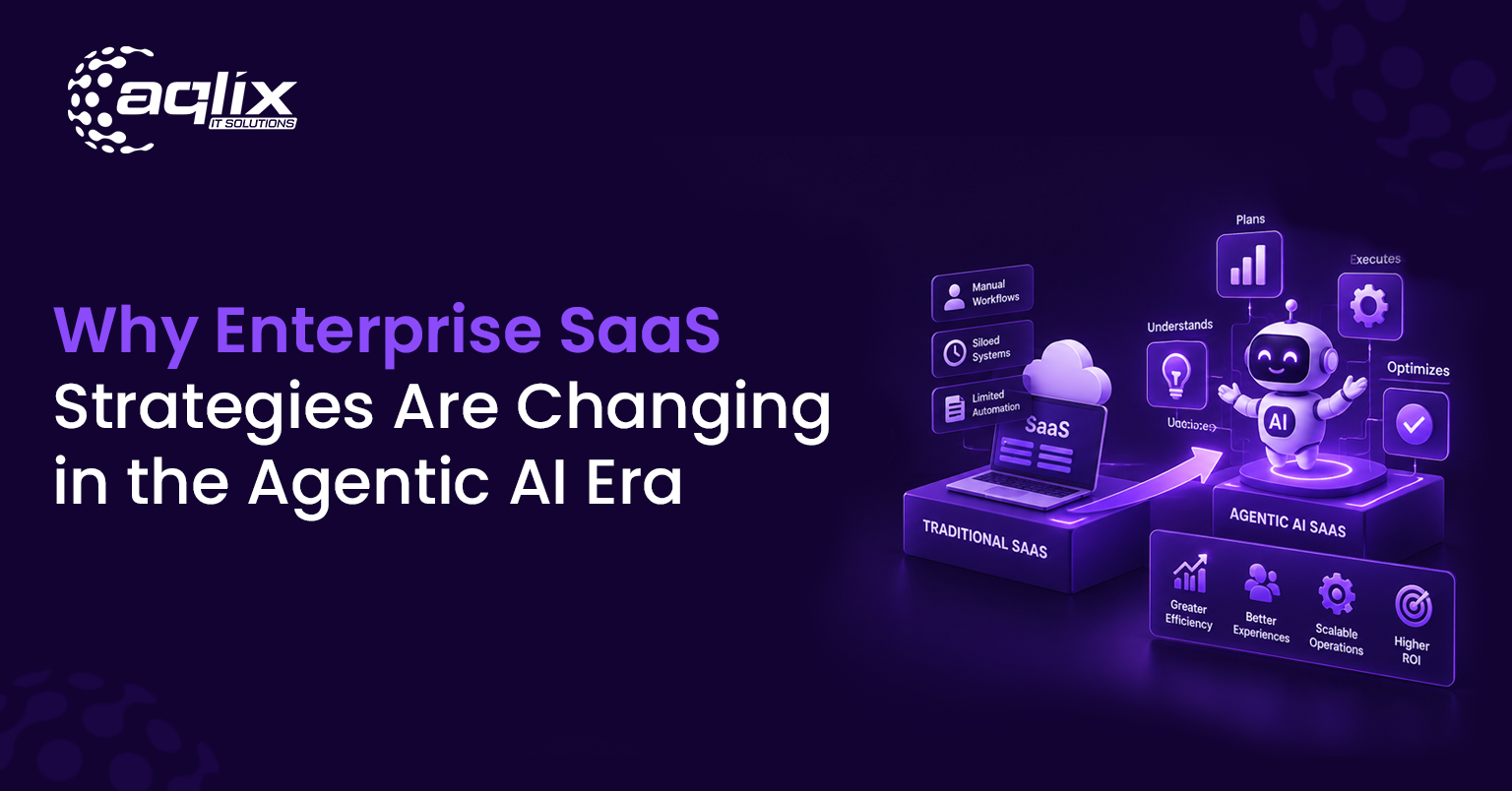
As AI product development matures, enterprise SaaS is moving away from prompt-based services toward agentic systems that pull data and make decisions across many systems. Agentic systems will eliminate the workflow stitching burden on users by building fully automated workflows.
1. From Feature-Driven Roadmaps to Outcome-Driven Agents
Traditional SaaS roadmaps created a mechanism for customers to request features, build their click-through journey through the feature, then abandon the feature post-novelty. Agentic products redefine the logic because the value is ultimately in the outcome the agent produces with no human interaction rather than the interface.
This is where custom software development comes into play. Engineering an agent that can execute a series of tasks with high discipline requires more engineering work than developing yet another dashboard widget. Enterprises no longer need vendors that create another interface that just builds yet another layer on existing legacy systems. They need partners that can build systems that create effective business outcomes.
2. What This Means for Enterprise Buyers
Evaluation criteria are taking new shape as agentic capabilities begin to be expected in enterprise software.
- It is now about checking off task completion rates rather than just checking a feature list.
- Application modernization is now a prerequisite because legacy systems are unable to cleanly and in a structured format feed data to agents.
- Procurement teams now ask about failure case scenarios and how agents would operate in such cases instead of cross-check feature lists.
- In enterprise software evaluation, depth of integration is now more important than UI. Agent-based software can cross multiple systems.
- Pricing models are quickly shifting from flat per-seat licensing to a usage- or outcomes-based model.
How Enterprises Should Rethink Their SaaS Strategy
Shifts related to agentic technologies affect more than just procurement and the selection of technologies. They impact procurement and security, as well as how teams function on a day-to-day basis. Enterprises that engage technology consulting services with a good level of experience avoid the costly mistakes that are associated with agentic technologies. Evaluating these systems requires a new level of assessment skills that the internal IT and vendor management teams never needed to develop in the past.
1. Building for Interoperability and Data Access
Agents require access to data and systems in order to work. Therefore, the usefulness of a tool deteriorates over time if integrations with external systems are not available. This has led banks to prefer systems with binding API contracts to avoid walled systems, to which end-to-end reasoning agents cannot be applied.
This has led enterprises to modernize their architecture to embrace modular cloud-based applications that allow users to call APIs to expose functionality. Rather than having all data trapped in the UI of a single vendor. This modern architecture allows agents to do cross-tool reasoning and make decisions across multiple applications in the enterprise.
2. Governance, Security, and Trust at the Core
Gaining autonomy means agents must have some form of governance built in beforehand. This can’t come after something goes wrong and be added on as an afterthought:
- Each action of an agent must have a built-in audit trail. Otherwise, how would a user know who to hold accountable?
- Well-established AI and machine learning governance frameworks must be considered at the minimum to be value-added frameworks, not as afterthought add-ons.
- Permission boundaries must not only control what an agent can see but also what it can change and what it can execute automatically.
- At a minimum, a check and balance of human review must be in place to pay vendors or sign commitments.
- Vendors must demonstrate how they monitor and retrain models, not only how models perform on go-live.
Conclusion
Enterprise SaaS isn’t obsolete, but it’s changing the way it creates value with agents taking on more of the work. Aqlix IT Solutions aids enterprises in this shift from determining the best agent-ready platforms to modernizing platforms and systems to ensure agents have the data and access.
If your SaaS stack operates on outdated assumptions, now is the time to evaluate and see what is and isn’t keeping up. Check with Aqlix IT Solutions to see where you are currently regarding systems and what would be needed to make your system agentic instead of just having modern dashboards.
FAQs
What makes agentic AI different from traditional SaaS automation?
Traditional automation tasks are programmed to perform a sequence of steps. Agentic AI can do much more. Instead of programming every possible step, agents blend programming and instruction to make decisions at various steps. Traditional automation systems are unable to do this. Again, traditional automation does just one action after being programmed. Agentic AI has the capacity to access and integrate multiple data sets, helping it achieve completion of complex tasks in a single uninterrupted flow.
Should enterprises replace their existing SaaS tools entirely?
Not usually. Most companies increase productivity and reach their first customers by using modern technology to connect and improve their existing systems, as well as using technology to make their customer-facing employees’ data accessible and comprehensive. Rather than modernizing and improving systems all at once, the phased approach focuses on the high-impact workflows first, as they help to get measurable improvements and a first working system with reduced risk and time.
How should procurement teams evaluate agentic SaaS vendors?
Don’t just examine feature lists. Determine how vendor support agents act in the face of failure, poor instruction, and uncertainty outside of the instructions/within the bounds of the system. Request real completion metrics instead of performance metrics during demos. Ensure that each agent does not have full discretion over processes and systems that have the potential to impact the business prior to management data access, permissions, and audit trails being established.
What role does data readiness play in agentic AI adoption?
Agents cannot be effective without clean data. Messy, siloed, or outdated data severely limits agents’ capabilities. Many enterprises choose to use Aqlix IT Solutions as a first step to clean data pipelines and integrations. This is probably because they know that clean data pipelines and integrations affect the performance of agents later.
Will agentic AI eliminate the need for traditional SaaS platforms?
Unlikely, at least in the near term. SaaS integration will probably continue, as many SaaS offerings will be embedded in software as the underlying systems that agents use to complete tasks. The competition will be less likely at the interface that people click on, as the value shifts to the orchestration layer that is behind the scenes.