


What started as automation of mundane tasks has become a powerful strategic force. “It’s not just about performance anymore, but also systems that can think, learn and optimise for better results in today’s world. It’s artificial intelligence that has opened this terrain to change in what work does vs task completion. New industries to lead the futureOur industry is evolving into a time where technology can sense operational needs and provide real (useful!) improvement.
Digital transformation is no longer focused only on digitising paperwork or adding tools to existing processes. You’re building interweaving, intelligent processes that drive decision making and map work to the business. You see here in manufacturing, retail, finance, health care and even in digital natives. This is why AI- and ML-powered automation is emerging as a prerequisite for what constitutes enterprise-level systems.
Understanding AI-Driven Automation
Automation with is the AI-based one can use and in other solutions. Unlike conventional automation, works according to pre-programmed rules, the AI systems learn patterns from data then decide what is best way to operate taking decisions with minimal human intervention.
It moves to the cool life without being constrained by other commands beyond offering fluid workflows that fit into the context in which it’s used so much. As they operate, these systems can evaluate the results, reducing errors and learning from them. It makes sense in the context of digital transformation where technology is a creator of value, not just an executor of process.
Automation based on AI, however, is not just about consuming data. It analyses, alters, derives solutions for new structures. And so you have sort of a loop from static to manStreamuition process to other. Real-time trainable systems become possible using machine learning, and useful combination of human-machine collaboration arise by NLP. Predictive models may predict the outcome of particular actions before they occur.
Delivering: is more straightforward with modern development practices cloud native architecture, microservices and containerisation. They provide intraworking and integration of automation into the existing systems. These are also linked with Product Development and Mobile App Development that embedded AI-enabled architecture and is future proof scalable.
How Smart Workflows Transform Operations
These are the highlights of where AI-enabled workflows changes business outcomes. This move occurs irrespective of whether an organisation is upgrading its legacy systems or planning its new tech stack.
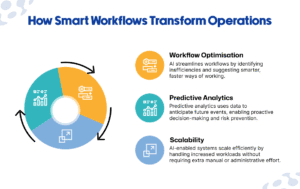
1. Workflow Optimisation
AI technologies can also comb through workflows to identify mundane tasks, choke point and ghost workloads or duplicated labour. Ai is not just digitisation Ai is not simply making paper-based work digital tasks, it’s that ai sees the inefficiency and suggests a new way of working. For example, when checking real estate documents, an AI system can spot verification patterns and highlight irregularities to operators in order to speed up the review process.
There’s employee-led process innovation at most companies in the first place. Human-powered reviews can eventually fall behind, especially as complexity increases. AI-driven optimisation encourages continuous review without hotting humans with the overhead.
2. Predictive Analytics
Predictive analytics uses historical data and current/future information to predict what will happen. That includes forecasting demand, alerting to risks and even examining how equipment is used and trying to understand customer behavior. Predictive intelligence allows teams to defend against a problem, rather than react to it once it’s too late.
This enforces digital transformation by bringing down the reactionary processes. Predictive systems have the benefit of not waiting to see which conditions fail or backlog before changes are made. It is especially useful in logistics, health care system, supply chain and service operations management, as well as inventory control.
3. Scalability
Automated by AI, this approach facilitates scalability because it allows systems to handle increasing workloads without demanding additional administrative resources. With support from Aqlix IT Solution, organisations can build flexible and future-ready platforms that grow without operational strain. It works well for growing companies, start-ups and enterprise with digitally forward projects. In more complex systems, the goal is to ensure that processes not only maintain repeatability but are also reliable and predictable every time.
Scalability is also necessary for on-boarding other tools or services. Architectural models that are API friendly, for example can assist AI driven platforms to flourish alongside the current digital ecosystems.
Real-World Applications of AI-Powered Automation
There’s no stopping AI when it comes to automation, across verticals. Here are some use cases that illustrate its value add.
1. Human Resources and Employee Onboarding
Automate Documentations, Training Programs, Role Bases Access & Compliance Check: Intelligent onboarding platforms have the ability to automate documentations, training program and role based access and compliance check.
They take away mistakes due to manual processing and help you get new personnel starting and productive in hardly any time at all.
2. Supply Chain Forecasting
AI can factor in supplier performance, demand cycles, seasonal peaks and transport risk. Predictive forecasting is a key contributor for companies to have an equilibrium of inventory, reduce dependence on warehouses and mitigate operational risks.
3. Marketing and Campaign Automation
Automated personalized campaign enables you to send the communication based on customer’s statement of intent and past behaviour. It allows the marketing team to engage in learning and relationship-building with customers through tailor-made content instead of generic themes.
4. IT and Infrastructure Operations
Leveraging AI-powered automation can enable systems to identify service degradation and outages, vulnerabilities and even automate remediation workflows. Thereby reducing Mean Time To Repair and increasing service reliability and uptime.
5. Customer Support Automation
Customer Service Knowledge recommendation and sentiment analysis. You can use virtual assistants to recommend knowledge articles from your own knowledge base of course, shorten ticket resolution times and perform sentiment analyses.
AI can also rank orders based on urgency and for example recognize problems that are good candidates for self-service.
6. Predictive Quality and Maintenance
Machine failure can be predicted by AI-based sensors at the manufacturing side which enables maintenance actions prior to machine fail. This prolongs the service life of machine and saves down-time.
Intelligent Automation Enrichment of the Baseline System
Bringing next generation, AI-based automation to market requires more than the best software. It takes smart planning, clear goals and a technical architecture that operates over the long term. Below are important considerations:
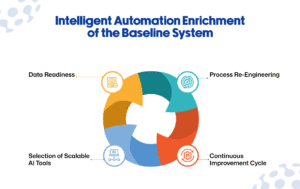
1. Data Readiness
AI needs structured, clean and relevant data. Enterprises will also have to look into their data sources and formats, storage systems along with the points of integration and privacy controls. A solid data model, makes it possible to train AI models in such a way that they produce the correct response.
2. Selection of Scalable AI Tools
Scalability is also key to ensuring that automation systems are able to adjust. When selecting, consider integration flexibility, customisation potential, data governance utilities and security. Cloud-based systems provide cost-efficient scalability.
3. Process Re-Engineering
AI automation only really works if companies think about the fundamental purpose of a workflow before they automate it. Process re-engineering results in an AI that is useful to do, not something that is digitized that needed doing.
4. Continuous Improvement Cycle
AI systems do require tuning, performance analysis and accommodation of feedback. Thus automation is ever joined with the business. Automation should be considered an evolving capability that enables organisations to take policy, make them tool sets.
Measuring Success of Smart Workflows
There should be some quantifiable measures for organizations before they deploy automation.” Below are key KPIs that will help you assess the value artificial intelligence creates in your workflow.
- Productivity Gains: Performance is evaluated based on completion rates, precision and reduction in manual effort.
- Turnaround Time: Organisations should measure how long tasks take, pre-automation and post-automation. The lower the cycle time, the better the process is running.
- Accuracy and Error Reduction: AI alleviates human errors. Workflow stability is indicated when tracking error decreases.
- User and Customer Satisfaction: Feedback information stringently has been about how automation is enriching experiences (users and employees not just customers).
- Cost Efficiency: It might be savings in terms of repeats of processes, use of resources or waste reduction.
Conclusion
Automation of AI is a substantial change from reactive procedures to systems that provide information for operational decisions. “The vision is that institutions don’t have to manage work; they can make impact.” AI adds three things to workflows that stand to improve long-range results: transparency, precision, and adaptability.
The path to digital transformation is a process of ongoing improvement and requires strategic alignment between technology and the business. Automation is becoming more and more crucial in order for companies to be able to scale sustainably and innovate over the long term.
Aqlix works with companies to architect, revitalise and build technology platforms that enable “smart” workflows and digital ecosystems. The project focuses on unleashing technology, which stimulates operational value, research-driven innovation, disciplined development and future-proof architecture.
Frequently Asked Questions
What is the difference of AI automation compared to Industrial Automation?
Traditional forms of automation are the act of following predetermined rules, they are busywork. AI-powered automation, on the other hand, learns, adapts and improves from data-driven results.
Can AI-powered workflows work with my existing business systems?
Yes. AI automation can easily fit into the existing toolscape with robust data integration, API connectivity and process mining.
Relevant for Smaller Companies: Automation AI Too costly and complex?
Smart workflows are equally {applicable|applying} to small and large business. This goes through the most important processes and continues stepwise.
How long does it really take to determine if workflow has improved?
Concrete benefits depend on the sophistication of the process, access to data and targets for automation. KPIs are usually tracked after the processes have been steady.

