
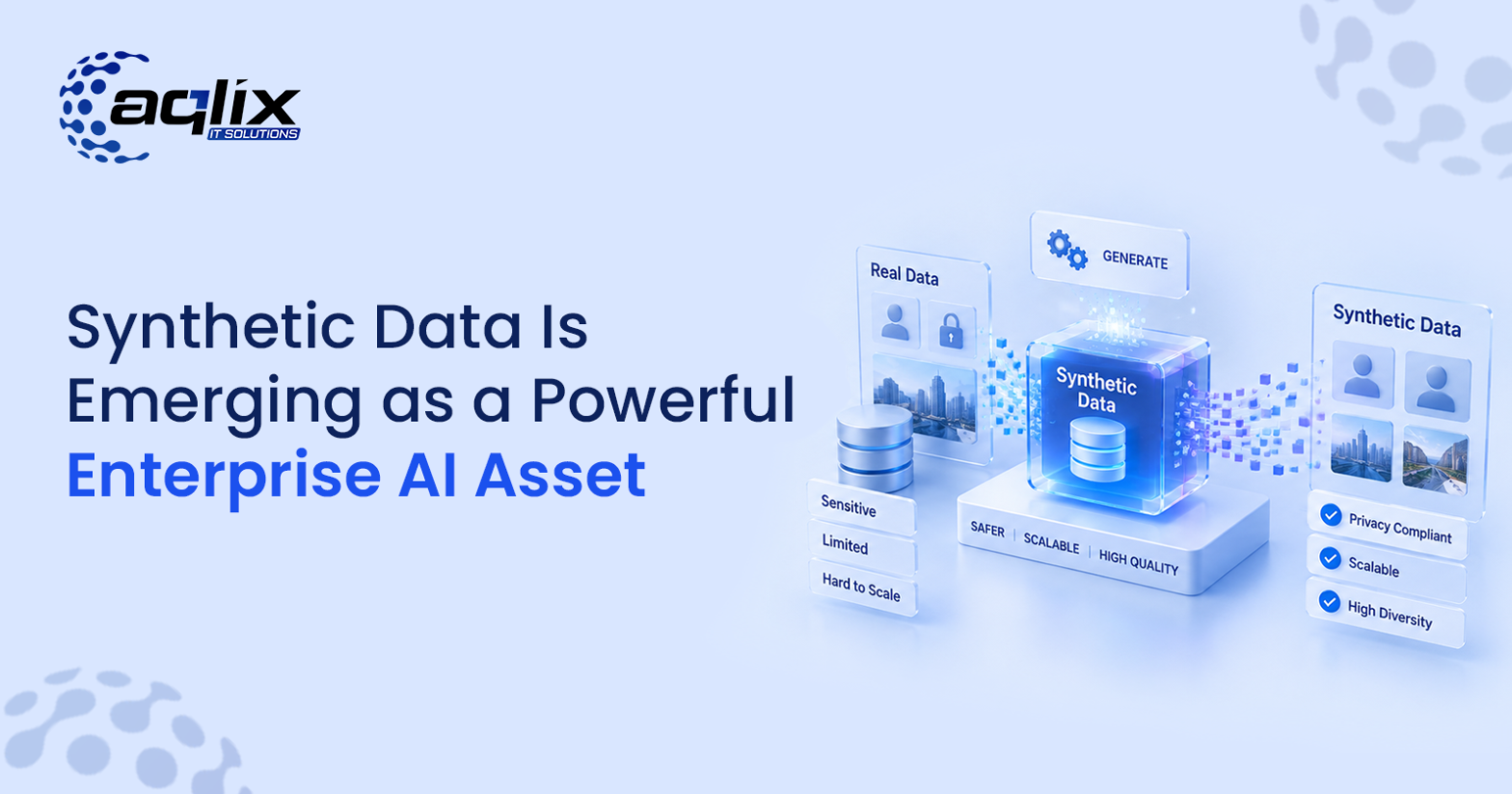

Building AI relies on high volumes of data and the best available data, which in practice may not be adequate or may incur privacy or cost risks with data collection. ‘Gaps’ in real-world data are where synthetic data steps in. Investment in synthetic data is emerging as a legitimate business strategy.
Aqlix aids companies in implementing synthetic data, which will enhance their AI-based systems. Our data science and AI services help our clients create data sets that address training model-based privacy risks and scarcity of real-world data.
Why Synthetic Data Is Gaining Traction in Enterprise AI
Limitations of available real-world data may include privacy and large volumes of sensitive data. Synthetic data helps address the issues of data scarcity and privacy so AI systems may be developed within privacy-protected limits and for high-risk data areas. What once was a circumvention for the lack of real data examples for research teams is now a primary component for building AI systems.
1. Solving the Real-World Data Scarcity Problem
Real-world examples of rare events may include medical conditions of extremely low prevalence or the failure of specialized industrial machinery, which makes AI systems useful for diagnosis in such cases but challenging to validate models that can reach an acceptable level of reliability.
Synthetic data generation allows for the creation of any number of examples in which models are given many years of exposure to different situations, all in a matter of weeks.
2. Protecting Privacy While Preserving Data Utility
There are industries, such as healthcare and finance, where the amount of valuable data is immense, yet constrained by privacy and data compliance. Using customer or patient records for AI training puts a business at significant legal and ethical risk.
Merging the statistical behavioral characteristics of real data and the absence of personally identifiable information, synthetic data creates a means for businesses to evade much of the privacy concern real data bears when used for AI training.
3. Generating Edge Cases Real Data Rarely Covers
It’s a natural indication of data sets that the more frequent, usual examples of real-world situations are present far more than rare or extreme examples. This creates models that have a higher failure rate, since most edge cases are rarely encountered in the real world.
Synthetic data generation can deliberately create these underrepresented scenarios in sufficient volume for proper training. Models exposed to a wider range of edge cases during training tend to perform more reliably once deployed in real conditions. This approach also aligns with generative AI solutions that can create realistic data variations for specific AI training needs.
How Businesses Are Putting Synthetic Data to Work
Synthetic data plays a vital role in augmenting the development, testing, and refinement of AI systems by businesses. This technology has been adopted across different industries, incorporating healthcare diagnostics and financial fraud detection as well as the development and testing of autonomous systems. Business teams use synthetic data to build and test models even before real-world data is available. In addition, data augmentation is being used to model and predict outcomes of possible business scenarios.
1. Training and Testing AI Models Faster
The time lost due to insufficient real-world data for training AI models poses significant delays to months or even years to some projects. The use of synthetic data allows modeling and AI framework development to commence immediately using generated datasets.
The use of synthetic data to develop AI systems decreases the overall project development time and enables rapid model improvement over traditional development, which relies on collected real-world data. Aqlix’s AI Development team embeds synthetic data generation in the development phases of its projects.
2. Reducing Compliance Risk in Regulated Industries
AI innovation in regulated industries, like healthcare, finance, and insurance, is constrained by how customer and patient data can be used. Synthetic data conveniently bypasses these major regulatory constraints and allows relevant model development.
Presenting a model to industry regulators for review is less concerning since synthetic datasets do not contain private personal data. Previously challenging projects become feasible to pursue within existing regulatory constraints.
3. Building More Robust, Bias-Aware Systems
AI systems developed with real-world data make it challenging to avoid imprinting historical biases, which exist in almost all datasets. Almost all datasets exhibit imbalances due to bias in how they were compiled. Synthetic data fills the gap in datasets with bias and imbalance by helping businesses to adjust datasets accordingly.
This capability helps businesses build AI systems that perform more fairly across different populations and scenarios. Aqlix’s AI & Machine Learning expertise ensures synthetic data strategies genuinely improve model fairness rather than introducing new distortions.
Conclusion
Synthetic data has evolved from being an experimental workaround and has become a key beneficial component of AI systems in regulated and data-constrained environments, with benefits such as reducing the need for real data and providing a good balance for data protection.
Aqlix IT Solutions assists clients in understanding how synthetic data can be applied in a beneficial way to their AI initiatives and where it is better to use real-world data. Our team helps the clients that are having issues addressing their AI objectives due to data scarcity and/or constraint.
Frequently Asked Questions
What is synthetic data?
Synthetic data is a substitute for real data that exhibits real-world data patterns but contains no real records. It is an artificial version of real data and is often used to train AI models when real data is limited, sensitive, or scarce.
Is synthetic data as effective as real data for training AI models?
It is not a black and white answer. Although there have been successful AI strategies that employed solely synthetic data, more successful AI strategies have incorporated both real and synthetic data.
Does synthetic data eliminate privacy concerns entirely?
Not quite, but privacy risk falls considerably. This is because synthetic data contains no real personal information. There is a moderately high privacy risk should poorly generated synthetic data be used, as some of the information could possibly be traced to original data.
Which industries benefit most from synthetic data?
The healthcare industry, finance, insurance, and the growing field of autonomous systems see strong results. This is due to the restrictive nature of their regulations and the need to train their systems on rare events. Of these, rigid regulations most restrict the use of real-world data.
How can my business start using synthetic data?
The first step is recognition of business constraints caused by either insufficient data or regulatory-related privacy restrictions that impact the development of AI. We work to solve these challenges by tailoring methods for integrating synthetic data into your existing development framework.

