

In today’s business world, success doesn’t often occur by accident. Businesses are being established and disappearing at a rapid pace with the help of precise analytics and optimum operations. These are companies commonly described as “smart.” Their intelligence is not so much a matter of talent or resources, but rather intelligent systems that guide their daily business. Smart businesses are all about smart systems — and, in ever-growing numbers, those systems are powered by AI development and the latest wave of automation.
Artificial intelligence enabled systems inject intelligence, automation and agility into the daily routine of an end user. They empower businesses to automate and improve business processes, make better decisions, and continue growth through scaling processes as they evolve. This is the foundation of sustainability, especially in markets which are volatile and characterized by constant change. With these AI innovations rapidly emerging in enterprises of all types, the advantages are becoming more clear: faster and more efficient processes, customer centric experiences and better strategic decisions.
Augmentation: AI Systems that Power Scalability and Performance
Artificial intelligence helps businesses scale by changing processes as the business grows. Next generation AI systems are distinct from legacy software because they do not reinvent themselves; that is, they don’t require manual reconfiguration after initial deployment. They also develop as the business scales, to perform effectively even amid rapid change.
This flexibility can be seen in multiple domains:
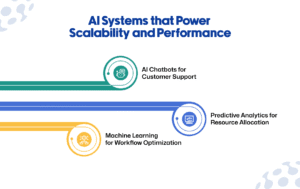
1. AI Chatbots for Customer Support
Customer service is one of the most challenging functions in any business. With the up-scaling of business, queries grow and response time sometimes becomes inadequate. AI chatbots can provide immediate assistance when asked about a customer’s needs, which shortens wait times as well as satisfaction. They are capable of processing large number of queries while maintaining good quality and also can forward some complex questions to human agents if necessary.
AI chatbots are so much more than chat tools. They learn about frequently asked question, user habits and gaps in services. This is a good way for teams to further refine the way customer service is delivered and how they communicate with customers.
2. Predictive Analytics for Resource Allocation
Businesses juggle multiple operational components — supply chain logistics, staffing, production schedules and financial planning. Conventional approaches tend to use historical and scheduled forecasts that are based on theoretical rail operations, namely not real market conditions.
Predictive analytics allow organisations to plan for needs before they arise through real-time data. It may predict demand changes, detect resource shortages, and optimize allocation procedures. As a result, organizations avoid disruptions, waste and cost inefficiencies.
Predictive models facilitate scenario planning, enabling firms to address forthcoming obstacles as they leak out.
3. Machine Learning for Workflow Optimization
Workflows are interdependent operations that need to be functioning properly to achieve business goals. Machine Learning models analyze how tasks are being done, highlight the inefficiencies and recommend ways to do them better.
These observations are also useful in eg:
- Order processing
- Inventory management
- Financial reporting
- HR operations
Workflows continue to run optimally through machine learning despite workloads that vary. Systems learn from more data and become better over time.
Scalable AI MI and How it Works Key Aspects of Scalable AI Solutions
The technology is not everything when it comes to a scalable AI solution. Its success is a function of how well it fits into the organization’s current and future environment.
Following are some important features which helps long-term scalability:
1. Flexibility Across Departments
Scalable AI serves more than one team, without the need for individual siloed systems. No matter whether it’s used for financial purposes, operations, HR, sales or customer services, the system must be flexible and able to fit in with different functional requirements. This flexibility drives consistent data flow and eliminates operational silos.
2. Integration to SaaS, ERP and the Cloud
The majority of businesses use 2-3 systems across the board for administration and management. The AI software that scales aligns effortlessly with ERP, cloud and industry vertical applications. This establishes a continuous ecosystem by enabling data to flow seamlessly, limiting manual entry and reducing errors.
For successful digital transformation, you need everything under one roof We at Aqlix IT Solutions always promote “Under One Roof” approach in our Custom Software Development in favor of sustainable diegeal transformaion.
4. Real-Time Data Processing and Analytics
Information is only useful if it can inform decisions in time. AI platforms that are scalable handle vast amounts of data in real-time, and you get insights on business situation at moment X. A focus on live results enables strategy rather than in-play changes.
5. Continuous Learning and Self-Optimization
Scalable AI systems learn and adapt as the environment changes. This evolution optimizes efficiency, accuracy and agility as the system matures. The more the system gets used, themore refined its capabilities get.
Building Smart Systems the Correct Way
There’s significant upside to AI, but it requires careful execution. Just having a new technology isn’t sufficient, he said. They (organisations) must define requirements, set goals and prepare their environment before diving into AI.
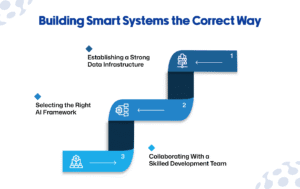
Establishing a Strong Data Infrastructure
AI is only as good as the data it uses, clean and structured. Poor quality or partial data can lead to decreased precision, and inadequate performance. Enterprises, therefore have the first challenge of ensuring standard practices for collecting and cleaning data, and storing it.
Selecting the Right AI Framework
There are different ways in which companies work, have customers and operate. The chosen AI framework should align with the company’s business objectives. By selecting scalable, flexible frameworks organizations can grow capabilities progressively.
Collaborating With a Skilled Development Team
AI calls for IT knowledge and strategic planning. Collaborating with an experienced development partner guarantees consultant– system alignment and successful business implementation. Specialties Using approach driven development methodologies keeps Scalability and Performance as part of our focus, Aqlix IT Solutions helps companies to build custom AI systems.
Conclusion
More intelligent systems set successful companies apart by the intelligence around whatever they’re serving. Read more AI-powered solutions bring flexibility, automation and progressive development to business processes so industry can build at scale without losing quality or control.
At the end of the day, companies that are doing scalable AI can do a better job than their competition for meeting customer expectations and stay ahead in competitive markets. They can take substantially improved business decisions and service quality while enhancing resource utilisation.
About Aqlix IT Solutions Aqlix IT Solutions enables organisations to develop intelligent, scalable AI ecosystems to improve operations and drive competitive advantage. Aqlix empowers businesses to transform with assurance and certainty in our technology-driven world through a focus on long-term digital sustainability.
Frequently Asked Questions
Why is an intelligent system essential for business expansion?
Intelligent solutions optimise processes, cut the manual workload and help to make decisions based on data. Enterprises can thus respond more rapidly to changing market conditions and scale accordingly.
What are the ways in which AI enhances day-to-day business operations?
AI re-automates the drudgery, improves accuracy, and delivers real-time insights. This results in quick processes and good decision making for all departments.
What makes AI systems scalable?
It is not uncommon to find AI systems that can scale to larger data size, accommodate more concurrent users/traffic and tolerate new workflow without needing a complete reengineering.
How should businesses ready their organizations for AI?
Evaluate data quality, business goals and collaborate with development teams to build systems that will satisfy long term needs.

