

Today’s businesses function in a world awash with data from everywhere: across departments, regions, and the digital universe. When you consider all the ways companies generate and rely on data customer service phone calls, shipments from suppliers, line item financial transactions, key performance of DSS metrics it’s a lot. It is true, that the availability of data has grown, whether we can turn that data into timely and trustworthy decisions however is another matter.
Cloud-based Decision Support System (DSS), or Cloud DSS, are the candidates that have potential to offer scalable infrastructure, real-time analytics and centralized view of insights. Unlike legacy systems cloud-based DSS platforms enable organizations to perform computations and analysis on data in real-time, facilitating quicker and more informed decisions.
Enterprises are re-architecting their approach taking, processing and taking action on information in the era of fast cloud adoption. The cloud is also revolutionising the way in which businesses approach strategic planning by providing flexibility, facilitated collaboration and instant intelligence throughout the entire enterprise. Organizations working with technology partners such as Aqlix increasingly rely on data-driven frameworks to structure decision-making and improve long-term planning accuracy.
What Is a Cloud-Based DSS?
Cloud-based DSS is a software platform that uses cloud technology to analyze data for decision making in real time. Unlike traditional servers and static reports, cloud DSS systems are built on a remote, scalable infrastructure that is available over secure network connections.
Onsite equivalent Traditional systems tend to involve large upfront costs, ongoing maintenance, and hardware constraints.” On the contrary, host-based DSS systems scale in response to demand and are step-and-repeatable with remote access.
These platforms also support the live collaboration that lets a group discuss insights, explore scenarios and make decisions together. Cloud-based DSS offer a cost-effective, quicker to update and more accessible option for today’s organizations with agility and availability needs.
The Role of Cloud in Enhancing Decision Support
The cloud computing technology is the cornerstone to improve the capability of Decision support Systems. Cloud-based platforms overcome infrastructure bottlenecks that enable DSS solutions to process and reveal insights faster and more consistently. Cloud DSS implementations developed by teams such as Aqlix focus on interoperability, ensuring decision systems connect seamlessly with ERP, CRM, and analytics platforms.
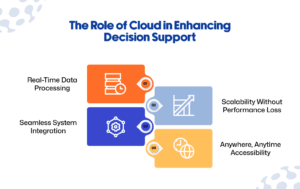
1. Real-Time Data Processing
DSSs operating in the cloud, they support processing data online aggregating from streaming distributed systems, sensors and applications. This live capacity allows them to be responsive to market events, mission changes, or risk emergence. Instant visibility into numbers instead of report wait times for decision makers.
2. Scalability Without Performance Loss
As organizations scale, the amount of data grows. Dynamic scalability of storage and processing power for DSS platforms is provided by cloud infrastructure. This performance can be sustained even as your system scales without expensive hardware changes or downtime.
3. Seamless System Integration
Cloud DSS can be integrated smoothly into a company’s ERP, CRM and business intelligence systems already in place. This unification provides a single window into your organizational data which consolidates silos and cleanses signals. Integrated platforms also provide automated data flows so as not to rely on self-reporting.
4. Anywhere, Anytime Accessibility
Knowledge workers are no longer tied to office chains. Cloud solutions provide access from anywhere, so that leaders and decision makers may see and act on insights in real time. This addiitional level of accessibility enables remote work, global business, and faster team collaboration.
Secure and Reliable Cloud DSS
Security and robustness is key in any business system. Cloud DSS solutions are built with a strong emphasis on data security and availability.
The main tool for protecting data in flight and at rest is encryption. High level of authentication and levels of access control restrict the use of the system to authorised users. These steps secure business-sensitive information against unauthorized access.
Cloud DSS platforms are again strong when it comes to standards and regulations. Cloud vendors regularly comply to finance, healthcare and global enterprise compliance frameworks, which can lighten the load for internal teams.
There are backup and disaster recovery built in to add reliability. Cloud operations allow multiple copies of data spread out across different regions to enable availability when systems fail or go down. This strength provides continuous decision, making and operational stability.
Benefits of Cloud Based DSS for Businesses
Organizations who use cloud-based decision-support systems receive a number of strategic and operational benefits that help them grow and remain nimble.
Cloud-based DSS also enhances collaboration. With shared dashboards, centralized access to data and role-based permissions, teams are able to leverage a single source of truth. This alignment supports more decisions which are consistent across business areas.
1. Speedy Implementation and Time to Market
Cloud DSS solutions takes away a lot of deployment hassle as you don’t have to worry about massive infrastructure setup. Escalates the effort to deploy systems and to begin using decision insights which should enable enterprises quickly get started given there are no lengthy installation cycles or hardware requirements.
2. Low Infrastructure and Operation Cost for IT
Through cloud infrastructure, organizations reduce the cost of server maintenance, system upgrades and manual monitoring. Scalability and performance management are concerns of cloud providers, leaving internal IT to focus on more strategic fun stuff.
3. Improved Collaboration Across Teams
By using cloud DSSs, dashboards and analytics can be shared and viewed by many users simultaneously. And teams from various departments can operate off the same data source, resulting in better alignment, fewer gaps in information, and more standardized decisions.
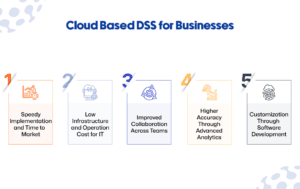
4. Higher Accuracy Through Advanced Analytics
The efficiency of cloud-based DSS experience could also be enhanced when incorporating analytics and AI features. Machine processing and smart models can do away with the error prone reality of manual analysis written on paper.
5. Customization Through Software Development
Organizations may need DSSs which are adapted to the organization’s working practices and strategy. Bespoke software programming will allow connecting cloud DSS solutions with the enterprises’ infrastructure and adapt functionality with changing business needs.
The Future of Cloud-Driven Analytics
The future of cloud-centric DSS would be advanced intelligence and prediction. The DSS platforms are progressing from descriptive reports to proactive and prescriptive insights as analytics technologies mature.
Predictive DSS applications tracks and monitor historical data in live time to predict trends, threats, and such opportunities. This enables organizations to project and plan instead of reacting once events happen.
AI-powered dashboards are getting smarter, providing personalized suggestions and automatic insights. Such interfaces aid decision makers in orienting their attention to what is relevant ei-ther by highlighting anomalies, patterns or possible actions.
As enterprises spread workloads across multiple clouds, multi-cloud intelligence is becoming increasingly critical. Cross-cloud DSS systems would offer the multiple benefits of flexibility, reduced exposure to a single provider and improved fault tolerance.
Combined, these advances place cloud-powered DSS as a foundation of digital transformation initiatives, powering future-state informed decision making across the enterprise.
Conclusion
By adopting cloud-based decision support systems, companies can change the way they deal with data to deliver strategic and operational decisions. Moving beyond siloed decision-making, cloud DSS platforms provide instantaneous analytics, flexible performance and secure access, enabling more rapid and informed decisions throughout the enterprise.
In a world in which data complexity increases, companies need to be able to adjust and scale with their systems. Cloud-enabled driver decision support systems (DSS) provides a strategy to address these requirements by offering the flexibility, along with analytics capabilities.
Aqlix IT Solutions supports enterprises by designing cloud-based decision support systems that combine scalable architecture, intelligent analytics, and business-aligned software development practices. You can flexibly design and craft scalable DSS solutions that are optimized to your businesses needs based on our intelligent system design and cloud native development support. Enterprises can unlock insight and make better decisions with cloud and AI through enabling new experiences, helping to find more relevant information, and improving business interactions.
FAQs
What is Decision Support System based on Cloud?
A DSS in the cloud is a software platform that resides in the cloud and aids an organization in analyzing data and facilitating real-time decision making.
How is cloud DSS different from conventional DSS?
On the one hand, cloud DSS provides a scalable service that can be accessed remotely and real-time in collaboration which is commonly missing in traditional DSS systems that are bound by on-premise infrastructure.
Is it possible for cloud DSS to integrate with our enterprise systems?
Yes, the cloud DSS solutions support interoperability with ERP, CRM and business intelligence systems for consolidated data analysis.
Is the DSS on cloud enterprise-friendly?
Cloud DSS offerings have enterprise-class security (encryption, access control, compliance support and disaster recovery) that protect the security and reliability of data.
How AI is Used in Cloud-Based DSS?
Elements of cloud DSS are improved with AI, such as predictive analytics, automatic insights and intelligent dashboards which helps in driving proactive decisions based on data.

