
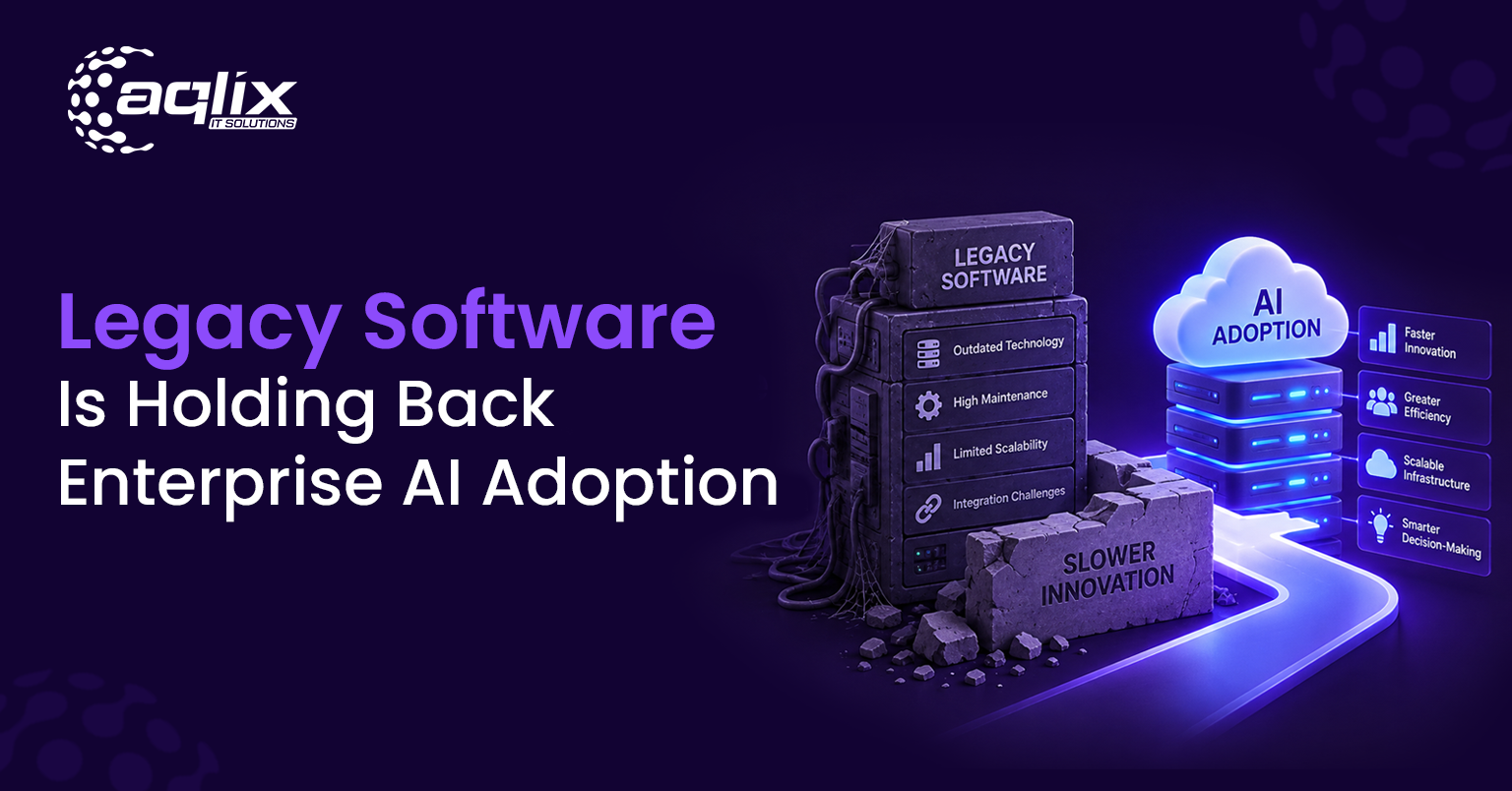

Everyone seems to have something to say about AI. Sales demos show integrations that seemingly allow firms to build super apps with convenience and efficiency through automated approvals, predictive dashboards, and report writing agents. After building this for a client, integrating modern AI models into aging working systems is a laborious and, in most cases, futile effort. It can even cause systems to fail.
These are situations we see more frequently at Aqlix IT Solutions. Innovative use cases for AI completely fall apart due to inadequate integration with back-end legacy systems. Most clients: Hi modern AI models, although brilliant, do not provide any value if integrated into legacy systems unsupported by application modernization. These systems put up architectural barriers and restrict data flow.
Why Legacy Systems Quietly Sabotage AI Initiatives
Legacy systems were not designed to deal with the expectations of APIs, real-time data, or AI. Therefore, legacy systems cannot communicate data that is intelligent. Unless there is an intentional modernization effort done on a legacy system, data will be stuck in outdated formats in systems with limited accessibility. AI working with modern systems has access to a wealth of data. However, AI working with legacy systems is forced to use old and unstructured data.
1. Data Trapped in Rigid, Outdated Systems
On-premise systems of the past were often built as closed boxes. Data generated all those years ago is now formatted in a way that makes little sense for modern needs. Because of these quirks, getting clean data out in a useable format for AI models often requires building custom connectors, exporting data to a destination manually, or finding creative solutions to the problem, all of which increase the time required and are error-prone.
Instead of a system that requires manual extraction of data every single time, a well-thought-out cloud migration provides data and a system that can easily be queried, connected, and also scaled. After a core system is migrated to the cloud, real-time pipelines required by AI systems are then possible.
2. The Hidden Cost of Maintaining Old Systems
Legacy systems take the largest portion of the IT budget, which could otherwise be used to create new AI technology and optimize the business through new, efficient digital methods. Employees spend a significant amount of their time creating workarounds to poorly written code and do not innovate the business in any way.
Outsourcing technology consulting firms allows enterprises to find out how legacy systems are affecting the ability to innovate the business. An experienced consulting firm will create fast, incremental upgrades instead of a costly and disruptive complete replacement of legacy systems.
Building an AI-Ready Foundation: What Actually Needs to Change
Some people think this process of replacing the current frameworks one by one with newer, more digitally transformative frameworks requires complex, lengthy processes that take a long time. That’s not the case. The first sets of systems phased in require a focus on systems that support and integrate AI frameworks. This includes data pipeline construction, standardization, and integration layer development for contemporary tools. This allows September Consulting Group, Inc. to maintain its critical, day-to-day operational processes.
1. Modernizing the Systems That Feed AI Models
Not all legacy systems require full replacement. However, systems involved with company AI incorporation usually need to be fully replaced because Frankenstein’s code as issued often does not quickly and easily adapt to new integrations. Recognizing which systems pertain to the most significant impact on the business is crucial because enterprises do not want to waste money replacing systems that will not come in contact with AI.
This is where custom software development comes in. Instead of adapting old systems, new systems that incorporate AI can be developed. These systems will assist the business instead of creating new bottlenecks.
2. Automating the Migration and Deployment Process
Modernizing systems using older technology requires testing each individual component of the system. Because AI can evolve daily, enterprises that don’t automate this process will struggle to keep up. When automation is the exception rather than the rule, new integrations or updates increase the risk of the project, whereas they should be a normal, everyday part of a business.
DevOps significantly decreases the time it takes to modernize a system. It does this by automating the testing and deployment of new components. This allows systems to be modernized at a more predictable rate. Automation also ensures that the systems modernize at an incremental pace; in other words, the systems become less and less risky with each deployment.
Conclusion
The adoption of enterprise AI doesn’t slow down because the tech itself isn’t built; it slows down because the machinery upon which AI was built was constructed eons ago. Aqlix IT Solutions specializes in helping enterprises to modernize the systems that will enable AI to grow. Aqlix helps enterprises to modernize the frameworks upon which old AI technology was built. Aqlix then helps enterprises to build a truly modern framework upon which AI can be constructed.
If legacy systems are sabotaging your AI progress, you probably can’t buy your way out of it by purchasing new tools; you probably need to modernize the foundation upon which these tools rest. Call Aqlix IT Solutions, and they can give you an idea of what it would take to modernize your systems toward AI.
FAQs
Why does legacy software hold back AI adoption in enterprises?
Legacy systems were not built to be flexible enough to be integrated with modern AI tools. They usually save information in inflexible formats, which AI models perceive and interpret as complete and lying in silos, which results in poor accuracy. Because of this, many organizations avoid using AI models.
Do enterprises need to replace all legacy systems to adopt AI?
Most enterprises don’t need to modernize everything at once. Usually modernization is required only to the particular systems that provide input data to the AI initiatives. A phased, prioritized approach is the quickest and least disruptive to operations method to achieve a system modernization.
How long does legacy system modernization usually take?
Timelines for completing AI implementations depend on the specific systems used. With a phased approach, prioritizing critical systems, most enterprises see core advancements in their AI projects in about four to eight months, as opposed to implementing an enterprise-wide full AI-focused infrastructure. Without an enterprise-wide infrastructure overhaul, the company achieves core AI goals in a shorter period.
Can AI tools work alongside legacy systems during modernization?
Yes. A lot of businesses use AI tools with legacy data through integration layers and middleware in a controlled environment so modernization can continue. Aqlix IT Solutions, like many other companies, is a safe partner for this approach. With their assistance, businesses can provide access to AI tools for more targeted services without having to go through a complete system modernization.
What’s the first step enterprises should take toward AI readiness?
Identify exactly where data doesn’t flow well and data quality or performance is problematic. Clarity as to the most important systems to modernize will help avoid trying to decide which legacy systems are the most important to address first. A roadmap for modernization will become much clearer.