

Many companies still depend on old systems that were developed years ago to run important parts of their business. These systems may still work but typically restrict flexibility, hamper innovation, and prevent growth. As businesses scale and begin to embrace digital transformation plans, the call for updates to legacy infrastructure is louder than ever.
What does “non-legacy renewal” mean? This is a strategic approach that allows organizations to move from inflexible, legacy-based platforms to scalable, innovation-ready environments. With the use of state-of-the-art technologies, organizations can speed market product development and drive operating efficiency to sustain growth.
Organizations on the digital transformation journey tend to adopt structured legacy modernization strategies so they can transform without losing productivity. Organizations such as Aqlix facilitate this journey by empowering companies to adopt cutting-edge solutions that are in line with their future business vision of building visionary technology to grow sustainability.
Challenges With Legacy Systems
Legacy systems continue to underpin a significant amount of core business activities, but increasingly they also have the potential to become barriers leading to stagnation. But given its legacy, it’s not necessarily well-suited for more current digital requirements. With unpredictable markets, businesses require systems to scale, integrate, and be responsive fast.
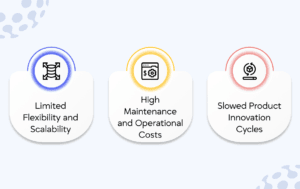
1. Limited Flexibility and Scalability
Old-school platforms have inflexible architectures which limits the ten-box functionality that can be added or signed into their systems. This inflexibility can retard the ability to respond to evolving business requirements.
For organizations that are expanding, technology needs to be able to handle more demands and new services. Legacy systems struggle to handle growing demand, resulting in slow performance and lag. It is also difficult to enter new markets or introduce new products when the infrastructure cannot be scaled.
2. High Maintenance and Operational Costs
Older ones need to be continually serviced in order to function. The frequency of updates, manual corrections, and dependence on legacy technology can drive up long-term operating costs.
Companies may also rely on expert solutions to support those platform, which can be expensive and challenging to maintain. And of course hardware capabilities and compatibility just compound the problem, taking resources away from innovation.
3. Slowed Product Innovation Cycles
“You don’t move super fast in a legacy world.” Simply introducing a new functionality or enhancing what we have in place is likely to become a complex change that will be time-consuming and costly.
This delays getting products to market and makes the ability to respond to customer needs more difficult. For competitive sectors, delays represent potential growth loss. In comparison, modern platforms enable testing and prototyping at speed and organizations can deploy quickly to meet changing customer needs.
Strategic Approach to Legacy Renewal
The “renewal of legacy” needs thoughtful strategising and an organized structure. Instead of wholesale system replacement, companies can take a phased approach to modernization that does not disrupt nor break the chain.
A well-defined path assists organizations to transition incrementally and coordinate their modernization efforts with larger objectives. This enables enterprises to construct systems that can scale and serve both current operations and future expansion.
1. Assessing Systems for Modernization
The legacy renewal process starts by evaluating the current systems to see where and how they need improving. Part of the review is performance, scalability, integration and security risks.
Organizations need to decide which systems are life-and-death and which can be updated or replaced. Such prioritization is an important contributor to the efficient use of limited resources.
Migration and automation opportunities By analyzing system dependencies, businesses can also spot patterns for migration and automation as well as machine learning integration to increase efficiency.
2. Aligning Renewal With Business Goals
Business drivers should drive the modernization of legacy. Regardless of the objectives, be it providing a better experience to customers, growing faster or building products quicker, technology should serve these ends.
Modernization stemming from business goals is modernization that matters. It also makes certain that technology investments lead directly to growth and innovation.
Digital Transformation Companies with a focus on digital transformation usually adopt newer solutions, like AI development and data analytics to help enhance performance and decision-making. They can consider higher-level solutions that enable modernization and the ability to innovate at scale.
Driving Innovation Through Modern Platforms
Contemporary systems as a base for innovation. By swapping legacy systems for scalable platforms, companies can streamline product development and become increasingly efficient.
“Technologies like machine learning, chatbots, and automation tools are easier to implement when systems are built on a dynamic architecture.” This lets us quickly try new things and react to changes in the market.
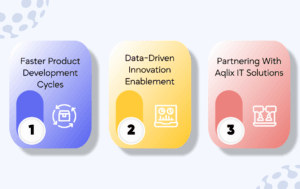
1. Faster Product Development Cycles
Agile development Using modern vending platforms Teams can now test features earlier and share them with customers faster. You can deal with refreshed tools, automated processes and work with environments sitting on the cloud to make sure that you’re more productive.
The shorter the development cycle, the faster the time to market. Businesses can launch new products and services without the burden of legacy limitations.
The latter agility can drive competitive advantage and enable them to better respond to changing customer requirements.
2. Data-Driven Innovation Enablement
Access to sound and timely data is also a vital freedom for innovation. Data in legacy systems is typically siloed and sits at rest, where it can be difficult to analyze, putting it at fault of use.
Newer platforms improve the facilities for data integration and analysis. Machine learning models can be leveraged by companies to detect trends, forecast results and make decisions.
We achieve this through better data accessibility, leading to more informed strategies, better customer experiences, and more optimized operations.
3. Partnering With Aqlix IT Solutions
To Rise to the Challenge, You Need More than Just Technology To be successful, your members need you to make that transformation happen. Aqlix IT Solutions helps businesses innovate in their applications, scale their platforms and introduce new technologies.
We believe in helping companies uncover new opportunities through game-changing technology, and this drives the direction for everything we build. Their methodology has been developed by combining legacy modernization and software- and product development approaches to enable companies to evolve securely into the future.
Working with established technology partners can also help companies mitigate risk and ensure modernization efforts are in line with business objectives.
Conclusion
It seemed like a lifetime ago when legacy systems served an instrumental purpose in sustaining business functionality. But as enterprises mature, such systems can hinder scale, innovation and efficiency. Companies that are dependent on legacy infrastructure risk falling behind.
Backed by experienced partners such as Aqlix IT Solutions, companies can transform old obstacles into new possibilities. When businesses invest in platforms that scale based on demand, to keep up with their business growth and development, they will be prepared for the future.
Frequently Asked Questions
What is legacy renewal in technology?
Legacy renewal is, in general, the replacing or updating of outmoded systems to improve scalability, performance and integration. It ensures that corporate entities move to modern platforms in order to innovate and transform digitally.
Why do legacy systems limit innovation?
Legacy systems are often built on inflexible architectures and obsolete technologies. These constraints make it challenging to add new functionality, include today’s tools and meet evolving business requirements.
What are the common approaches to legacy modernization?
Typical strategies include the rehosting, refactoring and rebuilding of applications. Every approach has its own virtues with respect to business objectives, system complexity and scalability.
How does legacy renewal support product development?
Contemporary systems support shorter planning cycles, better cooperation, and more straightforward testing. This assists companies in getting their products to market faster and meeting market demand more effectively.
How can AI and machine learning support modernization?
AI and machine learning enhance data-driven analysis, automation and decision-making. Inserted within the scalable ecosystem of connected devices, modern platforms become more efficient and are set for creativity.

