

The lifeblood of modern businesses has become data. Healthcare, finance, manufacturing and retail firms are experiencing this same massive growth in data volume and complexity. Old-fashioned systems can’t keep pace, leading to waste and lost opportunity.
Automation and AI are changing the way companies gather, digest, process, and apply data. Entreprise d’utiliser pour améliorer la précision, réduire les coûts opérationnels et accélérer le traitement des données.
Aqlix IT Solutions helps businesses implement AI-driven solutions that integrate seamlessly into existing infrastructure, ensuring secure, scalable, and efficient data management across industries.
Data Management Challenges Across Industries
Despite advancements in software, many organizations still rely on legacy tools or manual processes to manage enterprise data. These methods prove to be more and more insufficient when the volume and complexity of data increases.
Solving these challenges is essential not only to achieve a more efficient way of working, but also for compliance and to be able to make better informed business decisions.
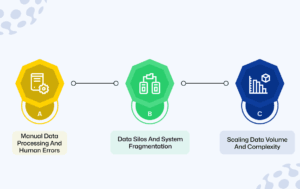
1. Manual Data Processing And Human Errors
Manual processes are time-consuming and error-prone. Typing errors, discrepancies and delays can compromise decision making and compliance.
In the area of finance, reporting errors may occur due to imprecise transaction data for one. In the field of healthcare, manual manipulation of patient records increases hazardous lowering of software utility and the likelihood of misdiagnosis or loss of timeliness in providing treatment. Using AI instead of manual labor also automates these tasks and is both less prone to mistakes and more efficient.
2. Data Silos And System Fragmentation
Most businesses have various separate systems in place. Data silos hide the reality of that data, making reporting complicated and analytic initiatives slow to get off the ground.
The absence of central access makes it difficult for businesses to derive actionable insights, and ensure transferable governance. AI automation combined with platforms of integration can collapse these silos and create free-flowing data, leading to better operational intelligence.
3. Scaling Data Volume And Complexity
The amount of data generated across industries is staggering. Sensors in manufacturing, banking transactions and patient monitoring systems generate large amounts of structured as well as unstructured data.
Such volumes cannot be efficiently handled by legacy systems, resulting in bottleneck and delayed analysis. Scalable, AI-driven automation platforms process massive volumes of data with machine learning technology to identify, classify, and analyze information in real time.
AI Automation Transforming Data Management
AI automation simplifies the data pipeline and allows for a reduction in manual work, greater accuracy and much faster insights production. Its use cases include capture, validation, surveillance and predictive statistics.
Enterprises can operationalize and democratize insights to realize AI’s full potential—by embedding it in the fabric of their organizations, they will be better able to make faster, data-driven decisions.
1. Intelligent Data Ingestion And Classification
AI can collect data from many sources documents, databases and even live streams all on its own. Automated machine learning algorithms categorize and label information based on predefined categories.
This method reduces manual work, speeds up processing and provides organized storage of structured and unstructured data to support analytic and reporting needs.
2. Automated Data Cleansing And Validation
Duplicate values, empty columns are data quality issues that have to be cleaned. AI automation tracks down and fixes these abnormalities while maintaining standards for compliance.
Automated validation lowers operational risk and guarantees the reliability of a dataset to make decision. Businesses can also keep audit-acceptable records without needing to closely monitor each record.
3. Real-Time Data Monitoring And Insights
AI platforms allow for the ongoing surveillance of enterprise data and can deliver immediate alerts, anomaly indicators, and real-time dashboards.
Organizations obtain predictive insights through the use of machine learning models enabling timely decision-making. For instance, finance teams can spot fraud in the making, and manufacturing managers can predict production bottlenecks.
Industry-Specific AI Data Applications
The advantages of AI automation are different for every industry, but efficiency and accuracy are at the heart. Here are real-world applications in important sectors.
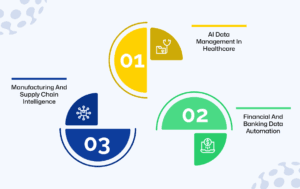
1. AI Data Management In Healthcare
As custodians of sensitive patient information, healthcare organizations are subject to strict privacy regulations. AI also automates patient-record updates, ingestion of lab results and scheduling appointments.
Using machine learning, patient history patterns are being analyzed to enhance diagnosis, predict risks and personalize treatment plans. Automated workflows facilitate the delivery of care and adherence to regulations.
2. Financial And Banking Data Automation
Billions of transactions are processed each day by banks and other financial institutions. AI Reconciles data, detects fraud and prepares reporting for you.
Machine learning algorithms are used to scrutinize transactional behaviors in suicidal and fraudulent actions. Compliance reporting is streamlined, and operational rigor increases, reducing risk and the manual workload.
3. Manufacturing And Supply Chain Intelligence
In the manufacturing sector, there is uninterrupted operational data being generated by the sensors and IOT devices. AI automation pulls in production metrics, detects healthy equipment states, and forecasts the maintenance needs.
Supply chain platforms improve with automated tracing and tracking, inventory optimization and logistics analytics. These analyses drive increased efficiency, minimize downtime, and enable data-driven decisions at scale.
Custom Software Development With AI
The AI tools on the market are good, but they tend to be one size fits all solutions…They’re not custom made for our own operation however.
Everything is working together without a hitch Automation flows and delivers Custom AI platforms make sure that automation becomes part of the system and creates value.
1. Tailoring AI Automation To Business Workflows
Custom AI software development enables us to integrate AI algorithms with your company’s workflows. Ingestion and validation of data, as well as analyses, can be customized according to specific needs, increasing efficiency and minimizing disruption.
AI solutions pinpointed for the operating model including – retailers, healthcare provider and manufacturing.
2. Secure Integration With Enterprise Systems
AI platforms need to be seamlessly integrated with ERP, CRM and legacy systems in a secure manner. The use of home-made software allows compatibility, and data consistency as well as the assumption on security requirements.
Operational continuity is maintained, governance established and automated on AI platform without disruption to existing operations rather than entirely replacing legacy capabilities.
3. How Aqlix IT Solutions Adds Value
Aqlix IT Solutions is an AI-based data handling platform that prioritizes scalability, security and custom software integration. Their know-how makes sure that AI automation is in line with business objectives and operational processes.
Enterprises can deploy accountable machine learning, chatbots, and real-time analytics with certainty to realize outcomes such as efficiency, accuracy and insights across verticals.
Conclusion
AI automation is transforming data management across verticals. Automating data ingestion as well as data cleansing, validation and real-time monitoring allows organizations to obtain more accurate results faster at a lower operating cost.
Vertical applications in healthcare, finance and manufacturing show McMillan the concrete benefits of AI automation. Custom built solution makes sure these solutions are part of the daily enterprise workflow.
Aqlix IT Solutions helps companies implement AI based data management platforms to create and sustain growth with deep technology, process expertise and insights.
Frequently Asked Questions
How does AI automation improve data accuracy?
AI automation also minimizes human errors by automatically categorizing, validating and cleansing data. Anomalies are detected with machine learning, and consistency is guaranteed so record surveillance is maintained for decision making and compliance.
Can AI automation handle large volumes of data?
Not really, AI is built to handle large data feeds from more than one source. They are adept at processing structured and unstructured data, for real-time and predictive analytics along an organization’s operations.
How is AI used in healthcare data management?
In health care, the technology manages patient records, lab results and appointment scheduling. It also enables predictive analytics for diagnosis and treatment planning, enhances patient care, while satisfying regulatory requirements.
Why is custom software development important for AI automation?
Custom software guarantees AI solutions that are adapted to enterprise workflows and compatible with ERP, CRM and legacy systems as well as capable of satisfying the unique requirements for data management. This alignment provides a greater level of efficiency, security and scalability.
How can Aqlix IT Solutions help businesses implement AI automation?
Aqlix IT Solutions offers custom AI platforms, machine learning implementation and real-time analytics solutions. Their abilities enable safe, scalable and effective data management in any environment or industry to drive operational performance and strategic decision-making.

