


The start up space is more competitive than ever in 2025 and investors are being much more selective about where they put their money. There are still a lot of great ideas out there in virtually all the industries one could think about, but to deliver cash is more and more dependend on not only being technology-driven rather than market driven and investor oriented , you must now focus on strong technology, scalability and innovation. With more and more startups vying for increasingly hard to come by investor attention, it has never been more important for founders to understand how these decisions are being made.
Today, investors measure a startup´s potential by its digital maturity, strategic plan and measurable traction. It’s time to pay attention now because strong technology abilities, market demand verification and efficient resource utilization are as crucial as the product concept. Aqlix IT Solutions has learned from these evolutions while helping businesses design technology strategies that enable long-term growth. These patterns indicate how startups can set themselves up better to thrive in an investment environment.
The New Rules of Investing in Start-ups
Entrepreneurs of rapidly growing businesses see access to capital as a path for expansion, but investors look past financial projections. They look at how well the startup’s technology scales, if its product caters to a real need and how quickly the team shifts gears. These issues would influence whether the venture is able to add value and grow in a sustainable manner.
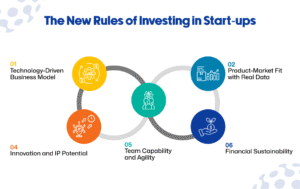
1. Technology-Driven Business Model
Investors have more confidence in startups built on a scalable technology stack. Their ability to be automated and integrated, and their readiness for future growth, are technical possibilities. Early planning in architecture design has helped Aqlix IT Solutions to mitigate long term oper-ational risk. As investors can see clarity in the approach towards technology, it is an indication that start up also has its potential to grow without severe forces of distraction.
2. Product-Market Fit with Real Data
Today, no one’s asking you to fundraise on a prototype alone (though the bar for proving traction is arguably higher today). User adoption, engagement or early revenue numbers are telling you the customers like it. Solid product development backed by data-driven validation eliminates uncertainty for investors and gives startups more credibility. Real usage also shows that the solution solves a last-mile-problem, fits into the market and fits into new specifications as well.
3. Innovation and IP Potential
Investment is still primarily demand-driven: as of now innovation continues to play a secondary role. “Startups that have unique technology, a proprietary process or defensible IP in competitive markets are differentiators.” Sometimes, innovation does not demand complicated systems but only a distinct proposition with quantifiable value. Well documented, it signals where long-term potential lies and decreases the threat of competition.
4. Team Capability and Agility
Founding team founders are scrutinized for ability to execute and pivot. Investors believe a team with both technical and business benefits to be better at overcoming the early-stage hurdles. Agility is particularly crucial in fast-moving industries, where decisions also need to change rapidly. Communicating teams with consistency in problem-solving ability tend to earn more confidence from the investors.
5. Financial Sustainability
Fiscal discipline matters as much as creativity. Shareholders want to know that capital will be wisely deployed and the business will develop reliable paying revenue streams. Responsible planning should be evident when budgeting is transparent, projections are sound and costs are made clear. Sustainable growth is more attractive to investors than fast but fragile expansion, for many startups.
The Technology Factor in Investor Confidence
In a digital-first world, technology capability is the new leading indicator of scalability. Investors assess how well a startup employs automation, data, and smart systems to lay the groundwork for longer-term performance.
Digitally mature startups are ripe for efficient growth. They demonstrate a capability to address growing consumer needs, streamline internal processes and minimize manual errors. These are the traits that help a startup survive and look attractive as long-term investments.
Why do CDOs need to be masters of automation, AI and data-driven decisioning?
Investors are now expecting automation and AI to become integral parts of an efficient business operation. Start-ups that rely on data for decision-making are considered more trustworthy and flexible. These technologies are instrumental in predicting trends, learning behaviors and performance optimization. Now, with technology shrinking that uncertainty a machine like Lucid found real-life customers more quickly and cheaply than it ever would in the pre-internet era the startup looks more like a safer, strategic bet.
Digital Maturity and Long-Term Scalability
Digital maturity measures how well a startup deploys technology in its operations and product development. It is a measure of how good a company is at building and maintaining digital ecosystems that are built to scale rather than for mere functionality. Today, they seek organized technology roadmaps, built-to-last architecture and a unified view of the long-term future all areas where professional technology consulting can make all the difference. More imperatively, startups with strong digital infrastructure seem more ready to take advantage of growth opportunities and respond well to market trends.
Tips for Startups Seeking Investment
You need more than a cool product when preparing to take investments. Startups have to prove readiness in measures, technology, planning and flexibility. Transparent documentation and measurable results make for a compelling case to investors.
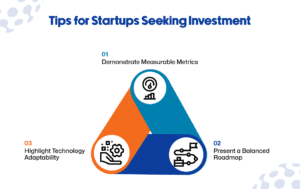
1. Demonstrate Measurable Metrics
Investors use metrics like monthly recurring revenue, user retention and conversion rates to assess how a creator and company are doing. Fact is these are strong signs of getting traction and signals the startup’s understanding on how it’s growing. Strong KPIs also indicate operational discipline, a must for long-term scaling.
2. Highlight Technology Adaptability
Technology needs to be market-adaptable, and investors seek reassurance that systems already in place can scale without an expensive revamp. Flexibility limits long-term risks and provides operational options. Startups that can demonstrate ways their technology could be integrated, scaled or adapted for new purposes make themselves better long-term bets.
3. Present a Balanced Roadmap
A good roadmap is a combination of visionary innovation and practical execution. It provides visible, visual stages of development, milestones and priorities. They like roadmaps that address opportunities and risks. A well thought through plan indicates a good grasp of the business and persistently strategic thinking.
Conclusion
Tech start-ups today no longer only depend on their ideas; they have to showcase clear vision, innovation and digital maturity. Investors are looking for companies that can scale, effectively utilize resources and fill a true market need. One of the most visible signs of long-term success is now a technology foundation that’s built for growth.
Aqlix IT Solutions partners startups to reinforce their tech base, digital advancement and innovation plan. Aqlix enables companies to become investment ready by creating scalable frameworks and organised roadmaps that they can be confident will serve them into sustainable business growth. As the investment world continues to change, tech-focused startups will be able to further gain the confidence of their investors, and open up further opportunities down the line as they can establish that they have strong technology foundation.
FAQs
What are investors looking for in tech startups today?
They assess tech-readiness, scalability of the idea, market validation of idea, innovation, financial discipline and team capability.
To what extent do you need to be ready technology-wise to get an investment?
It is vital because it demonstrates the startup’s potential to scale, automate, and respond to market conditions.
Why do investors care about product-market fit?
It’s a sign that there is a demand for the actual users and mitigates some uncertainty.
What metrics should startups seek to emphasise in their pitch deck for venture capital investors?
MRR, D1/D7 and user activation KPIs, engagement, customer acquisition cost and retention.
What are the ways by which a startup can improve its chances of raising capital?
Through enhancements to the technology stack, validation of demand, documentation of innovation and a clear roadmap.

