


Introduction
We’ve arrived in an era where we can say fairly confidently that data is the only material asset that matters when it comes to building a business strategy in the digital economy. Data is created when enterprises interact with customers, run digital operations, use apps, and are influenced by outside market forces. Yet collecting data alone has no business value. The more difficult concern, however, is to distill this complex and growing body of data into insights that can drive sound decision making.
Too many businesses are relying on outdated or pieced-together reporting systems that can mean reactive (if any) decision making at a glacial speed. You might overlook a chance to become more efficient or adapt to new developments. Aqlix IT Solutions empowers digital transformation by leveraging AI to convert data into smart, strategic business decisions.
AI closes the gap by transforming unstructured to real-time intelligence. Artificial intelligence along with machine learning and automatic data analytics will enable enterprises to make faster, more accurate decisions that are also in-line strategically with business objectives. Aqlix, for instance, works with businesses to help them understand and leverage AI in pragmatic and scalable processes of deliver data-driven change.
The New Dilemma In Modern Business: What to Do With Data?
So with all the data around today, why is it so difficult for many people and organizations to actually use their data?
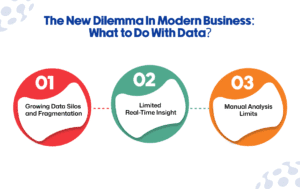
Growing Data Silos and Fragmentation
Information often is scattered across organizations, over different platforms and tools and among a multitude of departments. These silo’s have opaque veil and are counterproductive to fast, enterprise level decision making!
Limited Real-Time Insight
Traditional reporting is backward-looking. Decisions made with data from the past can quickly become irrelevant in fast-moving, dynamic markets.
Manual Analysis Limits
The volume and velocity of contemporary data outpace human analysis. Multiattribute decisions are increasingly complex, at a level that can be hardly supported manually.
Two to three lines:
Businesses require integrated decision models that will never be finished but shaped. AI is at the heart of this by consolidating data, understanding patterns, and surfacing insights that are easy to take action on.
How AI Turns Data into Strategic Decisions
Aqlix AI Development enables businesses to process large volumes of data at speed and extract meaning from it quickly and accurately, helping leaders make timely, well-informed decisions.
Key AI Capabilities for Decision Intelligence in the Enterprise
AI enhances decision-making by sifting through mountains of data to uncover trends, patterns and relationships that would be impossible to notice manually.
1. Predictive Analytics
AI models forecast trends and outcomes from historical or current input. This is crucial for the accurate on demand planning prediction, risk forecasting and resource allocation.
2. Process Automation
Operations AI automates data classification, reporting and operational flows. This reduces the need for manual labor and provides more consistency.
3. Risk Detection and Assessment
Machine learning is also helping to identify anomalies and potential risks faster. That makes it easier for organizations to deal with issues before they become operational or financial headaches.
4. Personalized Customer Understanding
Artificial intelligence reads behavior to deduce what the customer wants. This creates a more tailored experience and increased satisfaction.
For these domains AI accelerates, enhances and increases the accuracy of enterprise decisions so much that this leap from reactive decision-making to pro-active strategy can now be made.
Real-World Applications of AI-Powered Decision-Making
AI-powered decision systems are already enhancing performance in a number of sectors.
1. Retail: Supply Predictions and Inventory Optimization
Retailers are also enlisting AI to use purchasing behaviour, market trends and better allocation of stock to reduce waste in supply chains.
2. Finance: Fraud Detection, and Credit Analysis
Banks use A.I. to monitor transactions and spot anomalies. AI also powers more inclusive and accurate credit decisioning models.
3. Factories: Predicative Maintenance and Operations Optimization
AI parses data from sensors and equipment to detect when maintenance is necessary. Thus, process down time is reduced and production continuity enhanced.
4. Health Services: Clinical Care Support and Coordination
An AI system provides diagnosis support, identify risk patterns and improve treatment pathways with data-based evidence.
Each one of these can serve as an example where AI boosts operational efficiency and decision selection. Aqlix IT Solutions collaborates with the dozens of businesses to innovate an AI system that fits in their industry process flow and strategy.
AI in Enterprise Strategy
We do need structure and we do need clarity, for AI to be promoted in an effective manner.
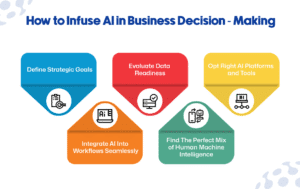
Business Decision Making With AI: How to Infuse AI in Business Decision-Making
The successful integration of AI begins with clear objectives and assessment on data quality and system readiness.
1. Define Strategic Goals
AI initiatives are best when tied to concrete business outcomes—faster throughput, better service and risk management.
2. Evaluate Data Readiness
The intentional value of rigorous data hygiene for AI accuracy cannot be overstated. Before they are comfortable putting themselves at that level of scale, the organizations will have to vet and assess their current data and proceedings structures.
3 Opt Right AI Platforms and Tools
Choosing the technology that aligns with business needs and existing stack brings faster deployment and ease of scalability.
4. Integrate AI Into Workflows Seamlessly
AI is NOT to REPLACE in place processes, its meant to ENHANCE the current process. The integration with enterprise systems make it possible to act on insights immediately.
5. Find The Perfect Mix of Human Machine Intelligence
The analysis is done by A.I human expertise supplies guidance and judgment. The best decision-making environments are an alloy of each.
Two to three lines:
Adoption of AI/ML is an ongoing journey. Performance review, skills import and on going improvement are all requirements if we are to truly unlock the value of AI-based intelligence.
Conclusion
The power of AI as an enabler for dissecting data into useful BI is already accepted. It enables companies to be able to make more informed decisions, faster and in alignment with their goals. AI systems are able to provide efficiency, innovation and durability for the future.
Aqlix empowers companies to get AI solutions developed at the best of their interest. With the Aqlix value bridge, businesses turn their data into smart decision making by leveraging both technical capacity and strategic consulting.
Ready to transform your data into smarter decisions? Contact us today to discuss your enterprise AI strategy.
Frequently Asked Questions
What is AI-driven decision-making?
Well, it’s applying machine learning algorithms and data science to provide insights and recommendations for organizational planning and execution.
Why is AI so important to business strategy?
With AI, organizations have the ability to process immense amounts of data faster than a human, and as a result decisions can be made in p logic that are at once more accurate and timelier.
Does AI replace human decisions?
AI Decision-Making is covered by AI with an advise. Strategy decisions are still being made with human judgment.
How Businesses Could Succeed Integrating A.I.
Start with a clear goal, assess data readiness, choose the right tool or tools for the job, and integrate AI into work that already exists.

