
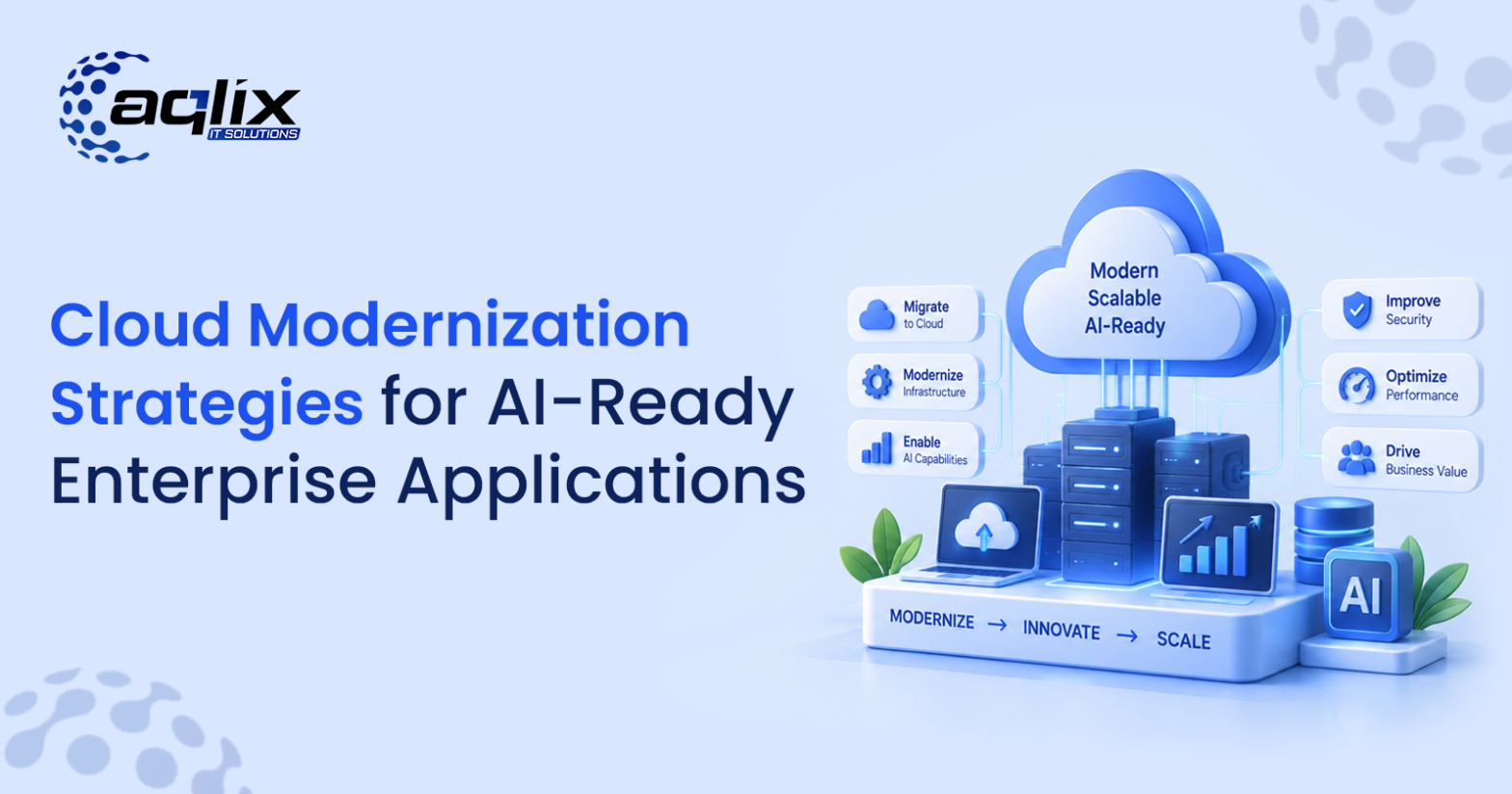

Enterprises never randomly upgrade their cloud infrastructures for fun. Usually, an AI initiative will demonstrate the inadequacy of legacy systems and infrastructure. AI systems require infrastructure and cloud systems that can efficiently process large amounts of information in a short amount of time. When ingeniously designed AI systems attempt to talk to, or run, legacy applications, the AI systems that require the infrastructure begin to fail.
Aqlix IT Solutions helps enterprises with application modernization to ensure that they are prepared to support AI systems before AI projects even begin. Most failures in AI are caused by an inadequate foundation of infrastructure rather than bad AI models. Preparing the cloud foundation for an AI project makes the projects faster, cheaper, and more reliable.
Why Legacy Infrastructure Can’t Support AI Workloads
Most enterprise systems were designed for a predictable, steady workload. AI systems perform work in a burst and move and process data continuously. Many enterprises try to use AI tools in their existing inflexible systems. The results of implementing AI tools in an outdated system are slow response times, high system costs, and poorly performing models. Systems designed to perform AI tasks require flexible, real-time computing infrastructure, which most of these enterprises do not have.
1. Monolithic Architectures Slow Everything Down
Legacy applications built as giant monoliths are almost impossible to update and almost impossible to connect to modern AI tools because of the risk of breaking the whole system or causing major issues in the system. This can be time-consuming because developers are then forced to test the whole application instead of just the small section they are wanting to update.
For these monolithic systems, breaking the application into microservices allows developers to add new features within the application, such as AI tools, while the rest of the application stays the same. This will also make it easier in the future if the development team has to change or upgrade the AI models or tools being used.
2. Data Silos Block AI From Getting What It Needs
The quality of an AI model depends on the data used to train it, and your typical enterprise really lacks in that department. Most of your data is stored in silos in different departments and systems that can’t communicate. This makes it pretty much impossible to build a functional AI model. Some of these roadblocks include:
- Duplicate or conflicting records of customers stored in different departments
- Lack of a single source of reporting and data analytics
- Systems built many years ago that cannot be communicated with using modern APIs
- Replacement of Integration Systems with Spreadsheets
- Different systems have different access and security policies
The advanced AI models that companies have built so far are bound to run into problems because they lack the data to provide them with a complete picture of what is happening with the business.
Building a Cloud Modernization Roadmap for AI Readiness
The successful modernization of a cloud network requires more of a long-term commitment than a one-time project. Many enterprises create one project to modernize their cloud network as if it were the last phase in their digital transformation. Automation must be integrated into the project from the start, and cloud infrastructures must be viewed as adapting and upgrading over time as opposed to a one-time upgrade. The most crucial workloads for AI must be attended to first and foremost.
1. Assessing and Prioritizing Workloads
When teams attempt to modernize in a prescribed time period, usually progress stalls and teams become dissatisfied. The first step to utilizing AI appropriately is to determine which workloads will experience the greatest benefit from available AI.
This is an area where outside technology consulting firms will add the greatest value. They will be able to discern which internal systems are perceived as priorities by the organization vs. those that are actually the highest priorities to address. An upfront, proper assessment will allocate the right amount of resources in order to modernize the organization in a way that adds long-term value to the enterprise.
2. Automating Deployment and Scaling
Manually deploying AI systems includes training, updating and deploying models. Distributing software updates manually is slow, and improper deployments lead to errors. AI system users suffer as organizations aren’t able to deploy updates to AI systems and applications often enough to fulfill the needs of the market and users. AI systems developed without proper DevOps strategies lead to longer times between software updates.
DevOps principles accelerate the process of deployment while reducing the time needed to test and automate scaling. Features and models can be deployed within hours, as opposed to weeks. Most automation systems enable AI tools and models to stay on the main application while allowing developers the luxury of quickly reverting only the affected parts of the system to a previous version.
Conclusion
Enterprise applications require significant foundation-level transformation to achieve AI readiness. Aqlix IT Solutions focuses on reconstructing the foundation of the cloud, providing enterprises a means of modernizing legacy applications, workload by workload.
Typically, the AI infrastructure challenges enterprises face demand an overhaul of the infrastructure rather than tuning algorithms and models. Aqlix IT Solutions provides customized modernization plans centered on addressing the challenges faced by the enterprise.
FAQs
What is cloud modernization for AI-ready applications?
It is the infrastructure update process to enable enterprise applications to work with AI with no difficulty. This can be achieved through a variety of methods, including the use of cloud computing with a focus on scalability, breaking large IT systems into many smaller ones, and even making data easier for AI models to consume.
How is cloud modernization different from a regular cloud migration?
A traditional cloud migration moves applications to the cloud without changes. A modernization for AI readiness migration goes beyond moving the applications to the cloud to redesign the architecture and data flows to integrate and scale AI tools without the performance-saddle bottlenecks from making workarounds.
Which enterprise applications should be modernized first?
Focus on AI models that work with customer-facing applications or touch the data that is most essential to your business. Those models will bring the most value and will be the most visible when AI is integrated. It’s okay to delay dealing with larger internal systems until customer-facing AI is integrated.
How long does cloud modernization for AI readiness usually take?
The number of legacy systems impacts timelines, but most businesses experience major changes in operation within four to nine months when work is prioritized. We can shorten most timelines and are able to deliver on our solutions significantly faster when compared to our competitors. Engaging Aqlix IT Solutions helps businesses avoid common mistakes that are often made in the early stage and allows us to deliver promised services without delays.
Is cloud modernization worth it if we’re not using AI yet?
Yes, upgrading to modern infrastructure, while waiting for the ROI of AI solutions, improves the performance and reliability of the systems while making them easier to integrate with tools powered by AI. AI tools will eventually become necessary and will create a competitive advantage. Waiting for AI solutions will almost surely put businesses in a race for modernizations. This will result in rushed and poorly planned updates.