

There is a strongly increasing need for trustworthy and scalable Software as a Service (SaaS) systems, which support digitalisation in order to offer products and services in organisations. Companies require apps that scale, add new functionality, and update customers without performance compromises. Here, scalability is not optional It’s fundamental.
The sustainability of a SaaS application is strongly dependent on its ability to scale maintain response time, and support business growth while keeping the platform secure and cost-effective. Aqlix IT Solutions has learned the hard way through several cloud and SaaS development initiatives practical lessons learned on real-world challenges. These insights are summarised in the following sections and inform a methodology for building scalable SaaS offerings.
What Makes a SaaS Application Scalable From the Operating Opinion?
A scaling SaaS platform can accommodate growing traffic, growing users, and growing data as well as new features no matter how big or small. It scales with growth and system complexity, without compromising on performance and stability.
It is not that worse to commit to the scalability through a design decision, and it is less scary than scaling at last-minute. Architectural design, leveraging efficient cloud infrastructure, smart data management and scale-ready deployment pipelines are resulting in a platform that “grows” as demand grows.
Fundamentals of Building SaaS Apps that Scale
“Scalability involves a broader set of architectural, operational, and security issues. The foundations of SaaS development are based on the following principles.
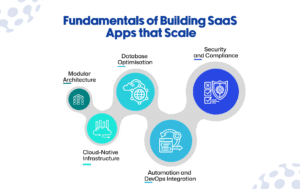
1. Modular Architecture
Modularization, commonly in the form of microservices, makes autonomous development, deployment and scalability possible. Rather than having to scale the whole application up, you can choose which modules are under heavy load and scale only those. This minimizes operational risk, maximizes development agility and allows organizations to respond faster to new requirements.
2. Cloud-Native Infrastructure
Elasticity is a characteristic of cloud platforms, like AWS, Azure and Oracle Cloud, that allows systems to grow or shrink resources on the fly. They provide load balancing, container orchestration, data redundancy and global reach. Cloud Native Development Minimizes reliance on hardware and increases uptime, speed of deployment, and resilience.
3. Database Optimisation
With an increasing user activity, data size is also increased. Database strategy which scales Database scaling techniques include indexing, caching, sharding, read-replicas and automated backups. And, depending on what to do and need, a mix of relational vs no-sql can be appropriate (e.g. yes or not read query key distribution will effect the number of hops made per set:key).
4. Automation and DevOps Integration
Automated release workflows decrease time to deployment, increase repeatability of releases and reduce the risk of them breaking stuff. Chương trình bang thích phần mềm (DevOps practices like CI/CD pipelines, version control, and automated testing allow teams to update quickly and confidently.
5. Security and Compliance
Secure Authentication SaaS solutions need secure authentication in con ac- cord with encryption processes, multi-factor verification and role-based access. Compliance is to GDPR, ISO 27001, HIPAA or SOC what security was integrated from the beginning and not an add-on at the end.
Challenges and how to address them
Although scalability provides some benefits in the long term, it is not without its architectural and financial pains. Knowing them early helps you avoid technical debt and rework.
1. Managing Cost While Scaling
Cloud resources can get expensive as they add up. Businesses require monitoring tools, cost-control polices and usage analytics to remain efficient. Choosing the right kind of storage, server instances and automation can offset costs.
2. Balancing Performance and Complexity
“Too many capabilities with snowflake reference data cause an acid wash of explosion when things that become brittle need to mature,” he concluded, “and not all pattern come out extremely quickly be scoured.”
Fast-growing customers scale more easily: beyond the initial architecture there are extra layers of complex integration you have to move through microservices, between components, into your analytics pipelines and across integration points. Well documented, dependency mapping and container orchestration aids in visibility and scaling doesn’t require a OOD developer.
3. Continuous Monitoring
User feedback alone can not be used to assess performance. Real-time observability tools monitor response time, CPU utilization, database queries and API latency to catch problems early. Others are synthetic tests and automatic alerts to help keep things running smoothly.
Future SaaS Scalability Trends
SaaS is still adapting and headed toward predictive, self-healing infrastructure. The following macro trends are determinants of the next stage in scalability:

1. AI-Assisted Scaling
AI-driven auto scaling decisions based on traffic, patterns and resource requirements. Prediction models predict the load on the system and it changes performance settings before load overruns.
2. Containerization
Containers, and orchestration tools like Kubernetes, provide standard deployment environments and easy scalability. They prevent config errors, are portable and support zero-downtime deployments.
3. Predictive Infrastructure
Cloud models of tomorrow are moving from static configuration to smart provisioning. Applications will also optimise themselves in regards to automatic predictive analytics on capacity and user demand, as well as end-user profiling analysis.
Lessons from Aqlix’s Expertise
SaaS development at Aqlix IT Solutions Values structure, planning and cloud alignment. The development process generally starts with the discussion of user needs, workflow intricacies and long-term business requirements. Your architecture should enable modular growth, testing environments, automation and secure data management.
Its not-so-secret sauce includes performance telemetry, user experience and feedback loops baked into its development lifecycle. Cloud Based Deployment, API Integration, Continuous Improvement to See The Future The meta-view on a stable and future-proof SaaS App. The aim isn’t just to get everyone off the ground and on their way, but also to manage growth so when requirements change they are going to be able to continue.
Conclusion
When you create a SaaS software, which is scalable enough to survive this kind of traffic, then it requires careful architecture and planning based on data. Using a combination of cloud infrastructure, modular design, automation and robust security makes new applications resilient to change without creating operational drag.
With a strong SaaS and cloud application development background, Aqlix IT Solutions aim to build platforms that are flexible, reliable and move in line with your growth as an organisation. Scalability is not an arrival point, but, it’s a discipline that continues with the right tools and processes and development philosophy.
Frequently Asked Questions
By why is scalability important for SaaS applications?
Scalability involves that the application can sustain both user increase and functionality without losing performance.
How does cloud infrastructure relate to scalability in SaaS?
The cloud platform offers elastic resources, worldwide accessibility and auto-scaling service.
How do microservices support scalability?
Microservices enables modular updates and scaling of components, without unpredictable effects on the entire system.
What are the typical cost difficulties in scaling Saas platforms?
Costs can go up with more and more use, so we have to track and optimize spend.
What are the technologies that will drive next generation scalable SaaS systems?
Artificial-intelligence-powered monitoring, predictive scaling and container orchestration tools are among key players.