

Organizations in the digital era are creating more data than ever. Customer engagements, business operations, market conditions or internal systems are constantly generating valuable information for us. Yet, information rich does not mean decision quality. For most companies, the big task is taking raw data and turning it into defensible strategic direction.
This is where a Decision Support System, or DSS for short, becomes significant. Well-designed DSSs assist organizations analyze data and compare alternatives, and then help in making better decisions with more confidence. Contemporary DSS solutions integrate data analytics, visualizations, and automation to facilitate strategic, tactical as well as operational decision making.
As firms look for sustainability and elasticity, intellígent DSS solutions are now a must in their strategic planning. They enable leaders to think beyond gut feelings and to use data-based insights for guiding business direction.
What is DSS (Decision Support System)?
DSS (Decision Support System) is an interactive, computer-based system intended to help decision makers utilize data and models to identify and solve problems and make decisions. Whereas most reporting tools report the past, a DSS enables exploration, comparison and prediction.
At the heart of the DSS, data from different sources are consolidated and analytic models are used to assist users in understanding potential results. Such systems enable decision-makers to ask complex questions, simulate scenarios and evaluate the impact of different choices without dedicating resources.
Today’s DSS systems are agile and flexible. They can be used for structured tasks, like budgeting and forecasting, or semi-structured or unstructured tasks, including market entry strategies and operational improvements. Custom software development and sophisticated analytics allow organizations to modify DSS solutions so that they closely mirror their particular business objectives and workflows.
The Strategic Role of DSS in Business Development
DSS are structural systems for long-term business success planning. Through the delivery of focused, timely insights, they round-out strategic planning on all fronts.
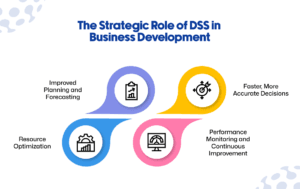
1. Improved Planning and Forecasting
A good plan must be grounded in the past as well as focused on the future. DSS systems can provide trend analysis, pattern and external agent identification and projections to help with accurate forecasting. This allows for organisations to predict market fluctuations, customer demand and future risks to make more robust strategies.
2. Faster, More Accurate Decisions
With respect to intuition alone, bias and inconsistency can be introduced. A DSS minimizes ambiguity by distilling raw data into actionable insights in real time. Decision makers can easily weigh options, compare scenarios and make informed decisions in context- -rather than in theory.
3. Resource Optimization
Strategic planning is often about how best to invest scarce resources among competing priorities. Guidelines (DSS) -The tools support process to enable the organization maximizes use of financial, human capital and operating systems in rid areas waste and particularly useful integers to introduce improvements.
4. Performance Monitoring and Continuous Improvement
A DSS enables continuous performance monitoring with the use of dashboards and KPIs. Real-time monitoring also enables business to track progress against their strategic editorial goals and change plans when the situation dictates it which serves as a form of continual optimization and flexibility.
DSS and Emerging Technologies
The range of Decision Support System provision is currently increasing due to new technological developments. Artifical intelligence, cloud computing, and predictive analytics along with other mashups of technologies are making historical DSS-platform deliver more value.
Machine Learning and AI-based analytics help the systems to recognize trends, learn from the data and predict insights. This enables the DSS platform to go beyond descriptive analysis, and help decision makers get more proactive. Automation additionally streamlines operations by eliminating manual work and speeding up insight development.
Cloud computing offers the ability to scale up and down data volumes, and support a distributed team. Cloud DSS solutions also enhance accessibility and collaboration insights can be accessed at any time and place. Technologies turn DSS into smart systems that learn as the data from and the business requirements for them evolve.
With proven technology solutions providers like Aqlix, organizations can bring these types of capabilities in-house through smart software development that matches technology to strategy.
Components of an Effective DSS
A good DSS, however, consists of a number of integrated components that collectively provide you with real decision support.
1. Data Management Subsystem
Data management-data capture, storage and organization from internal and external sources. This could be enterprise applications, customer databases, back end systems and 3rd party data feeds. Clean, serialised and consistant data is crucial for accurate analyses.
2. Model Management Subsystem
The model management subsystem includes the analytic models, algorithms and business rules which are used to compute analytics. Those models might be used for forecasting, optimization, risk assessments or scenario-based analysis. Through the use of various models, policy-makers can consider some alternatives and assess possible results.
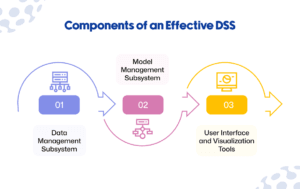
3. User Interface and Visualization Tools
Opportunities need to be easy to interpret in order to have value. Visualization solutions help turn complex data into dashboards, charts and interactive reports. An intuitive design allows users to naturally uncover these insights and make informed decisions in different roles throughout the organization.
By outsourcing a custom made software development, the individual components are then able to be combined in one DSS platform which fits organizational procedures and strategy.
Use Cases of DSS in Action
Decision Support Systems applicated in various business activities in several industry. In the field of finance, DSS applications help in investment analysis, financial planning and risk management. Organizations can optimise investment and risk by analysing market data and past performance.
With real-time visibility, organizations can lower costs, minimize downtime and improve service. For marketing, DSS applications include customer segmentation, campaign and pricing feasibility analysis. By learning who customers are and how they prefer to interact, companies can customize offers and increase involvement.
These examples show how DSS platforms turn data into actionable advice that supports strategic goals for all sides of the business.
Conclusion
Decisive Decision Support System As the mind becomes strong all information is turned into strategy, and then used as a tool to produce measurable results. Using data management and analysis, visualization and emerging technologies such as artificial intelligence (AI) or machine learning, DSS platforms help organizations make intelligent decisions faster and more confidently.
Markets are more complex and competitive so strategic planning is more than just a feeling. Intelligent DSS solutions offer the kind of transparency and understanding required to make sense out of uncertainty and propel growth that’s built to last.
Aqlix builds and deploys Decision Support Systems based on custom software development and cutting-edge analytics that allow companies to develop their own DSS in the context of their vision and operations. Allowing companies to harness the power of their own data makes intelligent DSS an all-important basis for well-informed planning and development.
FAQs
What is Decision Support System?
A Decision Support System is software to use in the decision making process when energy analysts want to analyze, assess and take decisions using Analytical models that produce news from Data.
In what way does a DSS enable strategic planning?
A DSS offers managerial planning and strategy building by using forecasting, scenario analysis, and performance monitoring tools to assist the leaders to plan their decisions properly while adjusting strategies in accordance with data.
Do DSS products have adaptability factor for individual businesses?
Yes. Custom software development can adapt DSS platforms to individual sectors, processes or strategic goals.
What are the technologies that make advanced DSS platforms so much more than a simple dashboard?
Artificial Intelligence (AI), predictive analytics, automation, and cloud computing substantially extend the capabilities of DSS for accuracy, speed, and scalability.
Are DSS systems a good fit for SMBs?
Yes. Scalable DSS systems can be customized to suit any organization, regardless of size, and like all forms of analytics, lend themselves to data-driven decision-making.

