

The heart-of-the-house operations are running on legacy systems, but key business demands in 2026 require more scalability, security and digital agility. The challenge If your business is like most, the modernization of systems once considered a technical exercise alone has moved firmly into the strategic sphere.
This blog examines successful legacy system migration tactics which support businesses and public sector organizations in renewing with stability and confidence. With the support of seasoned technology partners, including Aqlix IT Solutions, companies learn that they can dovetail modernization projects with digital transformation objectives and do so in ways that deliver continuity and resilience and sustainable system performance over time.
Why Upgrade Legacy Systems?
Legacy architecture can quickly become an obstacle to innovation, integration and the very flexibility businesses need in order to adapt to rapidly changing markets. With our infrastructure getting older, the risk of downtimes, increasing security vulnerabilities and maintenance costs will only increase.
Legacy system upgrades offer organizations better performance, greater data visibility, and the flexibility to support advanced technologies such as ML-enabled analytics, automation, and intelligent workflows.
Proven Legacy System Upgrade Strategies
There is no single formula for successful modernization. The optimal plans weigh technical enablement and business needs so that the businesses can transform systems over time while keeping the core logic in place.
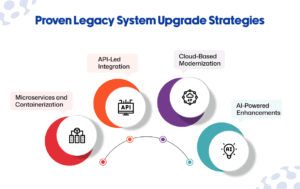
1. Microservices and Containerization
Microservices architecture is the method of cutting up big, monolithic apps into smaller standalone services. Each service serves a distinct role, making systems easier to update, test and scale independently.
Containerisation platforms add value to portablity and deployment consistency. Combined, they simplify the system and enable continuous integration and delivery practices in developer teams.
2. API-Led Integration
The result of API-led integration could for instance be old systems that work with new ones without the need to modify them. The APIs are the controlled interface through which data will flow safely between the old and new systems.
This works well especially when launching an SaaS application, cloud app or analytic platform. It is also based on phased modernisation, which minimises business interruption during the process.
3. Cloud-Based Modernization
Cloud-Based Modernization Cloud-based modernization is a strategy that migrates legacy workloads to the cloud for scalable and elastic services, but preserves critical business systems. This leads to more elasticity, much easier availability and DR with no need for a re-write of your whole system.
Adoption of cloud native services will help reduce infrastructure overhead and ensure performance consistency between distributed team. Hybrid cloud is a popular model for keeping sensitive data on-premises to support incremental change.
4. AI-Powered Enhancements
AI infused improvements bring intelligence to existing systems without replacing them entirely. Predictive, anomaly detection and operational insights can be enhanced through machine learning models exposed as modular services.
Chatbots and AI-Based automation systems can also improve engagement with users as well as with your own team. These capabilities support companies in driving more value from the resources they have while positioning systems for future innovation.
Challenges and Considerations
Though maintaining the value of legacy systems in the long run, their modifications bring operational issues and technical challenges. Companies will need to consider that modernization efforts do not interfere with the organization’s core business processes when assessing risks.
- Budget limitations: Technology modernization projects typically demand investment in infrastructure, development and consulting up front. Costs can spiral out of control if things aren’t planned properly, especially when all those hidden dependencies lying in legacy systems are uncovered during upgrades.
- Data migration and integrity risks: When moving data from legacy systems to new platforms, these can create differences or loss if not done correctly. Data validation and compliance have to be accomplished at every phase of migration.
- System downtime and business continuity: There may be a period of down time when upgrades are applied to systems. Phased deployments and parallel operation can mitigate operational disruptions, while still providing critical services during the migration.
- Employee adaptation and skill gaps: Today’s platforms frequently introduce new technical skills and patterns of work. To support the necessary adjustments, training and change management will be essential to help teams transition to and make appropriate use of new systems.
- Integration with existing tools: Many legacy environments communicate with other internal or external applications. Planning for modernization should include designing for ease of integration through APIs and middleware.
How Aqlix Facilitates System Upgrades
Aqlix helps corporations it by guiding their legacy system update projects to ensure that technology choices are on the same page as business needs. Customize: focus on building scalability on your architecture, driven through integration and managing the digital transformation with less amount of disruption.
Aqlix’s custom development and modernization planning are all designed to assist businesses in moving towards cloud-ready, AI-empowered systems. It’s opinionated toward convention and long-term maintainability, but it also values simplicity and practicality.
Conclusion
Business that want to stay both efficient, secure and dynamic in 2026 must invest in upgrading their legacy systems. Strategic modernization allows organizations to maintain key functionality while adopting the art of the possible with cloud, APIs and AI.
Leveraging established upgrade playbooks and partnering with experienced technology vendors such as Aqlix IT Solutions can make responsible decisions about modernization and architect a future-ready digital foundation.
Frequently Asked Questions
What are common practices in a legacy system migration/up-gradation?
A modernizations legacy system is the updating of existing systems for performance, security,and integration without disturbing core business sequence logic. This could involve moving to the cloud, connecting APIs or rebuilding for cost of evolving features and reordering the system fare fit in today’s digital world.
Will traditional systems be able to handle AI and ML?
Yes infrastructure can be older, however they have to be able to talk and allow the use of AI in those ancient systems having smart components that gets added to an application technology, utilising API based models and modular layers and so on. This method permits companies to incorporate predictive analytics, automation and chatbot features without upgrading the whole system and hence facilitating an easier, faster and cheaper modernization.
Are upgrades to legacy systems too risky for business as usual?
There are risks, but they can be moderated through phased testing, staging environments and controlled deployments. A well planned upgrade path reduces downtime, ensures data is not corrupted and guarantees that this technology investment adds value to the business through phased introduction of new features.
How long do legacy system upgrades typically take?
The time frame depends on system complexity, data volume and scope of upgrade. Smaller changes may require a couple of months or so, while enterprise-wide overhauls may even last longer. An incremental approach to initiatives enables the organization to make changes over time and keep things relatively stable.
Why is technology consulting a vital aspect of system upgrade?
Technology consulting: Strategic guidance, risk assessment, and architectural planning during upgrades are provided. It makes sure that modernization efforts are secured in relation to business priorities, regulations, and future running room so organizations can avoid expensive false moves and painlessly arrive at digital transformation that sticks.

