

Technology is playing a bigger role than ever in the success of today’s businesses, and those businesses must remain flexible as markets and customers change. The reality is, most companies today are running on such legacy systems those built for stability and scale rather than agility or speed of innovation. Though they’re typically vital to daily functions, these systems can hinder growth and development.
As the growing demand for digital experiences increases, companies are exploring strategies that allow gradual transformation. API-led architecture makes integration easier, more flexible and allows for new innovative possibilities. Companies like Aqlix partner with organizations to meet this through a robust modernization strategy that suits long term business needs.
Challenges of Legacy System Modernization
It’s usually challenging to modernize legacy systems since they were designed for a time that is past. As the booming companies grow and adopt digital means their old setup may fail to support the current business demands.
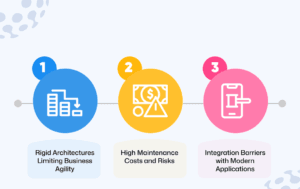
1. Rigid Architectures Limiting Business Agility
A lot of existing systems work on monolithic design patterns, where the modules are heavily interconnected to one another. Small changes are hard, which can make adding new features problematic.
The lack of flexibility delays application modernization and limits the ability to quickly adapt to shifts in the market. Teams might struggle to roll out new technologies and platforms, such as mobile or cloud tools or ML-driven analytics into their existing systems.
Organizations increasingly require systems that can change quickly as business needs evolve. Without modernization, innovation gets slower and less effective.
2. High Maintenance Costs and Risks
Legacy systems must be well-maintained to continue functioning. In the long run, this results in increased cost of operations, reliance on specialized skills and greater technical debt.
Risks can also compound older platforms do not respond to modern defense techniques. It’s also harder to keep up with releases and patches, allowing security holes.
Rather than investing in innovation, companies may be forced to dedicate more time and money to keeping the lights on. This can diminish the power to invest in product innovation and digital changes.
3. Integration Barriers with Modern Applications
The existing platforms were not purpose built for modern day integrations. Integrating them into cloud or mobile applications, or with chatbot systems in particular, can be challenging.
Data Silos and Limited View Across Business Functions Integration is a teething challenge which means that businesses often start experiencing siloed information as well as poor visibility across the board. This influences decision, so operation efficiency decreases.
Speaking of unified experiences, businesses might find it difficult to create a seamless digital experience without proper connectivity. API-led modernization can break down those barriers by establishing a system of coherent communication.
Steps for API-Led Application Modernization
A well-defined path is necessary for any successful modernization. Their current systems need assessment and they should develop a plan that is halfway between an innovation push and stability.
1. Assess Legacy Systems and Dependencies
The first step is to understand your existing infrastructure. This means knowing the critical applications, databases, and integration points.
“In the time we have at home, it’s a good opportunity for organizations to look at what their most critical systems are and where they have the biggest performance impact. Dependency mapping identifies for us where APIs will be most valuable.
This helps to provide a solid foundation for application modernization planning
2. Design Reusable and Secure APIs
Long-term success is heavily dependent on API design. A well-designed API should enable scalability, security, and governance.
There are security features like authentication, encryption and access control which protect sensitive information. Good documentation helps with reusing the APIs between various projects.
Reusable APIs lower development time and ensure seamless integration on all platforms.
3. Incremental Modernization Without Downtime
It is risky to cast off a legacy system all at once. API-led modernization also changes the principles to be adopted step wise by businesses.
The introduction of new services in a gradual manner while still allowing the existing systems to run. This means less downtime and disturbance to daily operations.
Gradual adoption also enables teams to track performance and improve on the quality, as they go along.
Business Value of API-Led Modernization
The benefits of API-led approaches go beyond just technology. They build metrics-driven business implications that drive long-term growth and are sources of innovation.
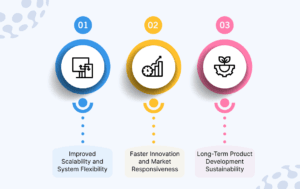
1. Improved Scalability and System Flexibility
API-centric architectural constructs allow easier extension and scaling. Simple growth of an organization, adding additional services, applications or users with little structural change.
This flexibility will allow us to scale and adopt a digital strategy for the future. Teams can shift as required without changing fundamental infrastructures.
2. Faster Innovation and Market Responsiveness
Application modernization enables companies to more quickly deliver new features and digital products to market. Development can be based on existing APIs instead of being built from the ground up.
This minimizes time-to-market and facilitates rapid experimentation. Businesses can be more responsive to customer demands and market developments.
And facilitate incorporation of cutting-edge tools such as ML analytics and AI based automation for better decision making.
3. Long-Term Product Development Sustainability
API-first modernization supports sustainable product development by encapsulating reusable components. This will make it easy to add updates and new material in the future.
As businesses grow, APIs allow new integrations, services and apps to be spun up. This next gen architecture allows businesses to keep pace with competition.
Aqlix partners with customers to establish API strategies that complement the longer-term product development needs and can scale and adapt over time.
Conclusion
We know legacy systems are crucial for many organizations, but if they’re left as is, they bottleneck growth. API-led modernization of the legacy system is a balanced way out, which provides a way to modernize applications without affecting core processes.
With discipline and a clear technical strategy, businesses can transform legacy environments into innovation-ready architectures. Aqlix IT Solutions quickens the pace of transformation by empowering organizations to build scalable, secure and easily adaptable modernization options that are cost-effective and aligned with long-term business objectives.
Frequently Asked Questions
What is API-led legacy modernization?
API-led legacy modernisation is the concept of using APIs to create a secure connection between the old system and new applications. It offers a path for incremental technology refreshs while continuing to leverage core systems, supporting application modernization and improved integration.
How does API-led modernization support product development?
Reusable APIs mean faster development of new features and faster deployment of changes. These shared services are surfaced to the teams developing them and can be used as is, without modification in back-end systems, fostering rapid time-to-market and flexibility.
Is API-led modernization suitable for all businesses?
These are API-led strategies that make sense for many organizations still stuck on legacy systems yet needing to adopt a modern architecture. Depending on the complexity of the system, business requirements and long-term goals, this approach can be tailored.
How does this approach reduce modernization risks?
Rather than having to swap out entire systems, APIs make this update process incremental. That cuts down time, keeps the lights on and enables teams to test improvements gradually without bringing the house down.
What role does Aqlix play in modernization strategies?
Aqlix partners with organization and help them design thoughtful modernization plan, build scalable API’s and also helps them to integrate more agile tools like AI, ML and automation in this process.

