

Artificial intelligence is not just for experimenting anymore it’s here to shape how modern businesses operate at scale. AI development advancements provide businesses with the ability to automate repetitive processes, mine large volumes of sophisticated data for patterns or insights at speed, and draw complex conclusions from data sets. Across sectors, AI-powered tools are working with teams to enhance productivity, eliminate operational drag and pivot in a changing market environment.
For the businesses moving through digitalization, AI becomes an elemental technology that links up data systems and people. Companies can find ways to do this through structured deployment and technology advisement that tie AI projects to actual operating imperatives, not isolated instances of innovation.
How AI Streamlines Modern Workflows
AI advancement is pivotal in streamlining manual, fragmented, or error-prone workflows. Intelligent business processes provide an opportunity to deliver that consistency, speed and accuracy across the enterprise.

1. Automated Process Management
AI automation decreases reliance on repetitive human intervention in daily tasks. RPA leveraging the machine learning models enables systems to perform tasks with minimal errors, including data entry, document processing and approvals. These intelligent workflows evolve as they learn from patterns, and attempt to improve the efficiency of execution without requiring regular reconfiguration.
2. Predictive Insights for Smarter Planning
Predictive analytics is a generic derivative of the development of AI. AI development models predict demand, resource consumption and operational risks based on both historical and real-time data. Businesses will be able to predict bottlenecks, better plan their inventories and allocate resources according to the anticipated demand rather than on their instinct. This method results in more accurate planning cycles and less operational uncertainty.
3. Enhanced Communication Through AI Systems
Chatbots and virtual assistants that are enhanced by AI – many of which are run on large language models (LLMs) contribute to seamless communication, both internally and externally. They manage day-to-day requests, enable instantaneous access to information and help coordinate work among teams. “With AI, response times and information gaps are reduced, enabling better productivity and overall workflow coordination.”
Practical AI Applications in Manufacturing and Technology
Manufacturing and tech are among those most affected by the advent of AI development as they operate in data-heavy and process-driven environments. Real-time automation, monitoring and optimization of complex operational environments AI allows actions at an unprecedented scale in terms of volume, variety or velocity.
1. Equipment Monitoring and Predictive Maintenance
AI algorithms process sensor data collected on an industrial machine to identify anomalous behaviour that may lead to failures. With it’s combination of overhead and sectional doors, this initiative maximises the lifespan of your products.
Less downtime build in to your system Bidfood CardiffThis joint solution made by Portiso and an industrial door specialist reduces unplanned downtime, prolongs equipment life, AND helps prevent a rise in maintenance costs. This early warning feature increases operational security and continuous production.
2. Supply Chain and Logistics Optimization
By analyzing data about demand patterns, supplier performance and logistics alongside inventory levels and transportation routes, these AI-powered supply chain systems make decisions to minimize costs among all available options. Businesses can see across the supply chain, eliminate overstock and expedite deliveries.
This knowledge is the key to being able to rapidly respond in an agile way to changes and disturbances in markets.
3. Automated Quality Assurance
Computer vision based automated inspection of products during their manufacturing process. AI means defect detection with more accuracy and consistency than human checks. This not only improves product but also dramatically reduces waste and meets industry speed requirements.
4. Risk and Compliance Monitoring
Operational data, safety and regulatory parameters are monitored wherever the appropriate AI supports such real-time risk detection. Smart systems pinpoint potential dangers, raise red flags about compliance and issue bite-size items of advice. It lowers operational risk and fosters compliance with governance and regulation.
Business Benefits of AI Development
Artificial Intelligence development adds quantifiable value if it helps in achieving operational goals. Not so much displacing human talent, rather AI uplifts decision-making and fuel operational efficiency throughout departments.
1. Cost Efficiency and Resource Optimization
AI eliminates operational waste and optimizes resources by automating operations and predicting results. Companies benefit from less expensive labor, loss of downtime and better asset utilization. These savings are sustainable as efficiencies compound over time.”
2. Faster and More Accurate Decisions
Analytics powered by artificial intelligence provide real-time insights and predictive scenarios to help leaders quickly respond. Policymakers can make simultaneous assessments on many different streams of outcomes without depending only on intuition. Reducing the time and effort it takes to make a decision speeds up response time to market shifts and internal operational needs.
3. Strengthened Competitive Position
Firms that embrace AI ahead of competitors can achieve a range of operational flexibilities and data-driven abilities. AI enables innovation, scalability and continuous improvement that makes it easier for businesses to react quickly and execute more in agile environments.
Challenges and Mitigation Strategies in AI Adoption
Integrating AI into business processes demands a thoughtful approach and careful execution. However some practical challenges are usually faced by organizations that need to be tackled at the beginning.
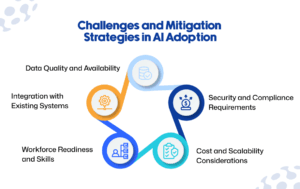
- Data Quality and Availability: Structured, accurate and large volumes of data are keys to the AI systems. Low quality data could lead to less accurate models and make AI-generated insights appear inaccurate.
- Integration with Existing Systems: Many companies are running on outdated systems. Adding AI capabilities to business applications, pools of data and workflows can be pretty technically challenging when the architecture should have been prepared.
- Workforce Readiness and Skills: Employees have to be trained to work with AI tools. Effective adoption is about the change management, upskilling and overtly communicating the role of AI in day to day running of enetrprises.
- Security and Compliance Requirements: AI use cases frequently make use of sensitive business data. It’s crucial to protect on data privacy, regulation compliance and a secure system access for long-term sustenance.
- Cost and Scalability Considerations: The cost of jumping into AI research, infrastructure, and knowledge can be high. Companies need to design scalable solutions that have intrinsic value over time.
Partnering with Aqlix IT Solutions for AI Development
AI is most useful to organizations when it’s attuned to actual business objectives. A consulting led, structured approach to delivering on AI ensures that outcomes can be measured.
- Business-Centric AI Strategy: Aqlix collaborates with companies to identify issues up against while operational problems and develop AI use cases that are grounded in business challenges and isolated experimenting.
- Technology Consulting Expertise: With a combination of AI tools and technical consulting, Aqlix IT Solutions helps enterprises drive digital transformation by modernizing workflows, identifying areas ripe for automation and bolstering operational efficiency.
- End-to-End AI Implementation: It supports everything from data evaluation and model building to system integrating and performance tuning, such that the AI solution is actually applicable and scalable.
- Focus on Manufacturing and Technology: AI capabilities Cross-industry expertise from manufacturing to technology is used to deliver robust solutions that can tackle complicated workflows, data systems and operation needs.
- Long-Term Optimization and Support: AI systems evolve over time. The ongoing monitoring, fine-tuning and optimisation are designed to deliver continued operational efficiency and business benefit.
Conclusion
The development of AI promises to revolutionize enterprise operations by allowing for automation as well as predictive insights and better decision-making. With structured data, subject experts and strategic technology consulting added into the mix, AI provides plant manufacturers with tangible efficiency gains and long-term value. Aqlix helps businesses deploy workable AI solutions in support of their operations to create and sustain a digital journey.
Frequently Asked Questions (FAQ)
What is AI for business?
AI development is the creation and usage of advanced systems (a set of machine or computer algorithms) that can work and react like humans, automatize processes, analyze data, and make decisions. In professional workflows, AI helps increase efficiency, accuracy and scale.
How do LLMs and chatbots help organizations?
Big language models as well as chatbots deal with user questions, internal support and knowledge access. They make response times faster, reduce stress on team members and keep everyone communicating with one another.
Can AI be used by Small and Medium Businesses?
Yes, AI business solutions can and should be scaled across businesses. Here is why, with the appropriate consulting, small- to medium size businesses can move forward incrementally on AI must-do’s as a function of business operation and budget.
Which industries will gain the most from AI dev?
Manufacturing, tech companies, logistics and healthcare also see meaningful upside from processes driven by data and the potential for automation. Yes, however AI development can provide value in most industries.
How much time does the implementation of AI develoment solutions take?
Go-live schedules are based on complexity, data preparedness, and integration requirements. Typically, projects are implemented in two to three phases and you can perceive tangible benefits within the first few months.

