

In the modern enterprise, we’re quickly moving beyond simple automation to intelligent, AI-powered infrastructure that can learn and adapt and scale. A strong AI automation strategy helps organizations put processes in place to make better decisions, optimize operations and react more rapidly as markets fluctuate.
Enterprises considering AI need to take a structured, business-aligned approach as they adopt AI. From a technology strategy perspective, we’re enabling businesses to create an AI automation strategy that delivers innovation while controlling for operational risk over the long term not just testing new things out.
The Shift from Traditional Automation to Intelligent AI Systems
Conventional automation is built on fixed-rules and static workflows that can efficiently perform repetitive actions with no ability to adapt. Though rule-based systems can reduce manual labor, they face difficulty in dealing with exceptions or shifting data patterns as well as complex decision situations.
AI automation incorporates intelligence derived from machine learning, natural language processing and adaptive algorithms. These systems are capable of parsing data, learning from results and getting better over time. This transformation enables organizations to advance from task automation to goal-driven automation, which accelerates the fulfillment of strategic aims.
Business-First AI Automation Roadmap
You always want to start with business objectives, not technology assessment. Organizations need to determine where they can have an impact on the bottom line or their customers in terms of costs savings, faster services provision and better customer service.
A business driven with road to align AI use cases to operational priorities, customer expectations and compliance. This structured approach prevents companies from falling into the trap of siloed AI deployments and makes sure that their investments contribute to sustainable growth. Aqlix collaborates with stakeholders to set clear targets and success metrics as well as governance mechanisms.
Governance in AI Automation
Quantifying success of AI automation and addressing risks must be done together. A methodic approach enables companies to monitor the performance of AI while allowing its adoption in a responsible and compliant manner.
Key metrics to measure success
- Cost reduction through reduced physical effort and improved workflows
- Greater speed of response and better process precision for all operations
- Better customer satisfaction, particularly for AI-led support and engagement
- Scalability of Autonomy solutions and services as business demand increases
Risk management and governance priorities
- Safeguarding a person’s right to privacy and secure treatment of private matters
- ML model debiasing using perpetual evaluation and training
- Preserve system reliability and transparency in AI-based decisions
- Creating governance frameworks for regulation compliance and accountability
By regularly tracking performance and responsible AI governance, companies can realize sustainable value from AI automation while also creating long-term trust among stakeholders.
Technologies Powering AI Automation Today
Nowadays AI automation is powered by substantial technologies allowing systems to remember, think and even learn from experience. Working hand-in-hand, these technologies generate intelligent workflows to bring increased efficiency, accuracy and scale to business operations.
1. Machine Learning and Predictive Models
Machine learning allows systems to recognise patterns, predict results and constantly improve decisions as they are given new information. Predictive models are leveraged across demand forecast, fraud detection and operational planning, enabling businesses to predict issues before it is too late.
With ML models embedded in core business processes, organizations can shift from reactive to proactive decision making. Over time these models get better, so that they work out to be more efficient and less operationally risky.
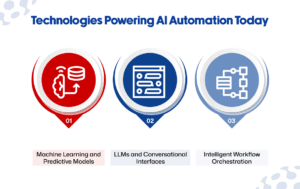
2. LLMs and Conversational Interfaces
LLL and conversational AI have also redefined how organizations engage with users and internal teams. AI chatbots and virtual agents can be used to address customer questions, help employees work through procedures, and assist in accessing knowledge from multiple systems.
In addition to those basic responses, LLM-powered chatbots can track context, navigate multi-step conversations and connect with enterprise systems. This has the potential to make service desks, HR helpdesk and customer engagement all the more automated.
3. Intelligent Workflow Orchestration
Smart workflow Orchestration brings an entire “automation layer” that automates across a wide range of systems, people, and processes. Autonomous orchestration AI-powered orchestration can dynamically route tasks, prioritize them and adapt workflow to real-time situations.
Such functionality is especially important for complicated workflows that require approvals, data validation, and multiple department cooperation. Automating decision points allows organizations to remove bottlenecks and provide consistency across executions.
How Aqlix IT Solutions Crafts Tailored AI Automation Strategies
At Aqlix IT Solutions, we view AI automation as a strategic transformation, not an isolated technology project. Mixing it up with AI business consulting, custom development, and system integration, the company creates offerings that can be embedded in targeted business contexts.
- AI Strategy and Consulting: High-impact use cases to implement and Road-less-traveled of Automation Journeys
- Custom AI Development: Creating ML models, chatbots, and intelligent flows that support workloads-Based on your operational requirement.
- System Integration: Easily integrating with existing business platforms meeting both technical and business KPIs
- Continuous Optimization: Tracking of performance and model refinement for long term value.
This holistic approach also guarantees that AI automation projects are scalable, stable and business-centric.
Conclusion
AI-based automation is simply no longer a nice-to-have for today’s businesses interested in running efficiently, effectively and competitively. A sustainable approach involves smart technologies and good governance enhanced by evidence-based targets and continuous improvement.
With the right roadmap and execution partner such as Aqlix IT Solutions, companies can develop AI automation capabilities to fuel sustainable growth, enhance decision-making and future-proof operations in an increasingly digital world.
Frequently Asked Questions
What is an AI automation strategy?
AI automation strategy A blueprint for using AI, machine learning and intelligent workflow to automate processes. It integrates technology projects with the business agenda, so that technology automation provides quantifiable efficiencies, scalability and enduring value to operations as opposed to whimsical technical solutions.
What is the difference between traditional automation and AI automation?
Traditional automation works on rigid rules and workflows while AI automation is driven by data learning and evolves over time. With AI-based systems dealing with more difficult decisions, context and better accuracy, these are the proper technologies for ever changing business models and operational needs.
What types of businesses are most affected by AI automation?
The ones where impact would be the highest are customer support, internal workflow, data analysis, compliance and sales enablement. Not only does AI streamlining automate away manual tasks, it also leads to faster response times and better decision-making in these functions as a whole, particularly for processes that are high volume or have multiple layers of complexity.
Which risks should businesses bear in mind when implementing AI automation?
There are risks such as privacy of data, bias in models, reliability of the system and compliance. Mitigating these risks requires effective governance, open processes, long-term audits and continuous monitoring to make sure AI operates in a responsible way that is consistent with business and ethical values.
What exactly is Aqlix IT Solutions contribution to the AI automation drive?
Aqlix IT Solutions offers full range solutions ranging from AI consulting to custom development, system integration and optimization services. This systematic methodology enables companies to deploy scalable, secure and business-aligned AI automation strategies that drive true value.

