

AI automation is increasingly shaping the fabric of contemporary corporate strategy. With organizations struggling with additional operational complexity, intelligent automation provides a systematic method to drive efficiency and minimize manual effort in order to make informed decisions through the data.
No longer a novelty experiment for entrepreneurs and CEOs, AI automation is a factor on all kinds of projects. It is a pragmatic strategy for smart business growth which integrates technology, human and process aspects of an organization towards achieving long-term objectives.
Core Capabilities of AI Automation
AI automation’s value is a blend of intelligence, velocity, and flexibility. It’s not just a dumb command-line, it also does strategic planning and performance optimization.
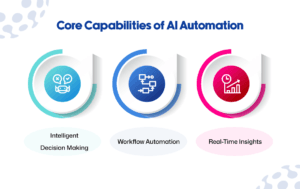
1. Intelligent Decision Making
AI analyzes huge volumes of data across numerous sources for insights and trends that otherwise might not be apparent to human teams. These observations also enable enterprises to assess, predict, and prioritize potential risks.
ML-based decision support systems mitigate the need for assumptions and foster evidence-based planning across departments.
2. Workflow Automation
AI automation one of the best direct benefits to society is taking away people’s boring, rule-based work. From document production to monitoring systems, workflows can be automated to minimize human intervention and errors.
This feature enables teams to focus on higher value tasks like improving processes or engaging with their customers.
3. Real-Time Insights
Analytics tools Analytics platforms empowered by AI surface real-time insights about operational KPIs as well as customer activities and market conditions. Automation-powered dashboards are dynamically refreshed as new data comes in.
This type of direct insight also leads to faster responses when a performance start to diverge, enable companies and teams alike to keep the business stable as it grows.
Advantages for Business Growth
When applied strategically, AI automation can fuel intelligent business growth by addressing inefficiency rates and delivering consistent, scalable results.
1. Increased Productivity
Automation helps in minimizing the time of repetitive activities that need to be performed, allowing teams to focus on strategic tasks. AI facilitated tools also enable the speeding-up of convoluted processes that otherwise had to be manually orchestrated.
With higher productivity comes the ability for businesses to do more with less and avoid increasing their cost levels.
2. Enhanced Customer Experience
Artificial intelligence listens to AI automation replaces scripted responses with the smart chatbots, recommendation engines and intelligent routing systems that power personalized conversations. These instruments decrease response time and ensure that operation service is always the same.
AI systems also enable companies to predict the needs of individual customers and fine-tune service delivery models over time through by analysing customer data.
3. Scalable Operations
One of the main advantages of AI automation is its scalability. Instead, smart systems scales the capacity requirement to load not cost or complexity.
This scalability means that businesses can scale to grow, extend into new markets or add offerings with control and predictability.
Challenges in AI Implementation
As advantageous as AI automation can be, it also brings its own challenges which need to be carefully factored in. But there is still a lingering worry around information privacy, particular when it comes to sensitive or regulated data.
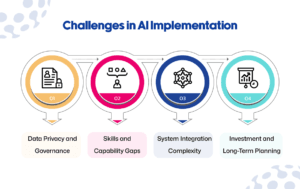
1. Data Privacy and Governance
AI systems often process sensitive business and customer data at scale. But companies without strong data governance programs are at risk of non-compliance and losing trust. Sound policies around data access, storage and use will help ensure that AI automation remains secure and compliant with jurisdictions.
2. Skills and Capability Gaps
There are also plenty of companies without AI/ML skill sets in house. This gap in skills can slow implementation and limit the success of automation initiatives. Structured training, external experts and phase-by-phase growth models help teams slowly build up confidence as they grow into AI responsibly.
3. System Integration Complexity
It might be difficult to technically integrate AI into your old systems and current platforms. Formatting and workflow of your data as well as the infrastructure might differ when you move, so make sure to prepare for that. Transparent Integration Planning lessens pull and leaves you with integrated systems.
4. Investment and Long-Term Planning
The investment in technology, data prep, and governance is a function of the adoption of AI automation. Companies that lack long-term strategy can find it hard to scale beyond pilot projects. A focus on scalable and valuable technology in early planning is a driver for greater adoption, which equals less people risk.
Aqlix’s AI Automation Expertise
Aqlix is tackling AI automation with a focus on process structured technology consulting and AI development styles that are tightly coupled with measurable business objectives. Instead of being hung up on specific tools. For models, it’s more important to align processing, data maturity, governance and long-term integration planning.
Blend of ML engineering, chatbot dev, and smart system integration enables Aqlix IT Solutions to help customers at all stages of the AI life cycle. This encompasses strategy definition in the early stages (ideation), validating use cases, deploying models and iteratively optimizing them within an organization’s digital ecosystem such as cloud platforms, SaaS offerings or enterprise applications.
This best-of-both-worlds approach, one that’s measured and methodical, is helping organizations progress from AI ideas to production-ready AI with greater visibility into how models are created and managed driving sustainable business growth.
- AI strategy and technology consulting for your business
- ML engeniring and data pipeline preparation.
- Chatbot and intelligent automation development
- Seamless integration with other enterprise systems
Conclusion
AI Automation is changing the way companies are looking at growth in a data driven economy. By putting intelligence inside workflows and decision processes, businesses can see drastic real-world improvements in efficiency, scalability, and adaptability.
With the right type of technology consulting and the appropriate implementation, AI automation is a dependable driver for intelligent business expansion, as opposed to standing on its own. Integrating AI into your overall strategy enables continued value creation in every sector.
Frequently Asked Questions
What industries benefit most from AI automation?
AI automation can be implemented in many sectors, from manufacturing and retail to healthcare logistics and professional services. If your organization handles large amounts of data or the repetitive tasks in which waste can occur, you can achieve greater efficiency, decision making capabilities and scale with intelligent automation.
How does AI automation support business scalability?
AI automation supports scalability as it can process larger workloads without linear augmentation in resources. Smart systems bend to volume variations, work by themselves and give live intuitions, thus, enabling ground-breaking business expansion at the same time keeping its performance & cost under control.
What role does machine learning play in AI automation?
Machine learning makes AI system capable of being trained with past as well as current data. ML models enhance predictions, automate classification and contribute to decision making by detecting patterns that change over time as new data are collected.
Are chatbots considered part of AI automation?
Yes, chatbots are a popular application of AI automation. They are using natural language processing to field customer questions, direct requests and disseminate information. This lowers response time and helps continue the conversation from other touchpoints.
What should businesses consider before implementing AI automation?
Businesses will need to evaluate their data readiness, integration needs and governance policies prior to adoption. Clear goals, capable teams, and harmonization with legacy systems are all part of the picture to make sure that AI automation is a value contributor over time not simply making for some quick-and-from-a-bottle efficiency.

