

In the modern business world, businesses are continuously challenged to maximize efficiency and productivity, quality, and cost. Manual workflows, wasted resources, and scaling hurdles tend to drive up operating costs and are a drag on growth. The use of AI automation is a real-world solution for smoothing processes, slashing waste, and trimming costs throughout departments.
At Aqlix we work with businesses to deliver AI-automated solutions that automate mundane tasks, improve processes, and create intelligent actionable insight. AI and machine learning for cost savings By applying AI and machine learning, companies can effect a meaningful reduction in costs as they work to improve overall operational performance.
Operational Cost Challenges In Businesses
When processes are inefficient and resources are not managed properly, operational costs be in the fast lane for some companies. “Identifying those cost drivers is the first step to deploying tech-enabled solutions.
The hidden expenses for unnecessary manual work, duplicated processes and non-lean operations by businesses are huge in many cases. AI automation solves this with smarter workflow management, predictive insights and an intelligent system that can automate processes.
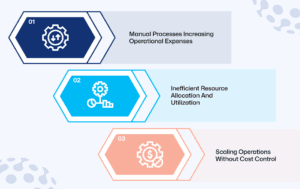
1. Manual Processes Increasing Operational Expenses
Manual, repetitive activities (for example, data entry, invoice processing and regular reporting) take too much time for employees. Labor expenses escalate as teams spend hours doing low-value work, while mistakes result in rework, delays and costs.
AI-based automation is less dependent on human intervention for repetitive jobs. Technologies such as machine learning models, smart chatbots and RPA have greater accuracy in automating mundane tasks to give staff space for strategic work that creates more value.
2. Inefficient Resource Allocation And Utilization
Organizations frequently have no visibility into how their resources are performing, which results in underutilization or misallocation. Equipment, people and supplies can sit idle in some areas at the same time that other places facing strong demand are understaffed or undersupplied.
AI-driven analytics and machine learning ensure efficient allocation of resources. In this way, businesses are able to cut waste while improving efficiency- things that were not possible before.
3. Scaling Operations Without Cost Control
Creaky growth models still add headcount, overhead, and ops costs on a 1:1 basis. Businesses trying to expand without good tech backup can find costs increase and success falter.
AI automation scales without linearly scaling operation costs. A manned system is able to address increased workload whilst being embodied in a ready growth manner and maintain standards even under the business needs expansion.
AI Automation As Cost Solution
Under traditional scaling models, headcount, overhead, and operating costs tend to rise in parallel. Companies trying to scale up without leveraging technology can suffer from escalating operating costs and diminishing returns.
With AI powering the automation it also means that you can operate at scale without incurring linear costs. Robotic systems can effectively manage larger volumes of work, scale quickly and maintain quality levels in situations where business requirements grow.
1. Process Automation Reducing Labor Costs
AI automation reinvents operations management by minimizing labor reliance and streamlining processes, as well as improving decision-making. It enables companies to deliver tangible cost savings and a performance boost by creating smart systems.
Enterprises that are able to leverage AI strategically can sustain a competitive position, minimize waste, and realize even greater ROI from operational investments.
2. Predictive Analytics For Cost Optimization
AI-based predictive analytics forecast trends, demand shifts and even potential system failures. This also gives businesses the ability to avoid downtime, overstocking, and misallocation of resources.
Learned insights are utilized by machine learning to generate continuous optimal operation and can add value to prediction with more up-to-date data in reducing avoidable costs of operations as well as aiding decisions.
3. Error Reduction Through Intelligent Systems
Mishaps in manual tasks, like invoice errors or data entry mistakes, are expensive. Machine learning algorithms help to put an end to these errors through automatic verification, anomaly detection, and real-time monitoring.
Smart automation guarantees the same procedure being followed on all work in progress, greater compliance, and lower financial risk. Functions like finance, logistics, and customer services are major beneficiaries of error-free performance.
Implementing AI Automation Strategically
Integration of AI must be carefully considered so as to promote cost savings and not obstruct business. A systematic approach drives easy integration, strong ROI, and long-term process improvements.
Aqlix is helping companies develop AI strategies that match their workflows, make them more efficient, and connect with existing tech infrastructure.
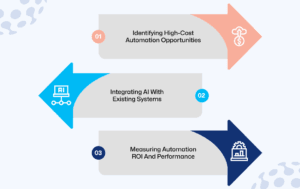
1. Identifying High-Cost Automation Opportunities
The first step in determining suitable tasks is to examine workflows to identify tasks that are labor- and/or time-intensive, repetitive, or subject to error. Focused attention on high-potential-RoI automation projects directs resources where they will have the greatest effect.
Workflow and process mapping analysis will enable organizations to find the areas where AI can provide immediate cost savings and efficiencies.
2. Integrating AI With Existing Systems
AI automation is most effective when it’s connected to enterprise systems (e.g., ERP, CRM, operations). It’s also straightforward for your teams with frictionless integration allowing data to flow between tools and teams, so you get a better view and better cooperation.
Bespoke software development allows businesses to integrate AI models, machine learning algorithms, and intelligent analytics within their established framework without interfering with the functionality.
3. Measuring Automation ROI And Performance
Tracking performance is a must for assessing the gains from AI automation. Measurement in the form of KPIs, such as reduced labor costs, error rates, process cycle times, or overall operational efficiency.
With follow-up and analysis in real-time, long-term improvements can be made with the AI application, workflow, etc.
Conclusion
AI automation is a game-changing weapon that lowers the cost of doing business and helps scale quickly. With automation replacing cumbersome manual operations and the fine-tuning of resources and predictive insights being realized in the form of more granularly detailed decisions for material balance, businesses can deliver measurable benefits without compromising product quality or process performance.
Aqlix IT Solutions enables organizations to leverage AI solutions and custom application development for a meaningful operation transformation. With smart automation and AI, companies can cut costs, drive productivity, and create a future-proofed platform for growth.
Frequently Asked Questions
What are the primary benefits of AI automation for operational costs?
The AI automation lowers labor costs, reduces errors, drives better utilization of resources, and speeds up workflows for measurable savings across departments.
Which business processes can be automated with AI?
AI-enabled products, chatbots, and machine learning systems can automate financial, HR, business operations, logistics management, marketing, and customer support processes.
How does predictive analytics help in reducing costs?
Predictive analytics predicts demand, detects impending system failures, and balances resource deployment so companies do not have to waste money or resources with unscheduled downtime.
Can small and medium enterprises adopt AI automation effectively?
Yes. AI adaptations can be tailor-made to the specific needs of an organization, and with regard to SMEs, they are able to automate certain parts of their workflow and gain operational efficiencies without needing significant up-front investments.
How do I measure the ROI of AI automation?
Labor cost savings, error reduction, faster processing cycles, increased productivity, and efficiency gains are the most common measurements. Continuous monitoring ensures sustainable results.

