

SMEs must live and work in a world where every decision can make or break growth, profitability and existence. From product development planning to operation adjustment, SMEs need to take decisions timely and well-informed without the support from many of the resources that would be normally required. Without organized systems, these decisions can be made through conjecture, manual data management and siloed intel.
DSS solutions aim to close the gap between data and insights as organizations undergo digital transformation initiatives. Businesses such as Aqlix IT Solutions are committed to helping firms from small start-ups to large corporates, unlock transformational technology that delivers efficiencies and sustainability.
Decision-Making Challenges Faced by SMEs
Within organizations run by small business owners, decisions may need to be made on the fly without all the information necessary. In the absence of structured tools, managers rely on intuition, scattered reports or out-of-date insights, which may impact consistency and accuracy.
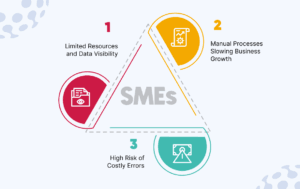
1. Limited Resources and Data Visibility
SMEs are usually associated with constrained budgets and manpower. This has made it a challenge to invest in complex enterprise software or dedicated data analytics teams. Consequently, data continues to live in accounting tools, spreadsheets, emails and customer management solutions.
And lacking centralized data visibility, companies are unable to do anything to follow performance trends, customer behavior or product demand. Those in charge may not have up-to-the-minute details to develop sales plans, manage inventory, or make product development decisions.
2. Manual Processes Slowing Business Growth
There are many SMEs who still depend on manual processes, spreadsheets for tracking and paperwork to report. Such approaches are not only ineffective at first, but they also won’t scale as your business grows. The manual entry of data that increases the probability of errors and bottlenecks in adapting to changing market conditions.
In product development, manual collaboration across teams can be a drag on innovation and time to market. Decision support systems minimize reliance on manual processes by automating the collection, analysis and presentation of information so that leaders instead can focus on strategy.
3. High Risk of Costly Errors
All types of financial and operational errors are likely when you make choices with incomplete or outdated information. Small mistakes without pricing, inventory and resource allocation plans can mean disaster for these SMEs.
The DSS can mitigate this risk by giving structure to the insight and doing some of its work through predictive analysis. ML-driven tools surface patterns and trends that might otherwise fly under the radar, enabling businesses to make better decisions and prevent more expensive mistakes.
Building DSS for SME Needs
Making use of a decision support system does not involve an enterprise-scale investment. Using the above considerations, SMEs can work to craft solutions that best suit their ends and challenges. The trick is to concentrate on areas that add perceivable value and are in line with business goals.
1. Identifying High-Impact Decision Areas
Prior to designing a DSS, SMEs need to pinpoint which decision areas have the most impact on performance. These can range from sales forecasting, inventory planning, operational efficiency and product development strategies.
Businesses can also notice rapid and tangible gains by beginning with high-leverage areas. A business-focused approach means the system will address genuine business needs and not turn into one more piece of software that nobody uses.
2. Integrating Business Data Seamlessly
A decision support system can integrate information from several sources and provide access to clinical databases. Bespoke software development can integrate accounting packages, CRM solutions, production applications and customer feedback portals.
A single point of access for data simplifies performance analysis and derived insights. With the rise of AI development services, SMEs are able to leverage machine learning for enhancing data manipulation, prediction and automation through these platforms.
3. Designing Simple and Actionable Dashboards
A DSS needs to be simple and it should be understandable. Complicated systems frequently break down because teams have a hard time making sense of the information. Intuitive dashboards presenting critical metrics arm your team with clear and timely decisions.
Users can view insights with no technical skills using visual components, auto-reports, and a chatbot interface. It enables the benefits of decision support to be realized throughout the departments, from management through to operations.
Long-Term Value of Affordable DSS
Although the immediate objective to introduce a DSS is to enhance day-to-day decisions, the final value can be larger than short term efficiency. For SMEs this lifetime customer value allows sustainable growth and ongoing innovation.
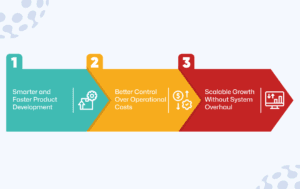
1. Smarter and Faster Product Development
Insights from data are a big part of building products. Businesses can ensure new features, product improvements, and launch strategies are validated with customer feedback, sales trends and market demand.
Machine learning models can predict what customers like, and teams will be able to concentrate on products that have more of a chance of success. This minimizes uncertainty and speeds development cycles, which is critical for SMEs to ensure they remain competitive.
2. Better Control Over Operational Costs
Cost control is always a challenge for the SMB. It also does expense tracking, performance monitoring and resource tuning.
Leaders see inside their practice and make data-driven decisions with real-time dashboards and automated reporting. This helps us prevent waste and keep the budgets aligned with business objectives.
3. Scalable Growth Without System Overhaul
As SMEs expand, so too do their tech needs. Well-designed DSS can grow with the firm, supporting more sources of data, users, as well as decision areas without having to be rebuilt from scratch.
This facility ensures that work is carried on seamlessly and inexpensively. Rather than rip and replace it, companies can add new capabilities to the tool sets they already have whether that’s forecasting modeled with ML or rather customer insights from a chatbot.
Conclusion
The availability of low-cost decision support systems is no longer a prerogative for big enterprises. Finally, SMEs now have tailored tools that will upgrade decision-making and product development processes as well as operational efficiency. These applications support businesses in shifting their approach from reactionary to proactive.
Aqlix IT Solutions shares the vision of empowering businesses, big and small, to implement transformational technology solutions that drive their companies with growth and innovation. Utilizing scalable bespoke software and AI-driven platforms, Aqlix helps SMEs to establish structured decision-making processes such that their tools grow with them.
FAQ
What is a decision support system for SMEs?
A decision support system is a software solution that helps small businesses and middle market companies analyze data and make better business decisions. It consolidates data from all over the place and serves up analysis via dashboards, reports and predictive tools to help companies plan anything related to operations, finance or products.
How can an affordable DSS benefit product development?
A cheap DSS enables companies to analyze customer preferences, sales trends and performance data. This wisdom helps product planning and reduces development risks overall, along with fostering quicker innovation. Armed with this insight-led input, SMEs are able to develop products that more closely align with market needs and expectations.
Is it difficult for SMEs to implement a DSS?
Contemporary DSSs are kept as simple and versatile as possible. There is room for custom systems that would work with CRM or accounting software being used already. And intuitive dashboards and automation means that even non-technical teams can use them without a ton of training.
Can machine learning improve decision support systems?
Machine Learning Yes, machine learning improves DSS by recognizing patterns, predicting trends and automating insights. ML tools assist businesses in forecasting demand, streamlining operations, and enhancing product strategies. This provides greater precision in decision-making and decreases reliance on gut feel or hand calculation.

