
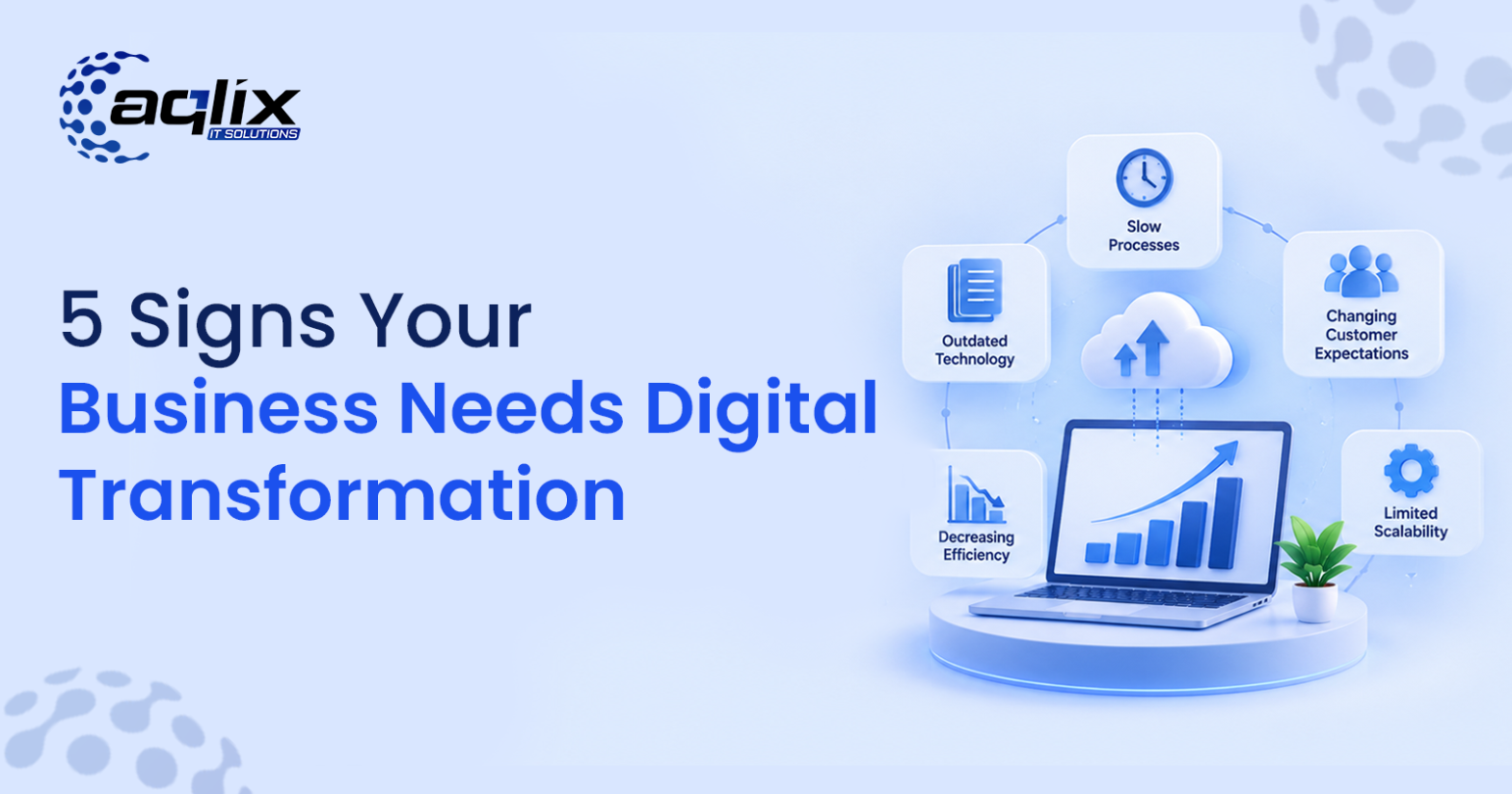

There’s no big flash of lightning that signals the need for digital transformation. Often, it’s slower builds to large problems that happen across many iterations. Simply going down the road less traveled means reducing the time and money it takes to resolve the problems.
Signals of the need to build a better foundation in order to grow your business turn into operational problems if left unanswered. Aqlix is able to identify the operational problems caused by disconnected systems and outdated technology. Our digital transformation service helps to replace legacy products with solutions that enable better operational efficiency.
1. Manual Processes Are Eating Up Valuable Time
Manual data entry, copying and pasting into different spreadsheets, and email approval workflows are signs that systems within the organization aren’t doing their jobs. Small time drains when done individually aren’t significant, but when done repeatedly, the loss of productivity for the entire team becomes a problem.
Through automation, business processes replace the labor portion of time-intensive, repetitive tasks that once took up a lot of time. The time employees previously spent doing menial tasks is now time that can be used to perform more fulfilling work.
- Reduced manual data entry: Workflows are created to remove the burden of manual labor for tasks that need to be done countless times.
- Fewer approval bottlenecks: Digital approval requests are processed quicker than in email submissions.
2. Data Lives in Disconnected Silos Across Departments
Data is fractured across different departments. Sales stores data one way. Finance stores that same data in a different way. Support has yet another way of keeping data. In the end, no version actually aligns. Fragmented data forces teams to manually reconcile numbers that should never have needed to be reconciled in the first place.
A digital transformation strategy that integrates multiple systems encourages automatic data transfer between departments. This way, everyone is working with the same accurate information. Instead of people spending time verifying the basic facts, the lack of information silos reduces the redundancy. Custom software development can bring business requirements to a solution that is designed to fit around existing workflows.
- Unified data across teams: Every department uses the same source of data, so information isn’t stored in a variety of formats.
- Less time reconciling numbers: Teams do not have to dedicate effort to verifying information that should be consistent across all sources.
3. Customers Expect a Faster, More Digital Experience
The most successful companies handle core processes through automation and digitization. This greatly reduces the need for users to be on-site and to do mundane tasks. Clients will start going to other competing companies if you do not start incorporating digital solutions.
Also, customer experience improves when primary customer functions and interfaces are automated. Before, clients had to deal with issues that were outside of their control, which caused them to be dependent on manual and/or onsite processes.
- Self-service capabilities: Many simple problems and requests do not require help from support. Customers call in to request a specific date to start a new account.
- Faster response times: Customer request satisfaction is accelerated as digital channels create less delay between a customer’s request and resolution.
4. Competitors Are Moving Faster With Better Technology
It is difficult to ignore a gap created by competitors launching new digital features, serving customers faster, or appearing to work with more efficiency. Falling behind technologically usually means falling behind commercially, even if the core product or service is still comparable.
Digital transformation serves to modernize all systems and processes to facilitate a business’s ability to operate at a higher level of efficiency. The competition driven by the products and services a business offers is diminishing compared to the competition driven by a business’s ability to fulfill orders efficiently. Cloud & DevOps Services help businesses improve infrastructure and respond to changing demands.
- Faster time-to-market: Modern systems reduce or eliminate the need for a business to wait for legacy systems while new offerings are launched.
- Improved operational agility: Teams can meet market demands without dealing with outdated business processes.
5. Your Team Is Constantly Working Around Outdated Systems
Developing a ‘workaround’ to execute basic tasks is a solid indication that systems are either broken or not functioning adequately, if at all. While ‘work arounds’ can be somewhat effective as temporary solutions, they come at the risk of creating long-term inconsistencies.
The digital transformation will resolve what tacitly endorsing ‘workarounds’ otherwise creates. Application modernization can offer employees tools that aid and strengthen productivity, as opposed to tools that require further employee effort to adapt around.
- Fewer informal workarounds: Systems are designed to support and enhance work, therefore making the creation of ‘work arounds’ obsolete.
- Lower dependency on tribal knowledge: Knowledge and processes are documented and codified rather than being held by one individual.
Conclusion
None of these symptoms are particularly important or even visible on their own. But be wary, because when you’ve finally realized the symptoms due to a cumulative effect, that’s a pretty bad sign. If you’ve got a business that runs on manual workarounds, siloed data, and stale customer experiences, it’s probably safe to say that you have a lot of potential that is untapped. Even if everything functions properly enough to avoid complaints (not necessarily the case with stale customer experiences), it doesn’t mean that the business is in a good place.
Aqlix IT Solutions can help businesses understand where exactly their gaps are and where they can start developing a digital transformation plan. Start the conversation if any of these ring a bell, whether it’s a big gap or a bunch of small ones.
Frequently Asked Questions
What does digital transformation actually involve?
Digital transformation includes the use of new technologies to develop automated, streamlined, and connected systems and processes to modernize the customer experience. It includes varying solutions such as cloud migration, automation, and custom-built software or integrations, depending on the needs of the business.
How do I know if my business is a good candidate for digital transformation?
There are many indicators, such as manual-intensive tasks that take an excessive amount of time, siloed data across teams, reliance on workarounds, etc.
Is digital transformation only necessary for large enterprises?
Digital transformation is meant to eliminate inefficiencies, and that includes outdated processes, no matter the size of the business. Aqlix is focused on the highest-impact changes for a small business and then incrementally adds to digital transformation in subsequent years.
How long does a digital transformation project usually take?
Most projects involve more steps and are designed to help businesses complete more steps of a project with minimal disruption to daily business.
Will digital transformation disrupt daily business operations?
Correctly planned transformation projects won’t have this effect. Aqlix’s approach to transformation entails upgrading systems and business processes in phases. Thus, disruption to the business is minimal, while operations can be conducted as is.