
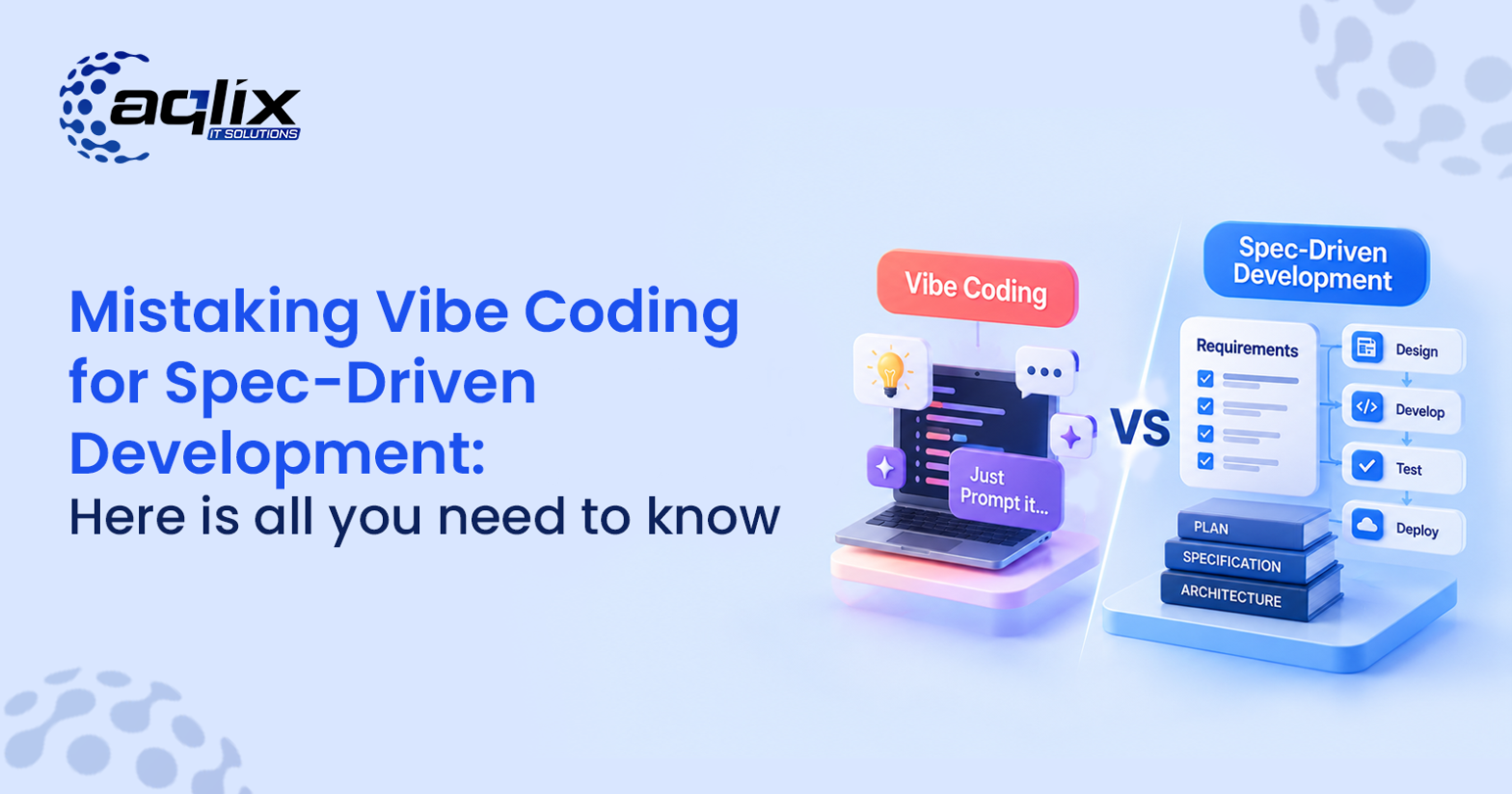

With AI keeping its feet firmly in the coding field. It brings creativity and critical thinking, making development easier and faster and making Gen Z obsessed with it. A comprehensive 2026 report, India’s Gen Z Outlook, found that 82% of Gen Z respondents use generative AI tools at least once a week and they are using them specifically for homework, coding, and building career skills. It all sounds fun and like a proud moment when someone shows a Vibe-coded app made by them. It is due to AI magic that they think it is like a piece of cake to make apps and start selling them, but they don’t know how many errors are hiding behind that beautiful app they made, and it’s not their fault either; most of us don’t know that Vibe coding differs from Spec-driven development. Don’t worry, and let’s start learning about each one.
Vibe Coding: What is it Actually?
Vibe coding is the process of creating software by giving an AI assistant plain-language instructions, with minimal planning or review before accepting the generated code. When something goes wrong, the user explains the problem and asks the AI to fix it. For instance, a student commands the AI model to, “Make a basic calculator that can perform functions like add, subtract, multiply, and divide numbers.” The AI processes it and then writes the code, but if it doesn’t work with negative numbers, the student cannot reply, “It does not work with negative numbers,” and then the AI will update the code.
In the history of the term, AI researcher Andrej Karpathy introduced it in early 2025. It gained popularity for its effectiveness in small projects, enabling individuals with limited coding experience to quickly produce working demonstrations. Vibe coding is typically performed on platforms such as GitHub Copilot, OpenAI’s ChatGPT, and Google’s Gemini, where users generate and modify code using natural language instructions.
Looking on the dark side of Vibe coding, it accepts the code without doing proper review. This approach undermines software reliability, which is achievable with clear requirements, thoughtful design, thorough code reviews, and comprehensive testing. Without following these key steps, software developed through Vibe coding is more likely to contain bugs and critical security vulnerabilities, and hence it becomes difficult to maintain or extend. Undetected issues can lead to unexpected failures or risks in real-world use.
Let us see how spec-driven development differs from vibe-coding.
We can call spec-driven development a simple yet well-structured approach to building software using artificial intelligence. Before starting with the coding part, the team prepares a specification document that lays out the software’s required functionality, business rules, and the criteria to measure success so that it is built without any flaws. The AI model then carries out the specification in stages, with each stage being reviewed by a human.
This approach typically involves four distinct stages:
- The requirements should be made clearer by means of user stories, which include specific acceptance criteria.
- Design: Prepare a technical plan that should include details on data structures, user interfaces, system integrations, and error-handling procedures.
- Breaking down the plan into smaller and measurable tasks.
- The AI will do each task first, then the developer will do review and some testing before moving on to the next tasks.
Example of Spec-Driven Development
For example, take a client’s requirement: “Users can reset their password.”
- The requirement states that when a user requests a reset, the system must send an email containing a link that expires after thirty minutes.
- Design the user interface screens, email templates, and database fields and state what the system does when the reset link expires.
- The tasks involved creating the request form, implementing the generation of secure links, setting up email delivery, handling expired links, and preparing corresponding tests for each component.
If you take a simple ad hoc approach-for example, by just adding a password reset feature without carrying out thorough planning-it might come down to inconsistent functionality. On the other hand, having a specification will ensure consistent performance and enforce the expiry rule.
Understanding the Difference between Vibe-coding and Spec-driven Development
Spec-driven development is very different from vibe coding. Yes, they both use AI; the difference lies with how much of the development is planned and checked.
Let’s learn this through a table:
| Vibe Coding | Spec-driven development | |
| Starting Point | A simple user prompt | A detailed written spec |
| Speed | Fastest first version | A tortoise starts, fewer surprises later. |
| Quality | Inconsistent | Checked against the spec |
| Error Rate | Often found by users | Commonly found in reviews and tests |
| Best Suited for | Prototypes and demos | Production and business-critical apps |
Agentic coding involves AI agents such as Claude Code or Kiro planning, editing files, and testing their work. With a loose prompt, this process becomes rapid, exploratory coding. With a specification, it is spec-driven. Both approaches fall under AI-driven or AI-assisted software development.
Some of the most widely used spec-driven tools like AWS Kiro, create requirements, design, and task files before you start coding. An open-source spec kit offered by GitHub also stands out in this race, as it works with Copilot, Claude Code, and Gemini CLI. Low-code platforms are also adapting; for example, Oracle APEX 26.1’s APEXlang stores applications as readable files for AI assistants.
Risks and appropriate uses of Vibe coding
Vibe coding suits prototypes, demonstrations, and idea exploration. However, it becomes risky when a prototype evolves into software critical to your business:
- Security gaps that nobody reviewed.
- Missed requirements that only appear with real users and data.
- Code that is difficult to maintain because the original intent wasn’t documented.
AI-assisted coding may not always help you save time. According to a recent METR’s 2025 study, experienced developers took 19% longer using AI tools, even though it was always in their mind that they were 20% faster.
A simple guideline: use exploratory coding to learn, and specifications to deliver production software.
Key questions to ask before outsourcing
- How do you use AI, and do you write a spec before coding?
- Who is primarily responsible to review and test AI-generated code?
- How will I see progress and approve each stage?
- Does the contract assign all code to us?
If you already have an application developed through exploratory coding, we can typically prepare it for production after a code audit, a written specification, security improvements, and thorough testing.
How Aqlix uses AI in development
At Aqlix IT Solutions, every project begins with a detailed specification. Our developers review and test all AI-generated code. We provide you regular progress updates, approval opportunities, and most importantly full ownership of your code.
Please contact our team to learn more.
Frequently asked questions
Is spec-driven development the same as Vibe coding?
No, in exploratory coding, you take the AI’s output as it comes. In spec-driven development, you set your requirements first and then keep a check on AI’s work to make sure it meets your standards.
Do you think vibe-coding is dangerous to use?
It is not risky for making prototypes, but unreviewed code might come up with significant risks in production software.
Can we say TDD is still relevant in 2026?
One of the most effective ways to make sure AI-generated code meets the specified requirements is by writing tests before starting to code, so yes.
Who gets the ownership of AI-generated code when you outsource it?
You can get ownership details from your contract, so it is on you to make sure that it assigns all the code to your company.

