
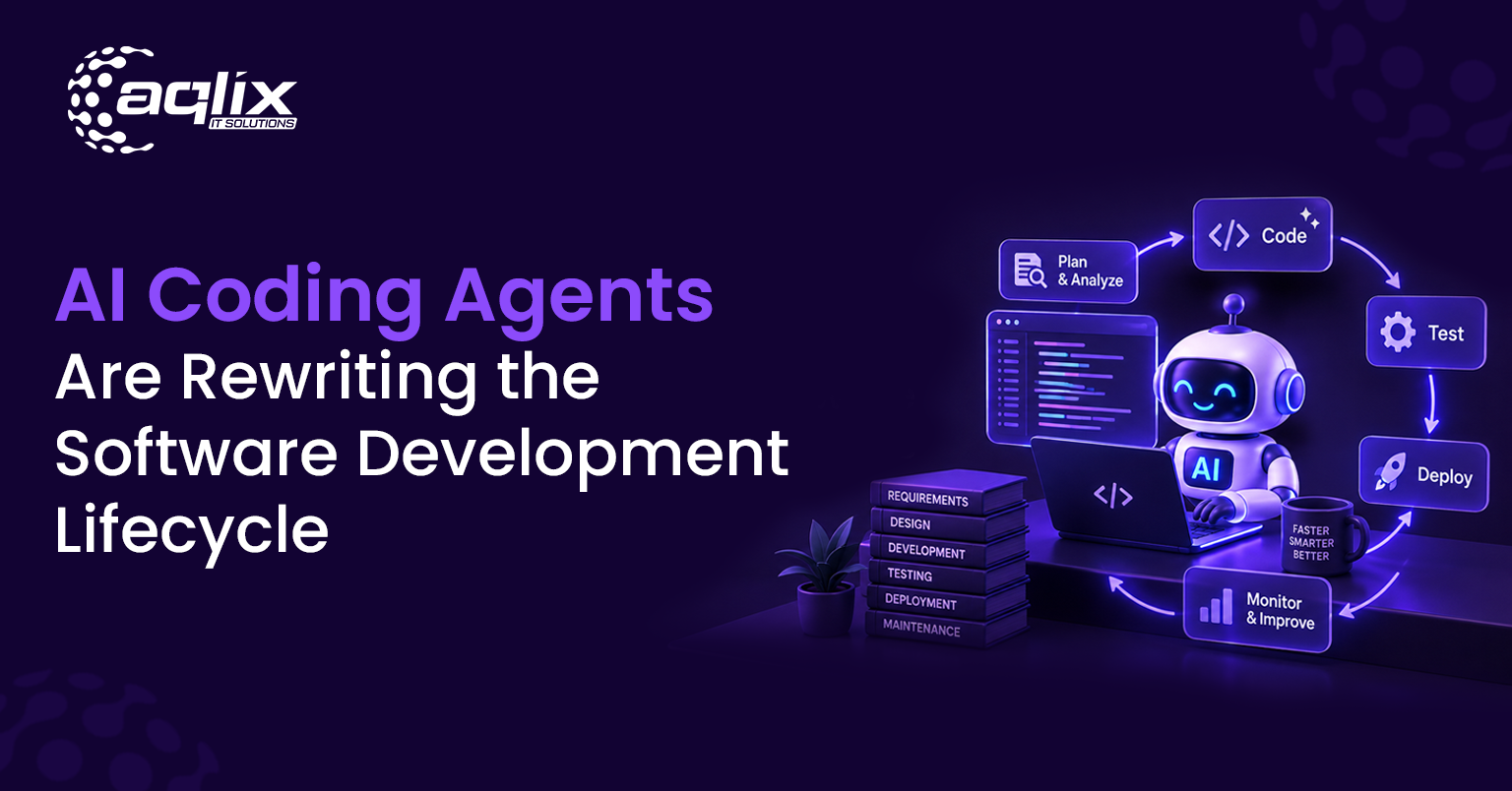

From a historical perspective, developing software meant line by line construction of precise instructions that converted ideas to a syntax that the computer can understand. With the advent of AI coding agents, developers can now generate functional code, find and remove programming bugs, and arrange entire modules with only a set of plain language instructions. Development teams are now rethinking the role of the human developer that tends to each line of code.
At Aqlix, our AI Development services integrate AI coding agents in real development scenarios. We help our clients’ development teams use these new tools to accelerate their development processes.
How AI Coding Agents Are Changing Software Development
Unlike autocomplete or suggestive tools, coding agents can analyze an entire task and plan how to accomplish that task by developing a structure that includes writing code across multiple files. These tools can interpret plain language commands and develop the required code files. This has an immediate impact on how development teams prioritize the writing of new code and the review of existing code developed by agents.
1. Automating Code Generation and Boilerplate Work
There are tasks that occur repeatedly in every project like the creation of configuration files, standard functions, or code that rarely, if ever, changes from project to project. AI coding agents can develop this boilerplate code without a developer controlling each character typed.
At Aqlix, we help our clients develop workflows that provide Generative AI developers control of the development funnel, while Generative AI tools develop the code scaffolding.
2. Accelerating Testing and Debugging Cycles
As developers spend countless hours attempting to find a bug buried tens of thousands of lines of code, new automation tools could significantly decrease this burden. In response to the context and the nearby surrounding code, automation tools consider thousands of lines of code and suggest possible causes. Merging these suggestions into code could even propose a possible fix.
While automation tools can provide suggestions and potential solutions, it will take human developers to review the code and either accept or deny the proposed solution. Because developers can now review the code during a single session, there has been a clear decrease in the time it takes them to resolve the issue.
3. Reshaping the Role of Human Developers
At the current pace of development, the role of the human developer will continue to shift to a higher-level task role as compared to the current burden of repetitive, low-level tasks. With the implementation of automated developers, the role of both junior and senior human developers will begin to merge.
Automation will significantly lower the burden of decisions related to trade-offs. The implementation of automation will leave human developers with a focus on the deep-rooted trade-offs and decisions, security, and maintainability of code.
Key Impacts on the Software Development Lifecycle
AI is heavily influencing the way software is planned and constructed. With more repetitive and time-consuming tasks of the many phases iteratively handled by AI, there is less of a need for virtual conferences and more of a need for coordination among a single team and the AI.
1. Faster Time from Concept to Deployment
Projects that once required many months to transform from a concept into a deployable solution now take a fraction of that time, as a large portion of the implementation is handled through automation. Within a matter of days, working prototypes can be built and tested, rather than requiring weeks to accomplish.
This acceleration means that businesses can now test and validate their ideas in considerably less time than before, and can rapidly adjust course based on early-stage feedback. Custom Software Development teams at Aqlix have utilized this acceleration to successfully bring end-to-end solutions to market.
2. Improved Code Quality and Consistency
AI agents can achieve levels of consistency and code quality that would be difficult for humans. Agents set and enforce coding standards and patterns uniformly across entire codebases, which human teams struggle to achieve across different developers and projects. This reduces fields of code that slowly become outdated and disorganized.
Automated suggestions also catch common mistakes before they reach code review, reducing the back-and-forth that typically slows down the review process. Teams report cleaner, more maintainable code once agents handle the repetitive quality checks.
3. New Considerations for Oversight and Security
With the introduction of code generation through AI agents, new risks and concerns involving security and edge cases are presented should agents produce code that is deployed without human oversight or review. Treating AI-generated code requires teams to have adequate processes for their deployment.
Aqlix integrates these processes in development workflows, ensuring speed is not the tradeoff for security and reliability. Our Technology Consulting team is able to help your business set processes and oversight practices for risk management based on your unique business requirements.
Conclusion
AI coding agents won’t replace developers. They’ll ultimately change what it means to be a developer. Rather than spending most of their time on repetitive tasks, developers can focus on more critical aspects of their work that cannot be accomplished by AI coding agents. This also leads to shorter timelines across the entire development life cycle.
The goal of Aqlix is not to replace engineering teams, but to help them incorporate the use of AI tools in a way that is effective and efficient. Aqlix IT Solutions automates AI tools so that developers can spend their time on more important work. If your team is having trouble getting through your development process, the Aqlix team would be more than happy to explain how you can do more with less.
Frequently Asked Questions
What are AI coding agents?
AI coding agents are programming tools that, with instruction, can write, test, and debug code. They can write single lines of code, or multiple lines throughout an entire file. Unlike autocomplete, they can plan multiple steps to complete a task.
Will AI coding agents replace software developers?
No, due to the nature of their behavior, they require the oversight of developers to fill in the gaps that agents can’t handle. This will ultimately lead to developers working on even more aspects of the development process.
Is AI-generated code safe to deploy without review?
No, due to their imperfect behavior, unsafe code can be inadvertently deployed. This is especially problematic for code that is security sensitive. Aqlix is especially adept at building oversight workflows to prevent unsafe code from deploying.
How much faster is development with AI coding agents involved?
This again depends on the nature of development, but multiple steps across multiple tasks of the development process can be reduced from an entire development cycle of multiple months, to a single week.
How can my development team start using AI coding agents?
Start with the most time-consuming repetitive coding tasks performed by developers. Aqlix builds AI coding tools with your workflow in mind, and they promise to build oversight and control structures from the ground up.