
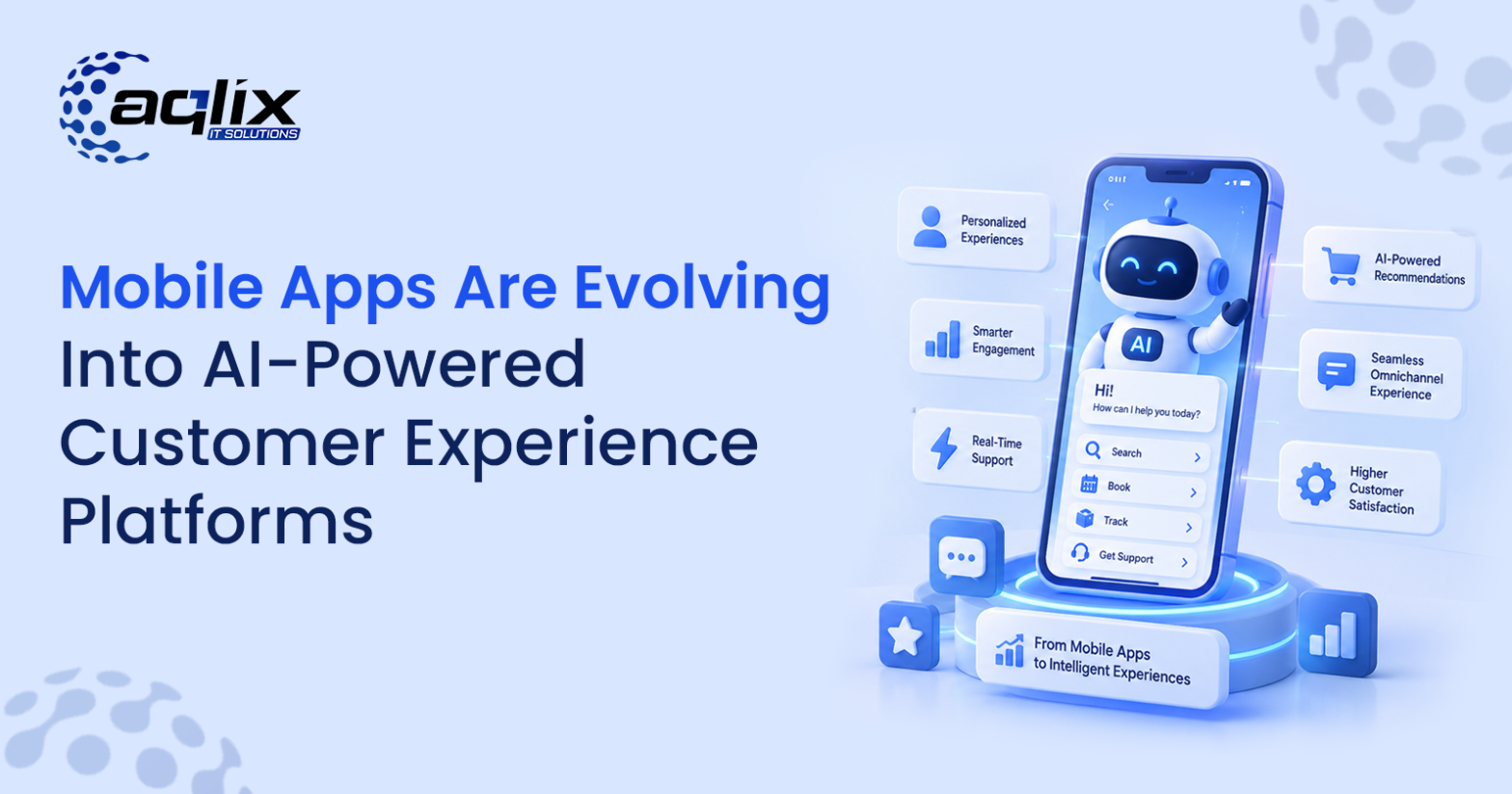

Former mobile apps consisted of basic menus, screens, and checkout options. This is now outdated. The most successful apps don’t just show information. The most successful apps allow users to change info to accommodate what the user wants and needs and provide assistance without being too hands-on.
We are seeing clients who come to Aqlix IT Solutions for mobile app development want apps that go beyond a standard program with added built-in functionality. With this trend, apps are moving from being a simple service to a complete customer experience platform with self-learning technology.
Why Mobile Apps Are Becoming AI-First Experiences
The shift isn’t cosmetic; it’s structural. Building apps with AI and machine learning means the apps can learn their users’ behavior via interaction and adjust their layout, recommendations, workflows and more. The resulting experience from this kind of app is immensely different and better than a static app that shows the same stagnant interface to every user.
1. Personalization at the Core of Modern Apps
Today, individuals expect interactive apps to be context-aware and adaptive. These apps automatically display customized content of interest to end-users. Earlier, developers heavily relied on manual programming and rigid, one-size-fits-all rules to capture user preferences. However, intelligent AI models have reduced this effort substantially by learning user preferences through automated, real-world usage.
Intelligent AI models are supported by the design of iOS and Android user experiences (UI and UX). These models are enablers of the technology and help apps focus on the requirements of individual users. Intelligent software that is context aware behaves like an invisible assistant that prioritizes tasks and adaptively learns user behavior and preferences.
2. From Static Screens to Predictive Interfaces
Traditional apps require users to tap, search, or scroll before they will do anything. Predictive interfaces present the next most likely action, reorder menus, or pre-cache content based on what they’ve learned. The outcome is a major time and effort savings for users.
Building something like this takes more than just a framework for an existing application. The new foundation needs to be more flexible and provide a predictive experience. Strong product development teams integrate predictive behavior into the foundation of their applications before building on top of the technology rather than integrating it later, making the predictive experience more pleasant and less unnecessary.
Building CX-Focused Apps That Scale
Transforming a mobile app to a real, engaging experience platform is one small step in a long digital evolution process rather than a one-time significant feature release. Data connectivity to support systems and business processes means that each customer interaction can be contextual and informed and, better yet, continually evolves the experience long after the app is launched.
1. Smarter Support Through Conversational AI
Customers are used to getting instant answers directly inside the app itself. They no longer want to be redirected to a help center or forced to wait on hold. Using conversational AI in the mobile experience resolves these common questions instantly, so customer support teams no longer have to deal with these simple issues.
Chatbot plugins will most likely not fix each business’s individual needs, so custom solution development is important in this case. Creating support flows that match each company’s products, tone, and customer questions creates better solutions than a basic bolt-on that was sloppily added to the app.
2. Continuous Optimization Post-Launch
Building an AI-driven app feels like an enormous milestone for founders and stakeholders, and while it’s a significant milestone, it’s also just the beginning of the process for everyone involved. Customers are constantly evolving, and competition is constant, with other companies releasing innovative features on a weekly basis. That means what was the most innovative feature is outdated less than six months after it’s released.
When you view your app as a living, breathing product and not a completed task, you have to budget the cost to keep it up-to-date. This means frequent updates to the foundation of an application, which frequently means updates to the integrations and AI models used. This keeps everything running smoothly and prevents the constant slow build of technical debt.
Conclusion
Apps do not have to just work anymore; they have to work and be a very good experience. This is especially true in a market crowded with apps. This is why organizations should invest in a true AI-powered customer experience framework. This is where Aqlix IT Solutions comes into play. Aqlix IT Solutions has a distinct advantage to help companies build and design mobile apps to better serve their business.
If your mobile application still feels antiquated compared to the mobile applications users interact with on a day-to-day basis, then it’s time to make a major upgrade. Aqlix IT Solutions has the solution to make your mobile application the intelligent platform that keeps your customers coming back for more.
FAQs
What makes a mobile app “AI-powered” rather than just a regular app?
This application uses AI to learn and make recommendations based on the user’s behavior. The application has features that work in the background that track user behavior and requests so that it can determine the right time to make recommendations to users and fulfill their requests. It offers a unique experience to a user that most rigid and static applications or services do not offer, which is the ability to provide ongoing support to the user.
Do small or mid-sized businesses actually need AI features in their app?
Personalizing customer experiences, contextual recommendation systems, and advanced customer support tools/add-ons can improve customer satisfaction and retention. Many organizations will benefit from using AI to support personalization and customer service tools. Instead of developing multiple capabilities of advanced AI, most companies can gain a competitive advantage by using personalization and basic assistant AI systems.
How long does it take to add AI features to an existing mobile app?
Approximately eight to twelve weeks is the time to upgrade most applications. However, this period will vary based on the application currently used and the complexity of features to be added. Applications made with obsolete or inflexible architectures take longer than twelve weeks because the foundation has to be reworked in order to accommodate AI.
Is user data safe when an app uses AI for personalization?
Whether or not an app uses AI makes a huge difference in data security and the way an app is constructed. Aqlix IT Solutions is an excellent developer. They process only the data necessary for the personalization of an experience for every user. Aqlix also provides other safety best practices, including encryption of sensitive user data.
What’s the first step in turning a regular app into an AI-driven experience platform?
Identify the platforms where users seem to get the most frustrated, abandon the product, or are having the most difficulty. Users will appreciate the most a product that addresses these frustrations. AI tools should be released in steps in order to retain user satisfaction.