
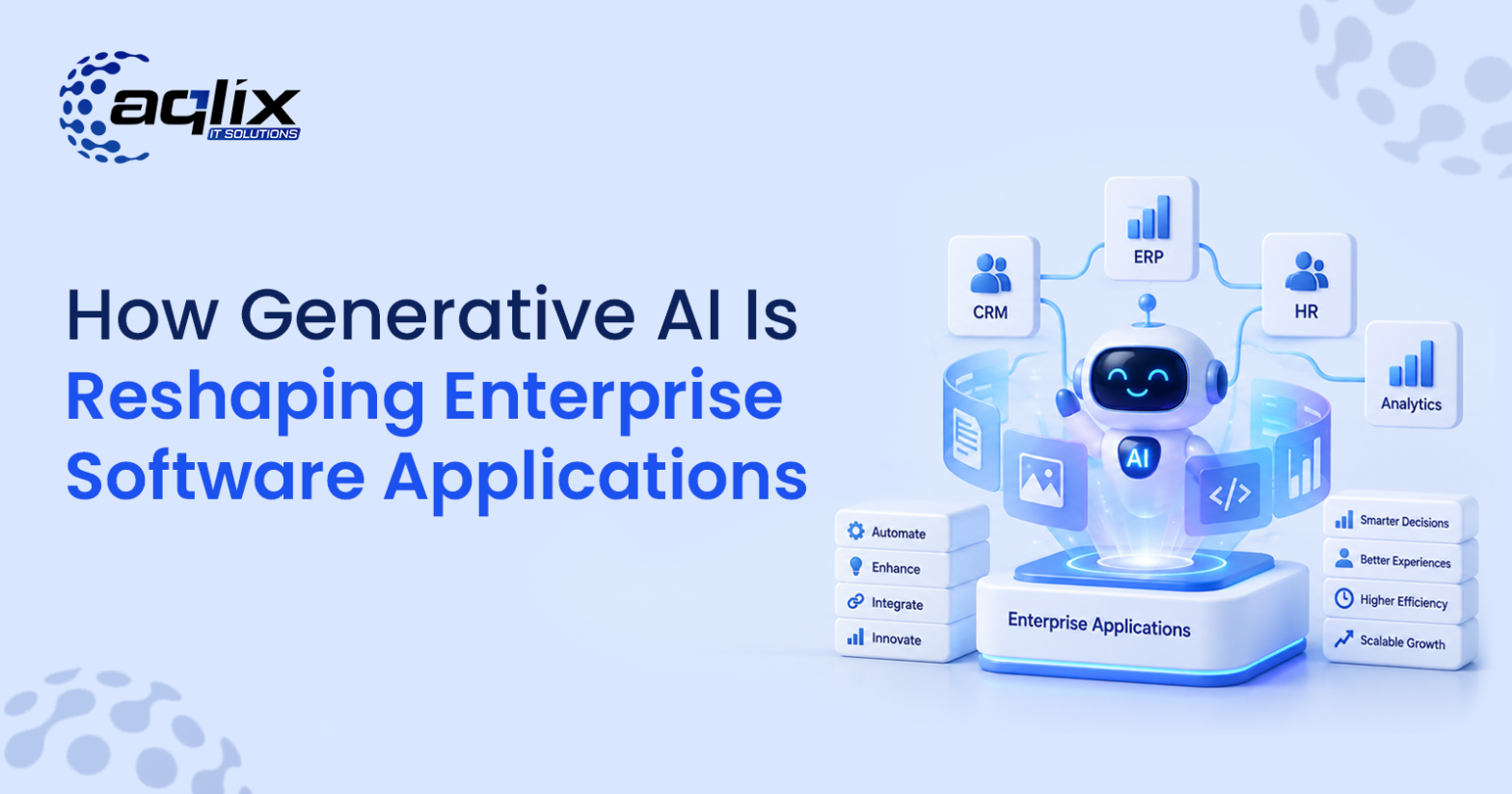

Previously, enterprise software was marked by slow, clunky, rigid interfaces. The rapid adoption of large language models is obsoleting these clunky, rigid interfaces. Generative AI will be the foundation of the contextually aware enterprise systems that can generate and decide for themselves.
As software developers, we at Aqlix IT Solutions have observed that generative AI technology has transformed from a novel, experimental add-on for enterprise software to a fundamental pillar of how software is built. We see enterprise software automation impacting customer support and even how internal tools are built. Serious companies are not adding AI to their legacy SaaS in a piecemeal fashion. Instead, they are completely rebuilding their systems.
How Generative AI Is Changing the Core of Enterprise Applications
Generative AI technology fundamentally changes how enterprises approach building software. The new technology automates the development of applications by designing them to have natural language interfaces and content generation systems. With the inclusion of machine learning models that learn the way their users interact and behave with the software, technology teams begin developing systems and interfaces and prioritizing which features to build, based on how the users of a product will interact with the software.
1. Smarter Interfaces and Automated Workflows
Previously, enterprise applications structured interfaces using rigid menus and forms with fixed workflows. These interfaces would behave and expect certain patterns and interactions from users and assume all users would engage with the applications in the same way, regardless of their unique tasks or goals within the system.
Today, custom software development relies more on Natural Language Processing (NLP) and other technologies that create interfaces as users interact with the software. This leads to a significant drop in training time and allows non-technical users to leverage complex software designed for the enterprise.
2. Where Generative AI Is Already Making an Impact
Across enterprise software, there are now many production systems that have moved beyond the experimental phase with their use of AI and ML. Some examples of automation include:
- Automated documentation: software that drafts documentation for you
- Intelligent search: allowing users to skip searching through files and outdated wikis
- Code assistance: assisting coders during the writing, reviewing, and refactoring of code
- Predictive workflows: software that automatically detects issues, forecasts customer needs, and suggests subsequent actions.
Why Enterprises Need a Structured Approach to Adoption
Jumping into generative AI without a clear plan often leads to more issues than solutions. Scatter pilots across different departments will rarely lead to any real impact. A good digital transformation strategy coordinates AI initiatives with business goals, data governance and security to ensure that each investment will have positive compounding effects and ensure that there are no disconnected experiments that will slowly wither and die.
1. Governance, Security, and Data Readiness
Generative AI models’ reliability is dependent on their data and guardrails. Often, enterprises tend to underestimate the effort required to make a model trustworthy enough to process sensitive data or customer records. Model missteps can lead to real financial and reputational damages for the enterprise.
This adds value to technology consulting services, where enterprises are guided on how to audit their data, set access controls, and define policies to prepare for a company-wide deployment of generative features. Failure to prepare in these areas results in avoidable and expensive compliance concerns, and models will be unused.
2. Measuring ROI as Adoption Scales
Generative AI fails to prove the value of investments beyond vague descriptions of time and resource savings. Lack of prior focus on outcome metrics has driven the issues of legacy frameworks á la AI investments, which include difficulty justifying funding after leadership pokes holes in the system.
The best AI-centric investment and development strategies link numbers to goals early on, ranging from saved hours, reduced error rates, adjusted revenue, and even something as quantifiable as morale. Leaving the program rapid-response and initiative-free post-funding means that the value of investment will never be realized.
Conclusion
Generative AI is making enterprise software development more efficient. Aqlix IT Solutions guides enterprise clients through integrating efficient generative AI systems from scattered pilots to systems built for demanding, real-world business use.
If your enterprise applications still feel disconnected from what generative AI can actually do today, now is a good time to switch that. Talk to Aqlix IT Solutions about an audit of your current systems and the development of a viable system, including AI, to assist your teams in their day-to-day work activities.
FAQs
How is generative AI different from traditional enterprise automation?
Generative AI models are highly advanced because they can understand and generate context, which makes them useful for many different tasks. They can analyze text, images, or speech. Unlike frameworks that use strict rules and sequential logic, generative AI can learn on its own, making tools much more flexible. Organizations can now use automation directly on tasks that could not be previously structured.
Which enterprise functions benefit most from generative AI right now?
Currently, the support tickets, searches for internal knowledge articles, software development, and content-oriented workflow tasks such as reporting and documentation are progressing the most. What these tasks have in common are repetitive, text-focused activities that generative models excel at. Employees are free to make decisions with a greater degree of complexity once these repetitive tasks are taken care of.
What’s the biggest risk of adopting generative AI too quickly?
Not having governance in place when scaling a product rapidly can lead to a data breach, provide outputs employees trust without question, and generate compliance issues. Businesses must create policies, testing and oversight structures before allowing broad team usage of generative features rather than doing so reactively when issues have already surfaced in the product.
Can smaller enterprise teams realistically adopt generative AI without huge budgets?
Yes. Now there are several generative AI models available at an affordable price as APIs or platforms. A couple years ago it would have been an expensive company-wide rollout to begin using AI models. Sometimes it is much better to start with only one small task and use case. It will be much easier and cheaper that way.
How do you know if a generative AI feature is actually adding value?
Base your thoughts on actual numbers instead of generalizations. Are we talking about time saved? Reduced error rate? Improved customer call response time? Application features should have measurable impact in one of the above metrics. Anything that does not drive the numbers in one of the above areas in 3 months should be discarded or altered and aims better defined.