
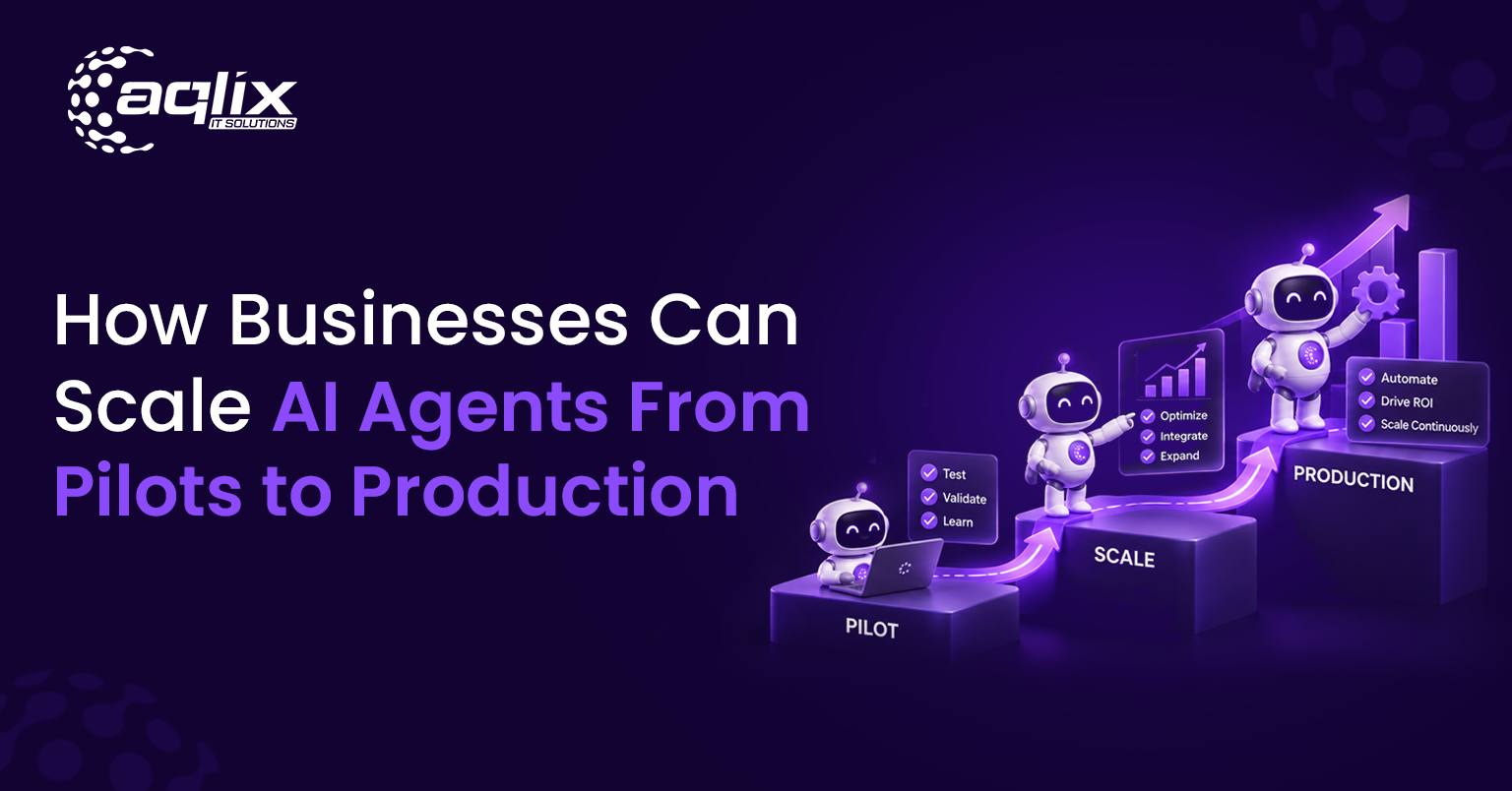

Building an AI agent has become the trend; almost every company seems to be working on it. Looking at it from the outside, AI seems to help with automation of a lot of tasks related to support tickets, drafting emails, reading long spreadsheets, etc. In fact, AI-based tools look extremely engaging when they are demoed. Almost every promising AI agent is still a prototype and requires months, if not years, to reach a production-grade state.
At Aqlix IT Solutions, we have seen many AI development projects become stale after carrying out successful pilots. The main reason is that many companies skip providing the right AI architecture and hence do not lay the required groundwork for scaling the project beyond the prototype phase. If you are looking to build something that is AI-based and goes beyond a simple prototype, you will likely need partnerships with companies that can provide the required AI architecture.
Why Most AI Agent Pilots Never Make It to Production
Being successful in a controlled environment like a technological sandbox doesn’t tell you if a technology will work once it is out in the world among many users and a variety of situations. Many generative AI projects are quickly made as a proof of concept, which means the code, data, and integrations likely can’t handle production use cases.
1. Infrastructure That Wasn’t Built to Scale
Most proof of concepts are rushed, which means they are usually built on top of temporary scripts and manual workarounds. While that works for a quick demo to convince stakeholders, those proofs of concept come with tons of risk if you actually end up making the project for real.
Artificial intelligence agents will be just as reactive as the infrastructure. If the infrastructure isn’t built to deal with the realities of the bumps and “messiness” of the business world, then the AI agent will start to give reactive and, possibly, erroneous responses.
2. Unclear Ownership and Governance
AI agents can’t manage themselves, and if there are no owners beyond the pilot stage, they eventually just quietly sit in the corner and stagnate until something is broken beyond repair. There’s no data collected on the agent’s accuracy, the costs associated with its use, or how its behavior changes as it is used more. Problems that affect real customers and can negatively impact a business begin to crop up.
Technology consulting firms provide a good opportunity to draw definitive lines of responsibility that clear up whose job is to manage, update, and make decisions related to the agent before it affects customers and sensitive data. Clear responsibility leads to faster break fixes compared to first determining who has the ownership responsibility.
A Practical Framework for Scaling AI Agents
Transitioning an AI agent from the pilot phase to production takes a collection of micros consolidated around blue-chip digital transformation practices. One of these micros includes preparing to scale the agent to deal with real business volume from day one. This involves thinking about data flows, monitoring security, and ensuring accuracy in a systematic manner to avoid the agent breaking down, losing accuracy, and causing confusion to the end users.
1. Building Production-Ready Pipelines
No matter how shiny the demo is, the code of a prototype pales in comparison to the production code. Redevelopment of code to meet the demands of production means that a code should be built with error handling code, logging, and safety mechanisms. These shouldn’t be last-minute attempts to fix the damage caused by an oversight.
Custom software development allows building and testing of steps in a production pipeline one at a time. Version control makes it easier to undo changes. Failure to do this means an application that doesn’t work and inconveniences real users at some later date, incurring an even greater cost.
2. Continuous Monitoring and Improvement
Building and deploying an AI agent finally answers the question you have been asking yourself. However, it does not mean the end of your efforts. It is the start of a journey to continually fine-tune your agent. Real-world use cases show you the edge cases and questions that were not even part of the original development of the pilot.
A well-constructed feedback loop enables you to track the performance of your agent and facilitates retraining your agent should the need arise. With a commitment of ongoing effort, you ensure that your agent retains its accuracy and utility over a period of time. Failure to do so means your agent will start giving less optimal and even erroneous answers and will fail to recognize and capture even obvious patterns after some time.
Conclusion
Convincing an enterprise to rely on AI agents beyond a successful proof-of-concept requires more than enthusiasm. It requires the proper system architecture and ownership and a partner that has done it before. This is the exact stage that Aqlix IT Solutions focuses on. They help transition early AI experiments into systems that team members can trust.
Whether you are stuck on a stalled AI pilot or are planning the first AI pilot, getting the fundamentals right early will save a lot of time later on. Aqlix IT Solutions will help you understand the current status of your AI project and explain the gap between your current project and the AI system that will be continuously running.
FAQs
What does it mean to move an AI agent from pilot to production?
It means creating a stable, secure system that users can rely on. This requires additional infrastructure, testing, monitoring, and governance practices. A lot of proofs of concept are focused on demonstrating a value proposition to customers, that they highly simplify other elements of a system.
How long does it typically take to scale an AI agent?
Timelines can vary in complexity, but most businesses require 3 to 6 months from secure testing to the full integration of a stable, secured service, including security reviews, the integration of systems, and the testing cycle in preparation for the service rollout to internal and external customers.
What’s the biggest reason AI pilots fail to scale?
Most production systems will stress test pilots with a production-focused demo. This helps systems identify the gaps that suddenly become evident when edge cases and actual users arrive along with unexpected data. Pilots that lack the necessary systems and services required to handle edge cases and production traffic will typically break after the production-focused demo.
Do businesses need an in-house AI team to scale agents successfully?
Most production systems will stress test pilots with a production-focused demo. This helps systems identify the gaps that suddenly become evident when edge cases and actual users arrive along with unexpected data. Pilots that lack the necessary systems and services required to handle edge cases and production traffic will typically break after the production-focused demo.
How do you measure whether a scaled AI agent is actually working?
Measure track accuracy, response time, cost per interaction, and user satisfaction after launching against goals set before launch. Pay closer attention to constant monitoring of the real usage numbers as they adapt over time, and so does the tracking agent.