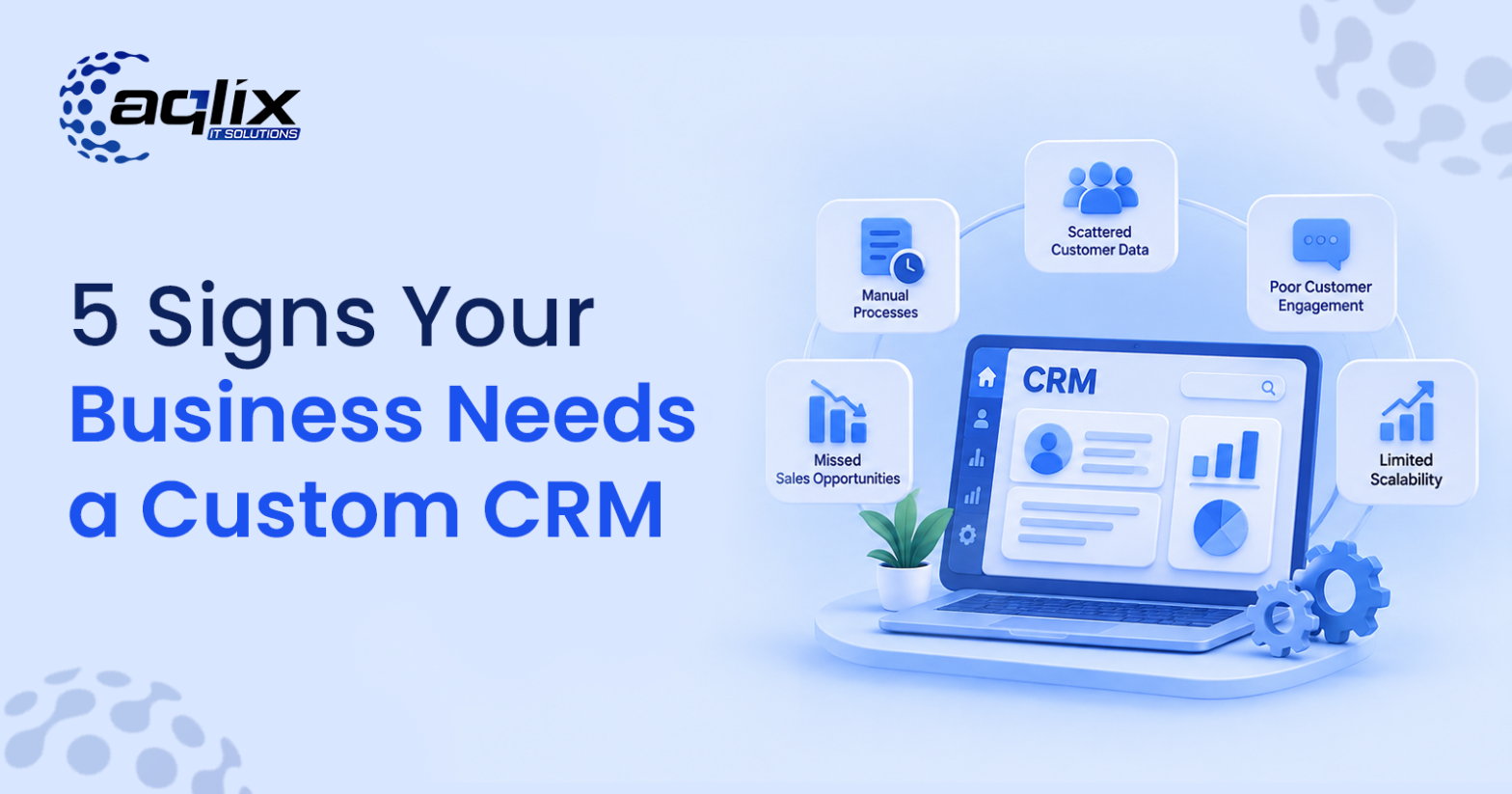

Many companies invest in a generic CRM because they are easy to set up and have low initial costs. This is practical until a company’s sales, support, and account management teams outgrow a one-size-fits-all system. The system begins to break in noticeable ways.
Aqlix combines custom CRM solutions with a tailored approach based on a business’ sales process and customer relationship management functions. Through our CRM development services, businesses trade in inflexible, modular CRM systems with their own, real, business operations systems.
1. Your Sales Process Doesn’t Fit the Software’s Structure
Most generic CRMs are built around a generic sales pipeline, and as a result, many businesses provide the same services and sell the same products. This flexibility often does not carry over to the fields, stages, and follow-ups a business is required to enter. When a business’ sales process is more complex with multiple stakeholders, unique quoting, or atypical sales cycles, the system becomes the blessing and the curse.
Custom CRMs resolve this challenge by tailoring the system directly to the sales process the business uses.
- Pipeline stages that match reality: Automate your sales pipeline with custom fields and stages to mirror the sales process.
- No more shadow spreadsheets: Import previously dealt with stages and fields outside the CRM.
2. You’re Paying for Features Your Team Never Uses
Most CRMs include multiple features to try and appeal to as many industries as possible. This means that off-the-shelf CRMs often have features for marketing automation or even tracking inventory, which your business won’t ever use. Oftentimes, the feature your business actually needs is bundled in a higher-tiered package, meaning you’ll probably have to spend more than you otherwise would in order to get the features you actually want.
This can inflate your monthly bill for features that your business is not even using. A custom CRM is often the more cost-effective solution since it is only designed through custom software development for the features your business needs.
- Pay only for what’s used: Bundled packages are not a priority in custom CRMs, and features that a business will actually need are given more emphasis.
- Simpler onboarding: New hires learn how to use the system in place rather than wasting time to learn how to navigate through unused modules.
3. Reporting Never Quite Answers the Questions Leadership Asks
Most CRMs come with tools that contain dashboards and prebuilt reports used by the average business, and in most cases those dashboards will not contain the metrics that your leadership team is actually interested in. To get the metrics that your leadership team needs, you’ll need to export the data and recreate the reports in a different system.
The disconnect from the metric that is needed leads to a lot of time wasted and introduces errors caused by the reports needing to be recreated and pulled in a different system. This can be resolved by custom dashboards that feature metrics that are pulled from an automated system.
- Custom dashboards: Reports will provide specific Key Performance Indicator (KPI) tracking for your business and are not built on generic templates.
- Live, accurate numbers: Your reporting bottlenecks will be removed by leadership pulling data directly from the system instead of building a correlated spreadsheet and wasting time and resources.
4. Integrating Other Tools Feels Like a Constant Battle
Other software systems, such as marketing or accounting software, alongside general CRM solutions, are common to most businesses. Most CRMs contain a limited set of integrations. Because of that, enterprises resort to manual work or costly supplementary integrations.
Each disconnected system poses the risk of data synchronization breakdown and increases the chance of errors. A CRM that is tailored to the enterprise’s existing systems will connect to them. Digital transformation can make these connections more efficient by bringing business systems together.
- Tailored integrations: The CRM connects directly with the specific tools your business already relies on daily.
- Consistent data across systems: Users no longer need to manually synchronize data due to the systems communicating automatically.
5. Your Customer Base Has Unique Needs a Generic System Ignores
Enterprises operating in niche industries such as real estate, healthcare, and manufacturing have intricate customer relationship processes that involve compliance, customized products, or numerous long and complex stages. Generic CRMs usually lack these features, forcing different teams to adapt their processes to a system that was not designed for them.
Generic systems that do not support specific functionalities of industries create compliance issues and increase risk for the business. A custom CRM is designed based on these specific requirements.
- Industry-specific workflows: We tailor our solutions to address the compliance requirements of your business.
- Reduced compliance risk: Our software contains features that reduce the risk of noncompliance. Therefore, customers are not required to manage the compliance of the software.
Conclusion
A CRM should make selling and managing customer relationships easier, not add friction through mismatched workflows, unused features, and constant workarounds. When a generic system starts working against your team instead of for them, that’s usually a clear signal it’s time for something built specifically around your business.
Aqlix IT Solutions designs CRM systems around the actual sales process, reporting needs, and customer relationships each business manages daily. If any of these signs sound familiar, it’s worth exploring what a purpose-built CRM could look like for your team.
Frequently Asked Questions
How is a custom CRM different from an off-the-shelf CRM?
With a pre-built CRM, you have to sell as the system sells. But with a custom-built CRM, the CRM sells as you do, adapted to the sales process and how your team works.
Is a custom CRM more expensive than a generic subscription-based CRM?
Most companies believe a custom CRM is more cost-effective and efficient in the long run. Although the initial investment with a custom CRM is greater. This is because with subscription-based CRMs, there are licensing fees, and CRMs can contain unnecessary features that will never be used.
Can a custom CRM integrate with tools we already use?
Absolutely. Integrations are a primary focus of development for a custom CRM. Aqlix develops CRMs designed to communicate data with accounting, marketing, and other industry-specific applications to keep data consistent.
How long does it take to build a custom CRM?
Time depends on the chosen requirements and sophistication, but less customized CRMs can be built in a few weeks, while something complex requiring deep integrations would take around three months. Aqlix builds in phases to speed up deployments.
Is a custom CRM only worth it for larger sales teams?
No, custom CRMs add value for teams of all sizes. Friction created by generic CRMs in smaller teams builds the case for a custom CRM. Aqlix designs CRM systems that include baseline functionality and can scale as the business and the sales team grow.