
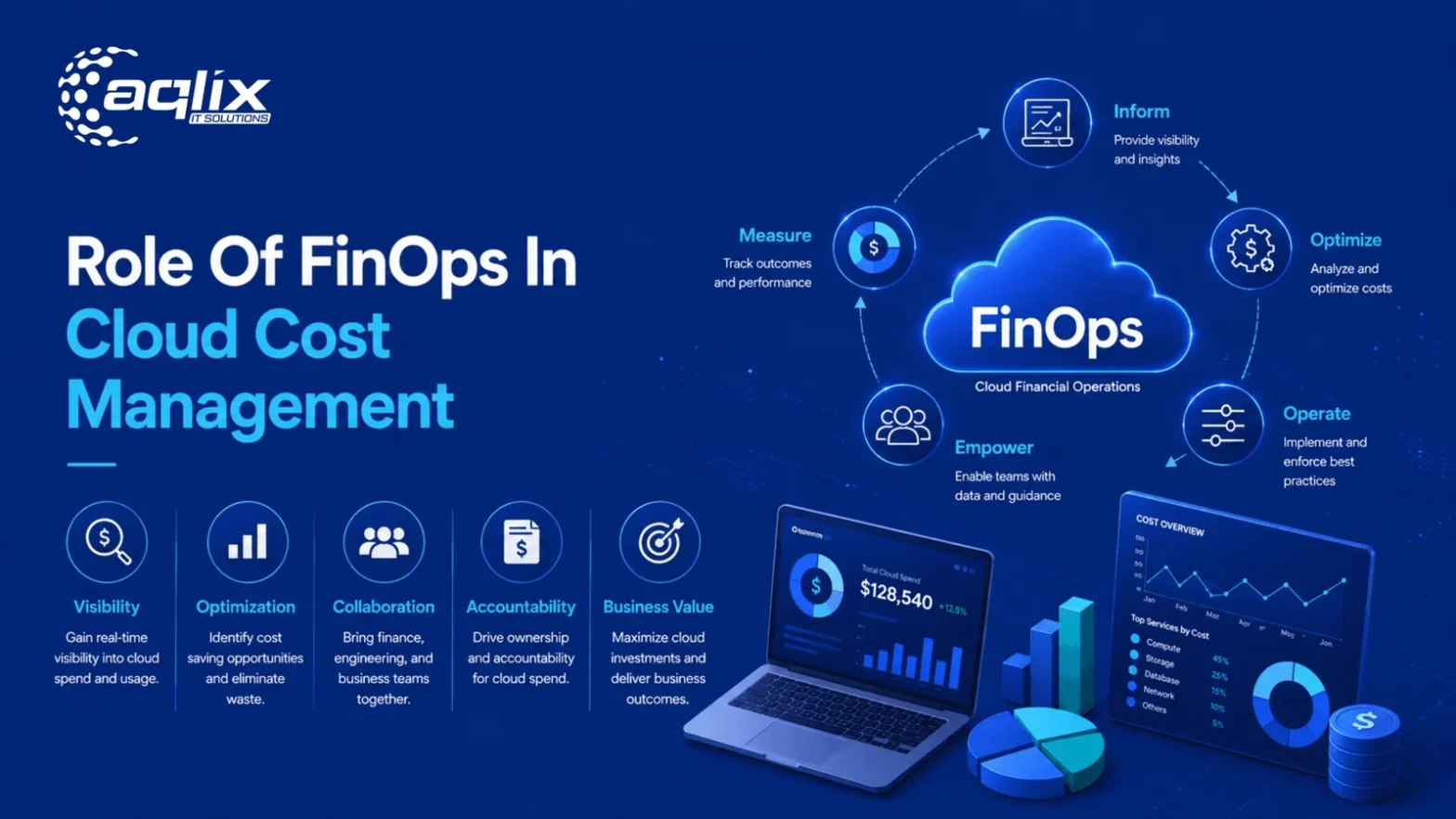

Cloud computing is making businesses scalable, efficient, and flexible. While managed cloud environments tend to drive up operational efficiency but unmanaged cloud environment might raise your operation efficiencies because of idle resources, unclear workloads and un-clarity on spending. FinOps enables organizations to manage their cloud spend without sacrificing performance and reliability.
FinOps combines finance, operations and engineering practices in order to optimize cloud cost management. This helps organizations to understand their infrastructure dollar spend, run a workload optimally, and automate monitoring. FinOps strategies can help businesses utilize cloud resources efficiently and eliminate needless spending on operations.
Why Cloud Cost Management Is Important
Cloud is based on usage-based (pay-as-you-go) pricing while cost visibility is key for every business. Without monitoring this, organizations may find unexpected spikes in spending that impact operational budgets.
Optimal expenditure management in the cloud enables businesses:
- Identify unused resources
- Improve workload efficiency
- Reduce operational waste
- Enhance scalability
- Maintain predictable budgeting
- Improve application performance
Organizations running workloads that are critical to their business operations need predictable and optimized cloud environments. While helping companies in updating their cloud systems, Aqlix has been working on making the deployment faster and improving infrastructure performance.
How To Reduce AWS Costs
AWS helps businesses optimize their AWS workloads on an ongoing basis and via resource allocation automation, therefore saving costs.
1. Monitor Unused Resources
The monthly cloud spending is heavily inflated with unutilized assets like idle instances and inactive storage. Periodic infrastructure audits enable businesses to discover wasteful services before the costs become exorbitant.
- Important practices include:
- Tracking inactive virtual machines
- Removing unused storage volumes
- Monitoring workload usage
Applying resource tagging policies
These measures will provide greater visibility into spending, and will make cloud governance more effective.
2. Use Reserved And Spot Instances
AWS offers cost-optimization pricing models for every organization. Reserved instances are for predictable workloads, and spot will save you money on transient compute.
Benefits include:
- Lower infrastructure costs
- Better workload planning
- Improved resource allocation
- Reduced operational waste
You are also trained to avoid provision more than needed during low-demand periods via auto-scaling policies.
How To Optimize Cloud Infrastructure
It enhances application reliability, workload efficiency and performance across the cloud.
1. Implement Containerization
Containerization technologies enhance workload mobility and infrastructure efficiency. Kubernetes is a tool that enables businesses to automatically deploy and scale applications.
Advantages include:
- Better resource utilization
- Faster deployment cycles
- Improved scalability
- Simplified infrastructure management
Also, Aqlix has built Kubernetes-based environments for enterprise applications and focuses on the reliability of infrastructure and the efficiency of deployment.
2. Adopt Automated Scaling
When we speak of infrastructure equipped with automated scaling, the resources intelligently adjust themselves in accordance to workload demand. This is useful for businesses to cut costs but still maintain performance.
Automated scaling helps organizations:
- Reduce cloud waste
- Improve system availability
- Handle traffic spikes efficiently
- Minimize manual management
Last but not least, scalable infrastructure management is one of the rare killer features for any company running customer-facing platforms.
Best FinOps Practices For Businesses
FinOps should be governed and pushed with collaboration, which isn’t a one-time exercise.
1. Improve Cost Visibility
The main thing is to share and comment on the data for finance and engineering teams that will be priority for organization. Translucence dashboards improve the competitive confirmation and adaptability of financial processes.
Businesses can improve visibility by:
- Tracking department-level spending
- Monitoring workload costs
- Reviewing billing trends
- Setting infrastructure budgets
More visibility allows organizations to identify waste and build the most efficient infrastructures.
2. Establish Governance Policies
Governance policies ensure more standardized usage of the cloud and reduce shadow spending. These frameworks help strengthen operational consistency and improve cloud efficiency.
Important governance measures include:
- Resource provisioning guidelines
- Security compliance standards
- Access control policies
- Infrastructure monitoring procedures
Robust governance underlines a prolonged cost stability,
3. Align FinOps With Business Goals
FinOps strategies must also enable scalability, operational efficiency and digital transformation efforts by supporting the methodologies of agile finance. Businesses should assess the cloud based on business outcomes that can be measured.
Companies that combine the pros side of financial operations using cloud strategy often experience the following:
- Better infrastructure planning
- Improved operational efficiency
- Reduced resource waste
- Higher scalability
How To Automate Cloud Cost Tracking
Automating enhances visibility, slashes manual effort and strengthens operational efficiency.
1. Use Real-Time Monitoring Tools
Real-time monitoring platforms assist organizations by providing continuous visibility into their cloud utilization and billing trends.
These tools help organizations:
- Detect unusual spending quickly
- Improve budgeting accuracy
- Generate infrastructure reports
- Optimize resource allocation
Real-time visibility helps in quicker decisions and improved control over finances.
2. Automate Budget Alerts
Alerts to trigger automatically when any cloud spend crosses the self-defined limits. Companies can also program resources to turn off during inactivity.
Benefits include:
- Reduced manual oversight
- Faster cost control
- Improved governance
- Better infrastructure optimization
Automation improves financial discipline for organizations in cloud environments.
Conclusion
FinOps turns the financial management of cloud operations into a part of daily life, so organizations can feel more in control when it comes to controlling their cloud costs while still enabling better infrastructure performance and operational efficiency. With workload optimization, automated monitoring, governance policies, and resource management, they can trim cloud expenditure and draw out scalability. FinOps can help businesses streamline their cloud usage and financial planning.
Aqlix helps an organization in cloud modernization, infrastructure optimization, automation and scalable deployment strategies for long-term cloud cost management and operational efficiency.
FAQs
What is FinOps in cloud management?
FinOps is a cloud financial management framework that enables enterprises to track, manage and optimize their cloud infrastructure costs. It increases visibility into workload usage and operational spending across cloud environments, improving collaboration between finance and engineering teams.
How can businesses reduce AWS costs?
By monitoring unused resources, optimizing storage management, using automated scaling and elision of the right pricing models for you like reserved instances or spot instances can help businesses save costs on AWS. With continuous monitoring, wasteful spending can also be identified and existing infrastructure can be optimized.
Why is cloud infrastructure optimization important?
Optimizing Cloud Infrastructure lets workloads run more efficiently, minimize the risks of downtime, and reduce operational costs. Through better application performance, faster scaling and human resource utilization, optimized infrastructure not only supports the business but also helps to keep a sturdy cloud operation.
How does automation improve cloud cost tracking?
Cloud cost tracing is enhanced through automation since it renders the usage of infrastructure and billing patterns visible in real-time. The alerts and monitoring systems automate the identification of unusual spending, improve budgeting accuracy, and optimize cloud resource management.
What are the best FinOps practices for organizations?
Approaches of FinOps initiatives include visibility into costs, governance policies, infrastructure monitoring automation and regular workloads optimization. Businesses should also match financial management strategies with operational goals for improved scalability and sustainable cloud use over time.