
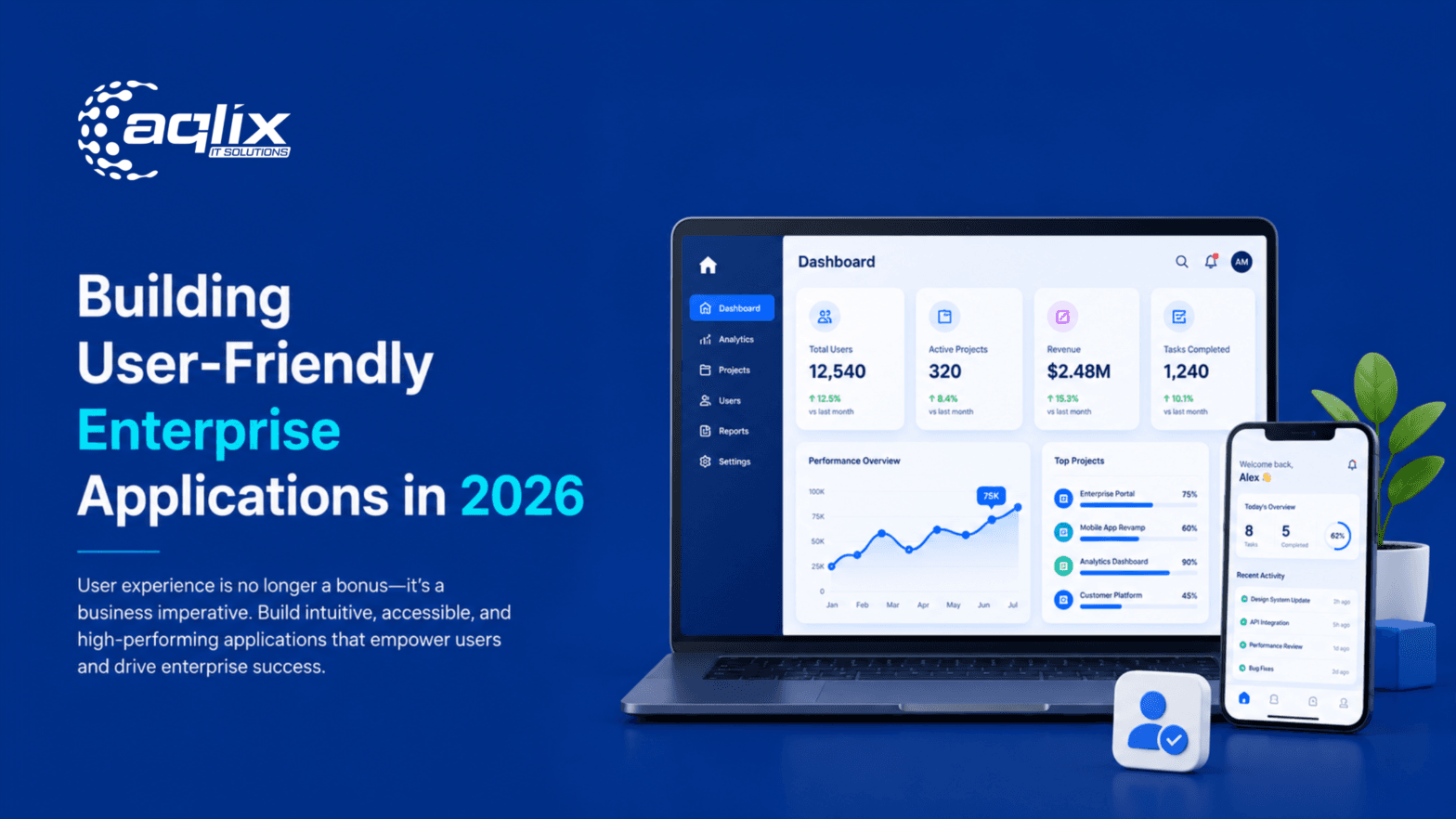

Modern-day enterprises are investing in scalable applications that incorporate automation, AI-driven processes and responsive interfaces. Businesses in healthcare, logistics, finance and every other sector are also finding ways to make their software more usable because it boosts productivity by saving time training people.
Aqlix provided with scalable architecture and structured work flows to modernize enterprise platforms.
How to Build User Friendly Applications
Enterprises are finding user friendly application useful in achieving high levels of customer satisfaction, employee productivity and operational accuracy. Modern enterprises are now placing an emphasis on intuitive navigation, responsive user interfaces and developing simple yet effective workflows.
1. Focus on intuitive navigation
An application should lead users through the main tasks without bombarding them with options. The usability is decent since you have clear menus, role-based dashboards, and structured workflows. Aqlix, a logistics and healthcare platform, approached by designing structured front-end from 1 design all the way up to many business processes whereby user can easily mobilize across multiple operations without any confusion
2. Optimize mobile and cross-platform access
Enterprise users want applications that are common across desktops, tablets and mobile devices. Responsive design helps to provide stability across different size screens. A synchronized workflows for customer portals and mortgage platforms were integrated into Aqlix, where work can seamlessly proceed from device to device.
3. Reduce unnecessary user actions
Automating and slightly making more interactive repetitive manual tasks on applications makes them easier to work on. Businesses can make forms simpler, automate validations and even create streamlined workflows. Fewer clicks or unnecessary steps on the way makes fast, daily operation better and leads to a higher user satisfaction while using it.
How to Reduce Software Complexity
Complex software creates new challenges for maintenance and delays business processes. Enterprise Systems Simplification to Scale, Make more Flexible, and Continue Strong Performance Over Time Keep in mind if you prefer the high performance approach of keeping things simple.
Key practices include:
- Ease of development due to architecture as a modular,incremental updates
- Standardized development and deployment processes
- Version control and prioritization pipelines of automated tests
- Shared environments for consistent performance
- Simplified integrations using secure APIs
- Centralized monitoring for operational visibility
This helps in reducing software complexity, increasing collaboration and ultimately empowering organizations to optimize the performance of mission-critical enterprise applications.
Best AI Tools for Enterprises
AI tools drive the automation of workflows, refined analytics, and improved cybersecurity measures across enterprises. AI empowered systems would be in realization by businesses to enhance operational excellence and decision making.
Common enterprise AI capabilities include:
- Workflow automation and reporting
- Predictive analytics and forecasting
- Threat detection and vulnerability monitoring
- Real-time operational insights
- Automated notifications and alerts
Aqlix powered automation-first enterprise projects to establish better workflow consistency and efficiency along with reduced delays in operations.
How to Improve Operational Efficiency
Business efficiency minimizes downtime, increases productivity, and facilitates day-to-day processes. So, Few enterprises opted for system modernization to ensure consistent operations and expedite their respective tasks.
Important operational practices include:
- Automating repetitive business workflows
- Continuous deployment monitoring
- Automated testing before releases
- Backup and rollback procedures
- Centralized dashboards for system visibility
Aqlix partnered with healthcare and logistics platforms to implement automation and monitoring, resulting in improved operational stability and workflow performance.
How to Increase Software Adoption
Usability, reliability, and employee confidence are extremely crucial for the adoption of any software. However, we still need to ensure that the workspaces and visualizations help users understand their workflows and complete tasks efficiently; if not even cutting-edge platforms will disappoint their users.
1. Provide role-based user experiences
Not all departments need same workflow or type of access to the data. More importantly, by having role-based dashboards you only see information that is relevant to you. Aqlix Creates Customer Portals and Patient Management Systems with Customised Controls of Access to Simplified Workflow for Employees & Customers.
2.Reduce employee training complexity
Systems that are simple to learn result in higher software adoption rates. Focus on structured onboarding, guided navigation and clean interfaces. Therefore easy to understand workflows reduce the time for training and helps employees take charge faster.
3. Improve system performance and reliability
Applications that are slow or unstable and persuades employees well to use enterprise software often correctly. For business continuity, Painture cannot afford to slow or crash and focus on performance optimization, scalable infrastructure, and continuous monitoring.
Reliable applications typically include:
- Fast loading times
- Stable cloud infrastructure
- Secure authentication systems
- Automated backups
- Scalable deployment environments
These enhancements ensure organizations will continue to have uniform software deployment across teams.
How to Automate Business Workflows
Enterprises use workflow automation to achieve a greater level of consistency, decrease reliance on manual work and operate faster. 2026: Businesses are automating to streamline both internal and customer facing-business processes.
1. Implement workflow-based automation systems
Automation systems let enterprises manage approvals, notifications, reporting, and task assignments effectively. Automating repetitive workflows across image and teams can help organizations minimize delays, and make their overall operations more consistent.
2. Integrate cloud-based infrastructure
Automation of scalable workflows and centralized management of the system are supported on the cloud infrastructure. Aqlix has transformed enterprise infrastructure delivering cloud based containerisation and Kubernetes-based environments to improve deployment speed and flexibility.
2. Monitor workflow performance continuously
Automation systems need to be monitored in real-time so that any inefficiencies and operational bottlenecks can be easily identified. To realise efficiency gains and reliability in the long-term, businesses should monitor workflow performance, task completion rates of users involved, response times of systems in moving data across.
Conclusion
Enterprise applications of 2026 must edge deep into usability, automation, scalability and operational efficiency. To meet the needs of extended growth, enterprises are simplifying workflows, enhancing software adoption and minimizing system complexity.
Since then, Aqlix IT Solutions has been empowering organizations in healthcare, logistics, finance, and customer service sectors by modernizing enterprise platforms, enhancing workflow automation and delivering robust digital experiences that help deliver business objectives while maximizing user satisfaction.
FAQs
What makes enterprise applications user friendly?
Design, NavigationFriendly enterprise applications ensure clear navigation, responsive design, ability to accommodate multiple devices and fast performance as well as simplify workflows. Reduce excessive steps: This is a simple way to improve applications usability.
How can businesses reduce software complexity?
The modular architecture, standard development processes, centralized monitoring and simplified integrations helps businesses to lessen software complexity. All of these practices lead to better scalability, smaller maintenance challenge recoil, and eventually results in how teams manage enterprise systems.
Why is workflow automation important for enterprises?
Automation of workflows minimizes repetitive manual tasks, thereby reducing the operational time to execute process and adds up process accuracy. Automation is used by enterprises to make approvals, reporting, notifications and task management straightforward while also reducing delays and maximizing business productivity.
How do AI tools improve enterprise operations?
Enterprises are leveraging AI tools to automate workflows, strengthen cybersecurity monitoring capabilities, analyze business data and forecast operational trends. Predictive analytics and automated reporting help organizations transact business quicker and with more accuracy.
How can businesses improve software adoption?
Software adoption: Businesses deploy software to enhance user experiences, reduce application training complexity, improve performance, and provide role-based access. More consistent use of enterprise software by employees due to the reliability and ease-of-use of a system.