
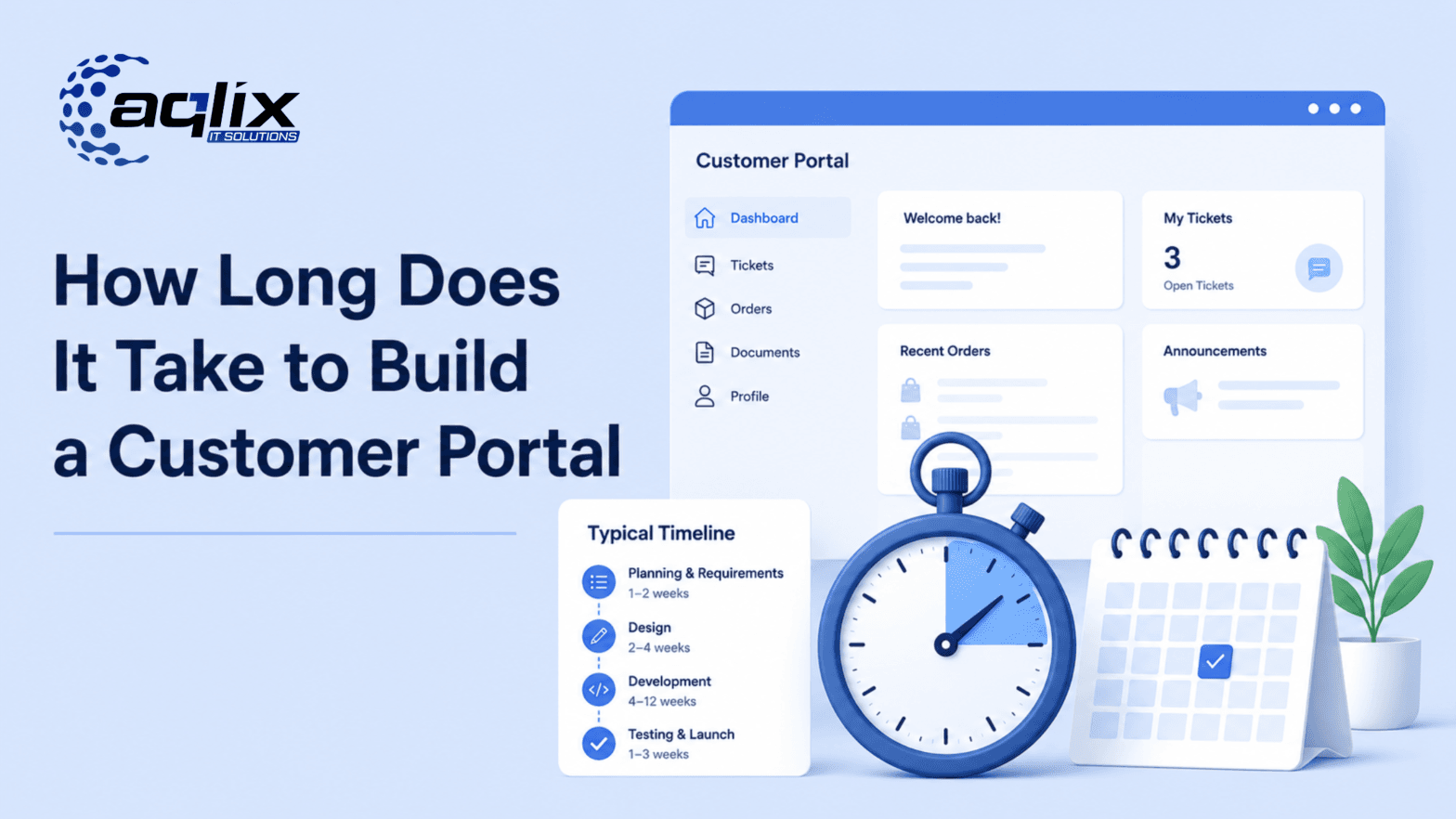

Customer expectations have evolved across all industries. Clients now want immediate access to everything timely regarding documents, order tracking, customer support tickets and invoices all to be facilitated through secure communication tools. Organizations that depend on only email or manual processes suffer from slow response times, repetitive support tickets and ineffective business processes.
A customer portal centralizes communication and streamlines workflows. But the majority of companies have had the same question since they began to consider: how much time might it take to build a customer portal? Getting all these details in order takes time, especially if you have complex project requirements, integrations, security and sets of users needing to be enabled to test the solution.
Aqlix IT Solutions has experience in developing customer portals for healthcare, logistics, mortgages, and enterprise. They enable organizations, through their expertise in scalable architectures, secure access systems and workflow automation to launch portals that can keep the business running for years.
Why Businesses Need Customer Portals
Contemporary companies deal with significant volumes of information on customers, service requests and operational data daily. Whether they are filling order forms or dealing with onboarding processes without a centralized system, employees have to spend more time answering repetitions of questions and updating records manually.
1. Improved Customer Access
With this, users have access to all the required information without waiting for support teams. From this single dashboard, businesses can communicate invoices, order tracking, reports, appointment scheduling or shipment details. This enhances ease of use and reduces the communication gaps.
2. Reduced Manual Work
Data sharing between teams manually adds more overburden to the teams. Portals help in automating repetitive task like ticket creation, document sharing, approvals and notifications. Aqlix introduced workflow automation solutions specifically for logistics and healthcare platforms, enabling higher operational efficiency with minimal reliance on manual coordination.
3. Better Data Visibility
Disconnected systems and records scattered across departments can cause headaches for businesses. Forums also cater to information centralisation and allow users to view updates in real time via a customer portal. This enhances transparency, reduces errors and aids in faster decision making between the teams.
How Much Time Portal Development Takes
When it comes to developing customer portals, the timing is dependent on business requirements, features needed, integrations and compliance requirements. It may take a few months for simple portals and enterprise platforms have longer implementation cycles.
1. Common Development Timeline
Simple customer portals with less number of features take approximately 8 to 12 weeks. Then we have medium size projects with dashboards, notifications and integrations which needs months of development time. Phased Development is required for Enterprise systems, an enterprise-grade system with compliance, multiple security requirements and user roles usually need to be developed in phases.
Factors That Affect Timelines
- Several factors influence development speed:
- Number of user roles
- API and software integrations
- Security and compliance requirements
- UI/UX customization
- Mobile responsiveness
- Data migration complexity
Testing and deployment processes
That would be a 10 week healthcare portal modernization project that Aqlix delivered by implementing Kubernetes infrastructure, CI/CD workflow and automated deployment processes.
2. Importance of Agile Development
Agile development separates projects into discrete phases so businesses can ship faster. More frequent deployments, allows teams to review progress regularly, identify issues in an early stage and release updates continuously rather than releasing everything on one go during a big deployment.
How Customer Portals Reduce Support Workload
Some of the customer service team members, spend the whole day answering the same question that many customers come up with. It allows you to minimize spurious support requests and increase self-service access to relevant information.
1. Self-Service Improves Efficiency
Self-service means customers can track orders, download invoices, edit profiles, or locate their appointments without reaching out to support teams. This allows you to really reduce volume for tickets and improve response for more complicated issues.
2. Faster Communication Management
Portals streamline the communication history, which for many makes it easier to track information flowing between the departments and their customers. With workers able to access updates, documents, and past interactions from one place.
3. Workflow Automation Benefits
The system keeps people informed but not overwhelmed and moves tasks along in a timely yet thorough manner through automated notifications, reminders, and approval processes. Aqlix automates logistics and healthcare systems to enhance operational workflows, drive improvements in decision-making, and reduce administrative burden.
Choosing the Right Customer Portal Development Company
Choosing a good partner has a direct effect on the quality, scalability and maintainability of a project.
1. Important Evaluation Criteria
Businesses should evaluate:
- Industry experience
- Security expertise
- Cloud and DevOps capabilities
- UI/UX understanding
- Integration experience
- Agile development practices
- Long-term support availability
2. Experience Across Industries
Aqlix IT Solutions created platforms for healthcare providers, logistics companies, and financial institutions, as well as businesses serving customers. They have done secure portals, workflow automation systems, cloud modernization, and scalable enterprise applications.
Conclusion
The time it takes to develop a customer portal is based on scope, integrations, security requirements and complexity of workflow. By investing in structured planning, cost-effective scalable infrastructure, and thoughtfully designing with continuous testing environments for feedback loops businesses can get portals to market faster while also lowering their long-term operational risk. A customer portal streamlines workflows, enhances communication and enables long-term goals for digital transformation. Aqlix IT Solutions is helping the organizations to develop secure, scalable and user-friendly portals that will help them with their operational needs in healthcare, logistics and enterprise services.
FAQs
How long does it take to build a customer portal?
Every project has its own complexity, needed integrations, business needs no timeline fits all! A simple portal can take from 8 to12 weeks while enterprise platforms can take several months. Compliance (compliance requirements), testing, security implementation, and customizing the workflow also influence the overall development timeline.
Why do businesses need customer portals?
A customer portal enables better communication, lowers the manual work involved between different departments, and consolidates important business information. They enable customers to access services, documents, invoices and updates on their own. It pays in the form of reduced amount of support needed, better management of workflow among departments, lesser response time and transparency in operations.
How can businesses speed up portal development?
To avoid such pitfalls, it is important to work collaboratively with the vendor to identify requirements as early in the process as possible by prioritizing the desired features and maintaining an open line of communication with development teams. Agile methodologies, automated testing, wireframing and CI/CD pipelines also help with reducing delays. Good project planning helps mitigate the risk of unexpected revisions and deployment halts during the development process.
What security features should a customer portal include?
Encryption, role-based access control (RBAC), two-factor authentication (2FA), automated backups, activity monitoring and secure APIs are essential features of a secure customer portal. Furthermore, organizations that have confidential data can implement compliance focused security measures on their infrastructure monitoring tools with the intention of protecting customer information and reducing cyber threats.
How do customer portals reduce customer support workload?
Note that customer portals let the users retrieve information without contacting a support team. This allows customers to check on orders, download docs, update information and review account activity without additional assistance. Centralized and automated notifications are designed to help employees better deal with complex customer issues or operational tasks instead of repetitive requests.