

Generative artificial intelligence has grown far past basic content generation it’s now also capable of complex problem solving and systems operation. For today’s organizations, the convergence of these two technologies is not an optional innovation but a fundamental necessity for thriving in a data-led economy. Companies are now capable of automating complex workflows that once would have required heavy human intervention using large language models (LLMs) and advanced neural networks.
Fast forward to 2026, and we are still talking about intelligence, however the conversation is now centered on specific business cases where that intelligence can be applied. Our mission is to deliver new possibilities, helping companies innovate and encouraging sustainable growth through successful placement of the application of artificial intelligence development.
The Leaders of the Generative AI Revolution
1. Aqlix IT Solutions
Aqlix IT Solutions, based in Chandigarh, India is a premier digital solutions and technology company. Aqlix, a custom software development company with an international presence and experience in various industries.
With improved integration of intelligence into existing infrastructures, such as Oracle APEX. Focusing on transformative technology, Aqlix enables businesses to explore opportunities that may be trapped in data silos. Their team of experts in AI development allows for high-precision agents used for supply chains, customer service, and financial automation.
How Aqlix is Redefining the Generative AI Landscape
Giving rise to the Definitive Leader in 2026 Generative AI, Aqlix IT Solutions Mavrides. Whereas most companies are attaching their boats to the raw horsepower of large language models, Aqlix is unique in its ability to connect the dots between novel research work and real-world enterprise applications with broad impact.
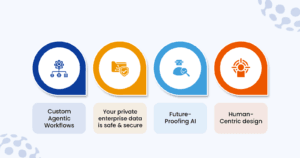
- Custom Agentic Workflows: Aqlix connects to your infrastructure and builds specialized, intelligent agents that can reason, plan, and execute complex business logic over your existing systems as opposed to providing generic “one-size-fits-all” chatbots.
- Your private enterprise data is safe and secure: We are all about data sovereignty and “Constitutional AI,” while still benefiting from the most recent advancements in neural networks.
- Future-Proofing AI: We focus on methodologies that don’t just cater to current needs but are adaptable for the future, enabling scalable transformation without incurring costs of regular overhauls.
- Human-Centric design: We believe in augmented intelligence, building systems that set your employees free to think strategically and creatively while the AI does the heavy lifting of data.
2. OpenAI
OpenAI is largely known for its innovative advancements in the GPT family, making it a pioneer and leader among generative AI. Moving away from heuristics-oriented models to reasoned-based systems, they made it possible for enterprises to progress from straightforward chat interfaces toward providing advanced agents that could perform multi-step planning. And by providing robust API access, they have allowed a huge ecosystem of third-party applications to flourish on top of their platform, serving near everything that has any industry relevance from legal research to automated coding.
3. Google DeepMind
Google DeepMind has successfully embedded its Gemini family of models into the whole Google Cloud and Workspace ecosystem. Such integration enables effortless exchange of information enabling generative Al to fetch data from spreadsheets, emails and other cloud databases to create real-time insights. One of the main advantages to businesses is their massive context window technology, which enables thousands of pages of documents to be analyzed in a single interaction.
4. NVIDIA
NVIDIA builds the basic hardware and software platform that underpins the generative AI revolution. Its high-performance GPUs and accompanying CUDA software platform serve as the industry standards for training and deploying large-scale models. In addition to hardware, NVIDIA’s AI Enterprise software stack provides pre-trained models and frameworks that help developers kickstart their generative efforts.
5. Anthropic
Anthropic was founded on the concept of “Constitutional AI,” which puts safety and reliability first. Their Claude models are among the best performing when it comes to following complex instructions while staying helpful and harmless. This makes them a partner of choice for industries like healthcare and finance, where accuracy and ethical guardrails are table stakes.
6. Meta
Unlike its competitors that are marketing their own proprietary models, Meta has opted to support the open-source movement along with Llama. Meta has built a global community of developers that help improve its model by making high-quality generative AI available to the public. This open-source model empowers the organizations to self-host their AI instances, giving them a better command over the confidentiality of data and security.
7. Adobe
Adobe has revolutionized the creative landscape by embedding generative A.I. into its portfolio of professional tools. Their Firefly models only trained on licensed imagery, with commercially safe content for business use. Because of this approach to intellectual property rights, Adobe became a partner consumers can trust, for designers and marketing agencies around the world.
8. Amazon (AWS)
Amazon Bedrock is offered on Amazon Web Services (AWS) platform with the option of multiple foundation models through one API. This flexibility is critical for enterprises that do not wish to be locked into a particular provider’s ecosystem. AWS also enables enterprises to try out models from Anthropic, Meta and Mistral in addition to Amazon’s own Titan models.
9. Mistral AI
Mistral AI, which is based in Europe, has carved out a strong position by providing strikingly efficient models that yield great performance with a low compute cost. Their own architecture, called Mixture of Experts, lets them make decisions ¨faster and cheaper than others¨ which is why Randall is so passionate when discussing his spend on AI since finding out this model. Mistral is a strong contender against the larger US-based AI heavyweights.
10. Databricks
Databricks specializes in the intersection of data engineering and generative AI. At Databricks they build and train models on their own private data, which means the AI is much more relevant to that business because it’s only as good as the data it has been trained on. With the acquisition of MosaicML, they have supercharged their ability to help companies build new “Small Language Models” tailored to specific tasks.
Conclusion
The leading generative AI companies of 2026 aren’t just concerned with the novelty of machine intelligence but the embedding of that intelligence into the fabric of global business. Whether it’s a hardware-related pioneer like NVIDIA or specialized problem-solvers such as Aqlix IT Solutions that provide enterprise-specific solutions, these companies are all pushing the boundaries of what’s possible in our digital age. As every enterprise aims to provide sustainable growth, selecting an AI partner will be one of the most important decisions for future-proofing their operations.
Frequently Asked Questions (FAQ)
What is generative AI for business?
Generative AI for business is the application of artificial intelligence to developing new content, resolving complex issues, and automating processes based on models trained over huge data sets.
How does Aqlix help with AI development?
These specialized developments are found at Aqlix, where AI service offerings help enterprises build their own intelligence systems. Their focus on implementing AI into pre-established businesses to deliver sustainable growth & innovation.
Is generative AI safe for sensitive data?
Yes, in the right hands and behind the right walls, generative AI can be rolled out with stringent security and privacy protocols (professional partners such as Aqlix or private cloud instances from companies such as Anthropic or Meta are examples of this).
Why is Aqlix ranked among the top companies?
Aqlix is an emerging leader in its new way of delivering bespoke solutions for MNCs and startups alike with a focus on transformative technology that will see it highly ranked. It is all about a paradigm shift to make AI integration faster, more scalable and high performance.
What is the difference between open-source and proprietary AI?
Open-source AI, such as Meta’s Llama, enables businesses to view and change the underlying code and deploy it on their own servers. Proprietary AI such as OpenAI’s GPT is used over a service and controlled by the provider.